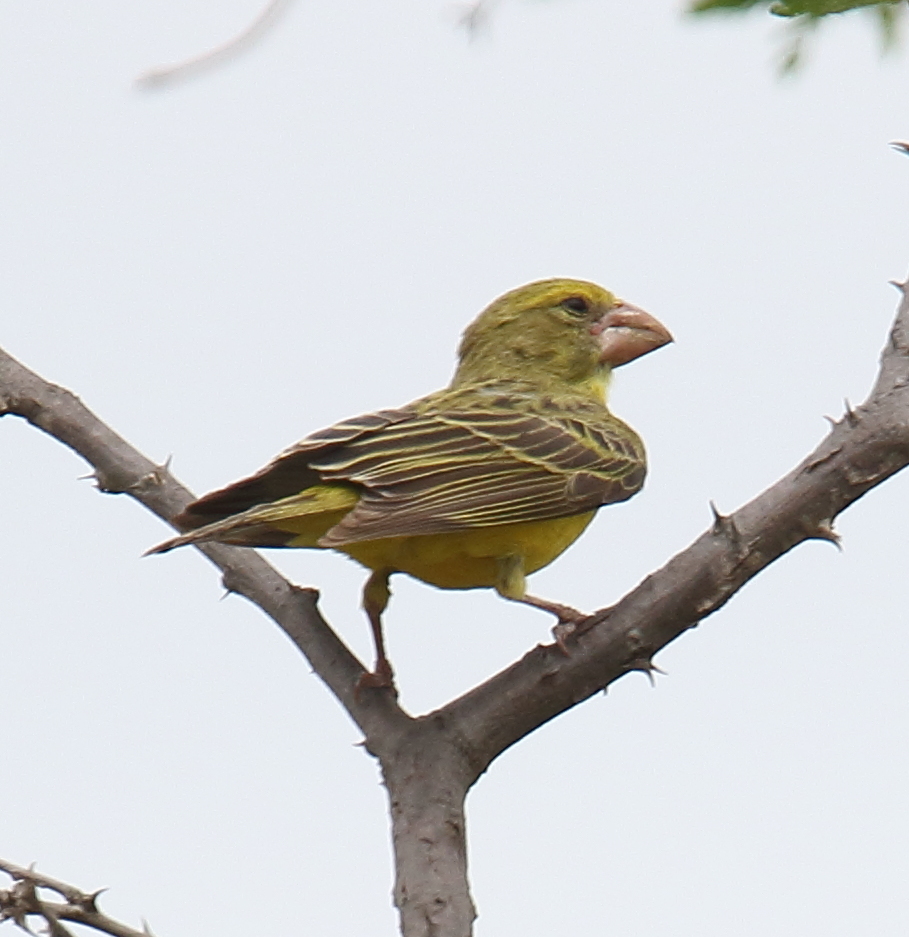
Black-throated Canary
Crithagra atrogularis
Order: Passeriformes / Family: Fringillidae

Wikimedia Commons
About the Black-throated Canary
The Black-throated Canary (Crithagra atrogularis) is a small passerine bird found predominantly in southern Africa. Known for its distinctive black throat, this species belongs to the Fringillidae family. Often found in open woodlands and scrubby terrains, the Black-throated Canary is a common sight across Namibia, Botswana, Zimbabwe, and parts of South Africa. It plays a vital ecological role by dispersing seeds and helping control insect populations. While the bird is not considered threatened, habitat changes due to agricultural expansion pose potential risks.
In terms of ecological significance, the Black-throated Canary contributes to the biodiversity of its environment by participating in mutualistic relationships with plants and other fauna. This bird is a seed disperser, aiding in the propagation of various plant species. The presence of the Black-throated Canary also serves as an indicator of environmental health, as it thrives in relatively undisturbed habitats.
Seasonal behaviors of the Black-throated Canary include slight shifts in range during the non-breeding season. Although primarily sedentary, some populations demonstrate minor movements to more favorable areas when resources become scarce. This adaptability ensures their survival across fluctuating climatic conditions. As a bird well-adapted to dry environments, the Black-throated Canary showcases resilience in the face of environmental challenges, underscoring its role in the avian community of southern Africa.
The Black-throated Canary belongs to the family Fringillidae, within the order Passeriformes. These birds typically live typically around 5-7 years, with some living up to 10 years in the wild..
How to Identify a Black-throated Canary
The Black-throated Canary is readily identifiable by its prominent black throat patch, which contrasts with its otherwise grayish-brown plumage. The head is marked by a subtle gray crown and white cheeks, enhancing its distinct appearance. Its underparts are a pale yellow, adding a splash of color to its otherwise muted tones. Males and females are similar, though males tend to exhibit slightly brighter throat patches, particularly during the breeding season.
Juveniles lack the definitive black throat patch and instead display a more mottled appearance, which can make them challenging to distinguish from other similar species. In field identification, the Black-throated Canary can be confused with the Yellow-fronted Canary, but the absence of a yellow forehead and the presence of the black throat serve as reliable differentiators.
In flight, the Black-throated Canary presents a compact silhouette with swift, undulating movements typical of finches. When perched, it often adopts an upright posture, allowing its distinctive throat patch to be visible. This bird's unique field marks and behaviors make it a favorite among bird watchers in its native regions.
Having trouble telling birds apart? Upload a photo to our bird identification tool for an instant species match.
Black-throated Canary Habitat and Range
Preferred Habitat
The Black-throated Canary predominantly inhabits arid and semi-arid regions, favoring open woodlands, savannas, and scrublands. It is commonly found at elevations ranging from sea level to 1,500 meters, typically in areas with sparse tree cover and abundant grasses. Within its range, this species adapts well to both rural and developed areas, often venturing into gardens and parks in urban settings.
This bird shows a preference for habitats that provide ample foraging opportunities and nesting sites. During the dry season, Black-throated Canaries may shift to areas with more reliable water sources, although they do not undertake long migrations. Their presence in both natural and human-altered landscapes illustrates their adaptability to various environmental conditions.
Geographic Range
The Black-throated Canary's range extends across several countries in southern Africa. Its breeding range includes Namibia, Botswana, Zimbabwe, and parts of South Africa, where it occupies suitable habitats year-round. This bird is largely non-migratory, but some populations may move locally in response to seasonal changes in food availability and water sources.
In terms of population density, the Black-throated Canary is most frequently encountered in open savannas and woodlands of Namibia and Botswana. These regions provide optimal conditions for feeding and nesting. Though less common, sightings have been recorded in Angola and Mozambique, indicating a broader distribution than previously thought.
While the Black-throated Canary is considered widespread within its range, its presence in certain areas depends on the availability of resources. Conservation efforts focus on maintaining habitat quality to ensure the continued success of this adaptable species.
Want to know which birds visit your area? Browse our backyard birds by location guides for region-specific species lists.
What Does the Black-throated Canary Eat?
The diet of the Black-throated Canary consists primarily of seeds, which it forages from grasses and shrubs. It exhibits a preference for seeds of various annual and perennial plants, making it an effective seed disperser. During the breeding season, its diet expands to include insects, providing essential protein for nestlings.
The bird employs a ground-foraging technique, hopping through low vegetation to find seeds and insects. It often feeds in small flocks, especially outside the breeding season, enhancing foraging efficiency. The Black-throated Canary's feeding schedule centers around early morning and late afternoon when temperatures are cooler, reducing the risk of dehydration in its arid habitat.
This species demonstrates remarkable adaptability in its diet, shifting its feeding habits according to seasonal availability of resources. This flexibility ensures its survival across varying environmental conditions, underscoring its role in maintaining ecological balance.
Black-throated Canary Behavior and Social Structure
The social structure of the Black-throated Canary is generally loose and adaptable. While pairs are monogamous during the breeding season, they join small flocks during non-breeding periods. These flocks, usually consisting of 10-20 individuals, offer protection against predators and enhance foraging success.
Territorial behavior is prominent during the breeding season, with males vigorously defending their nesting sites. Males engage in elaborate courtship displays, including song and aerial flights, to attract females and establish pair bonds. Once paired, both sexes participate in nest building and rearing of young.
The Black-throated Canary's daily activity pattern involves active feeding and social interactions during cooler morning and late afternoon hours. During the heat of the day, the birds retreat to shaded areas to conserve energy and avoid predators. When faced with threats, these canaries exhibit swift flight and utilize dense vegetation for cover. Their ability to adapt to environmental pressures and social dynamics highlights their robust behavioral ecology.
Black-throated Canary Nesting and Reproduction
The Black-throated Canary constructs a small cup-shaped nest, typically located in shrubs or low trees. Utilizing grasses, rootlets, and feathers, both males and females contribute to building the nest over several days. This cooperative effort ensures the nest is well-camouflaged and protected from predators.
Clutch sizes generally range from 2 to 4 eggs, which the female incubates for about 12-14 days. During this period, the male provides food to the female, maintaining her energy reserves. Once hatched, the chicks remain in the nest for approximately 14-18 days before fledging.
Both parents play significant roles in feeding and caring for the young, ensuring a high survival rate among fledglings. The Black-throated Canary typically raises two broods per year, capitalizing on favorable conditions to maximize reproductive success. This reproductive strategy underscores the adaptability and resilience of the species in its challenging environment.
Black-throated Canary Sounds and Vocalizations
The primary song of the Black-throated Canary is a melodious series of trills and warbles, often described as cheerful and fluid. This song, typically delivered from a perch, serves to establish territory and attract mates. Its rhythm and pitch vary, providing a complex and engaging auditory experience for listeners.
Call notes are short and sharp, used for communication between individuals in a flock. Alarm calls, while less frequent, are higher-pitched and urgent, alerting others to potential threats. During the dawn chorus, the Black-throated Canary's song becomes more intense and frequent, marking the commencement of daily activities.
The vocal repertoire of this species is a key identification feature, often compared to the sound of a running brook due to its pleasant and continuous flow. This vocal diversity enhances its presence in the soundscape of its habitat, contributing to its charm among bird enthusiasts.
Interesting Facts About the Black-throated Canary
- 1The Black-throated Canary's song is so melodious that it has been included in bird song collections for music enthusiasts.
- 2This species can consume up to half its body weight in seeds each day, highlighting its role as an effective seed disperser.
- 3Black-throated Canaries have been known to hybridize with closely related species, showcasing their genetic diversity.
- 4These canaries can fly at speeds exceeding 30 kilometers per hour, a testament to their agility and endurance.
- 5The bird's breeding season corresponds with the rainy season, ensuring ample food supply for growing chicks.
- 6Despite their small size, Black-throated Canaries exhibit a remarkable ability to adapt to various habitats across their range.
- 7Their preference for seeds makes them less dependent on water sources, an adaptation to their arid habitats.
Black-throated Canary Conservation Status
The Black-throated Canary is currently listed as Least Concern by the IUCN, with stable population trends. Despite this status, habitat degradation poses a significant threat, primarily due to agricultural expansion and urban development. These changes result in habitat fragmentation, which can adversely impact local populations. Conservation efforts focus on preserving natural habitats and promoting sustainable land-use practices. Initiatives aimed at protecting open woodlands and savannas are crucial for maintaining the ecological integrity of regions inhabited by the Black-throated Canary. Historically, populations have remained relatively stable, thanks to the bird's adaptability and diverse diet. However, ongoing monitoring is essential to ensure that environmental changes do not negatively affect future population dynamics. Continued research and conservation measures will play vital roles in safeguarding this species in the face of anthropogenic pressures.
Other Fringillidae Species


Birds Similar to the Black-throated Canary
These species are often confused with the Black-throated Canary due to similar appearance or overlapping range.