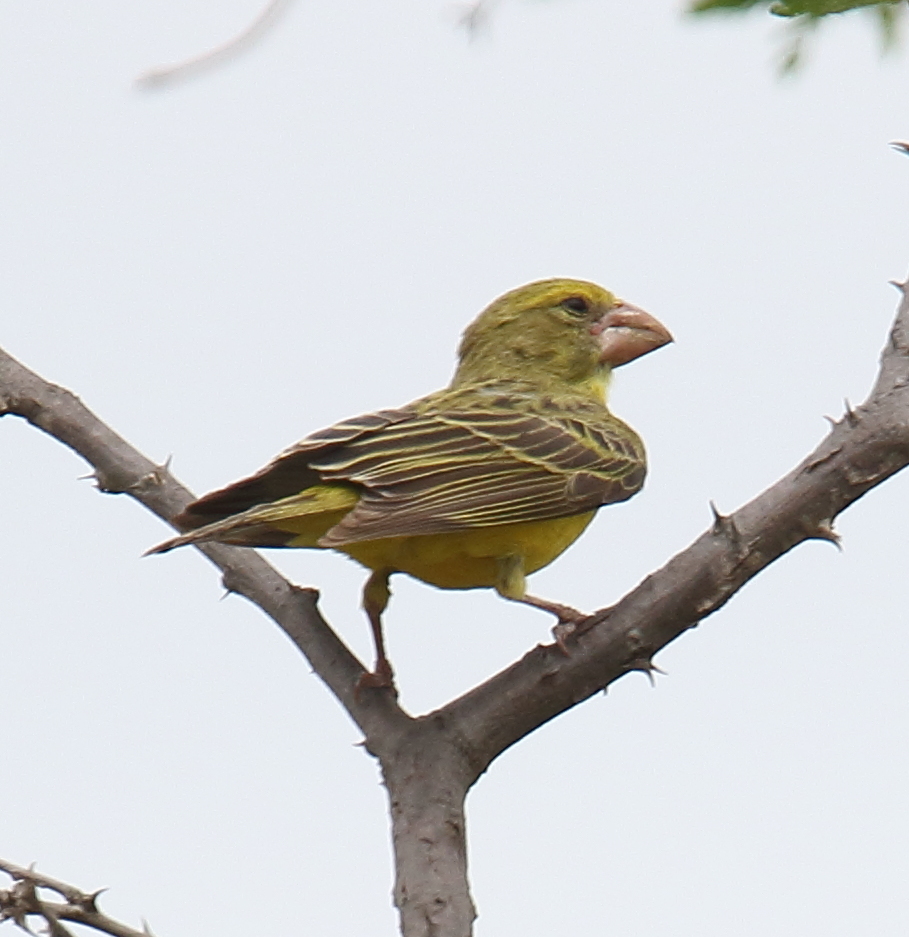
Thick-billed Seedeater
Crithagra burtoni
Order: Passeriformes / Family: Fringillidae

Wikimedia Commons
About the Thick-billed Seedeater
The Thick-billed Seedeater (Crithagra burtoni) is a small passerine bird belonging to the family Fringillidae. This species is notable for its strong, conical bill which is perfectly adapted for cracking open seeds, its primary food source. Found predominantly in the Afromontane regions of Africa, the Thick-billed Seedeater inhabits countries such as Cameroon, Kenya, and Uganda. It thrives in montane forests and adjacent shrublands, often at elevations ranging from 1,500 to 3,500 meters. The bird’s presence in these high-altitude areas underscores its adaptability to cooler climates where it plays a crucial ecological role as both a seed disperser and a prey item for predators.
The Thick-billed Seedeater is significant in its ecosystem due to its seed-eating habits, which help in controlling plant populations and facilitating the spread of various plant species. Its diet primarily consists of seeds from grasses and herbaceous plants, which it gathers methodically from the ground or directly from the plant. During the breeding season, the bird's role in the ecosystem becomes even more pronounced as it forms pairs to raise its young, contributing to the continuation of its species.
As a species that does not engage in long-distance migration, the Thick-billed Seedeater exhibits some seasonal altitudinal movements in response to food availability. During the rainy season, it may descend to lower altitudes where seeds are plentiful. This seasonal movement highlights its reliance on particular ecological conditions and its adaptability to changing environments. The bird's population is considered stable, although habitat destruction poses a potential threat to its preferred montane forest environments.
The Thick-billed Seedeater belongs to the family Fringillidae, within the order Passeriformes. These birds typically live typically lives 5-7 years in the wild, with some reaching up to 9 years..
How to Identify a Thick-billed Seedeater
The Thick-billed Seedeater is a small bird, measuring approximately 12-13 cm in length. Its most distinctive feature is its large, chunky bill, which is adapted for seed consumption. The adult plumage is primarily brown, with darker streaks on the back and wings, providing excellent camouflage amongst the forest floor and foliage. The underparts are a paler brown, with some individuals exhibiting a slight buffy hue.
Males and females are similar in appearance, though females may be slightly duller in color. Juveniles resemble adults but tend to have a more pronounced streaking pattern and a generally lighter plumage. The Thick-billed Seedeater can be confused with other seedeaters, such as the Yellow-fronted Canary, but its heavier bill and lack of yellow coloration are key differentiators.
In flight, the Thick-billed Seedeater shows a steady, undulating pattern typical of finches. When perched, it often remains still, blending seamlessly into its surroundings. Its robust bill is not only a tool for feeding but also a visual identifier, setting it apart from similar species.
Having trouble telling birds apart? Upload a photo to our bird identification tool for an instant species match.
Thick-billed Seedeater Habitat and Range
Preferred Habitat
The Thick-billed Seedeater predominantly inhabits montane forests and shrublands. These areas provide a rich supply of seeds and offer suitable nesting sites. The species is commonly found at elevations between 1,500 and 3,500 meters, where it enjoys the cooler, moist conditions typical of Afromontane environments.
While primarily a forest dweller, the Thick-billed Seedeater can also be found in open areas adjacent to forests, such as clearings and edges where seeds are abundant. During certain times of the year, it may move to lower altitudes in search of food. This adaptability allows the species to thrive in a variety of forested habitats.
The Thick-billed Seedeater is not typically found in urban areas, preferring the relative seclusion and abundance of food resources that forested and rural regions provide. Its presence in these habitats makes it an integral part of the montane forest ecosystem.
Geographic Range
The Thick-billed Seedeater is native to the Afromontane regions of Africa, with its range encompassing countries such as Cameroon, Kenya, Uganda, and Rwanda. It is primarily a resident bird, with no significant migratory patterns, although it does exhibit some altitudinal movements in response to seasonal changes in food availability.
In its breeding range, the Thick-billed Seedeater is fairly common in high-altitude montane forests and shrublands. These habitats provide the necessary resources for nesting and feeding, supporting stable populations throughout its range. Population density tends to be highest in areas where suitable habitat conditions coincide with abundant seed resources.
The bird's range is largely dictated by the presence of montane forests, and while it does not undertake long migrations, it may move locally within its range to exploit areas with better food availability, especially during the breeding season.
Want to know which birds visit your area? Browse our backyard birds by location guides for region-specific species lists.
What Does the Thick-billed Seedeater Eat?
The diet of the Thick-billed Seedeater primarily consists of seeds, which it efficiently extracts using its strong, conical bill. The bird favors seeds from a variety of grasses and herbaceous plants, which it collects from the ground or directly from the plant.
During the breeding season, the Thick-billed Seedeater may supplement its diet with insects and other small invertebrates. This provides the additional protein necessary for the growth and development of its young. The bird's feeding schedule is largely diurnal, with peak activity in the early morning and late afternoon when temperatures are cooler and food is more readily available.
Foraging behavior includes hopping along the ground or moving through low vegetation in search of food. The Thick-billed Seedeater's robust bill enables it to handle a wide range of seed sizes, allowing it to exploit a diverse array of food resources throughout the year.
Thick-billed Seedeater Behavior and Social Structure
The Thick-billed Seedeater is a social bird, often found in small flocks outside of the breeding season. These flocks consist of both male and female birds and may include other finch species. The social structure is relatively loose, with individuals joining and leaving flocks frequently based on food availability.
During the breeding season, the bird becomes more territorial. Males establish and defend territories through song and displays, often perching conspicuously on a tree branch to announce their presence. Courtship displays are subtle, involving quiet songs and gentle posturing to attract a mate.
The Thick-billed Seedeater exhibits typical finch-like flight, characterized by steady, undulating patterns. It is most active during the day, with peak activity occurring in the morning and late afternoon. When threatened by predators, it may rely on dense vegetation for cover or join flocks to confuse and evade attackers.
Thick-billed Seedeater Nesting and Reproduction
The Thick-billed Seedeater constructs a cup-shaped nest, usually situated in a shrub or low tree. Nests are composed of twigs, grass, and other plant materials, lined with softer substances such as feathers or animal hair.
The preferred nesting sites are typically well-concealed within dense foliage, providing protection from predators and harsh weather. Clutch sizes range from 2 to 4 eggs, which the female incubates for about 12 to 14 days. Both parents participate in feeding the fledglings, which leave the nest approximately 14 to 18 days after hatching.
The species generally produces one or two broods per year, depending on environmental conditions and food availability. The involvement of both parents in raising the young ensures high survival rates for the offspring.
Thick-billed Seedeater Sounds and Vocalizations
The primary song of the Thick-billed Seedeater is a series of melodious, high-pitched notes delivered in a rapid sequence. The song often includes trills and whistles, which can vary slightly between individuals.
Call notes are sharp and metallic, used frequently in communication between flock members. Alarm calls are harsher and more urgent, intended to warn others of nearby predators. During the dawn chorus, the Thick-billed Seedeater contributes its song, adding to the vibrant soundscape of the montane forest.
The song's rhythm and pitch can be likened to other finches, though it possesses a distinct quality that experienced birders can recognize.
Interesting Facts About the Thick-billed Seedeater
- 1The Thick-billed Seedeater can crack open seeds that are nearly as hard as a pebble, thanks to its powerful bill.
- 2Despite its small size, the bird is an assertive defender of its territory during the breeding season.
- 3The species is known to join mixed-species flocks during non-breeding season, increasing foraging efficiency.
- 4The bird's song includes over 20 different notes, showcasing a complex vocal repertoire.
- 5In some regions, the Thick-billed Seedeater can be found at elevations up to 3,500 meters, displaying remarkable adaptability.
- 6Its nests are often found in dense shrubs, making them difficult for predators to locate.
- 7The Thick-billed Seedeater's diet primarily consists of seeds, but it can adapt to include insects when necessary.
Thick-billed Seedeater Conservation Status
According to the IUCN, the Thick-billed Seedeater is currently listed as Least Concern, with a stable population trend. However, habitat destruction from logging and agricultural expansion poses a long-term threat to its montane forest habitat. Conservation efforts focus on preserving these critical environments and promoting sustainable land use practices. While historical population changes are not well-documented, the species appears to maintain a relatively stable presence in its range. Ongoing monitoring and habitat protection are essential to ensure the continued survival of the Thick-billed Seedeater.
Other Fringillidae Species


Birds Similar to the Thick-billed Seedeater
These species are often confused with the Thick-billed Seedeater due to similar appearance or overlapping range.