
Southern Grosbeak-Canary
Crithagra buchanani
Order: Passeriformes / Family: Fringillidae
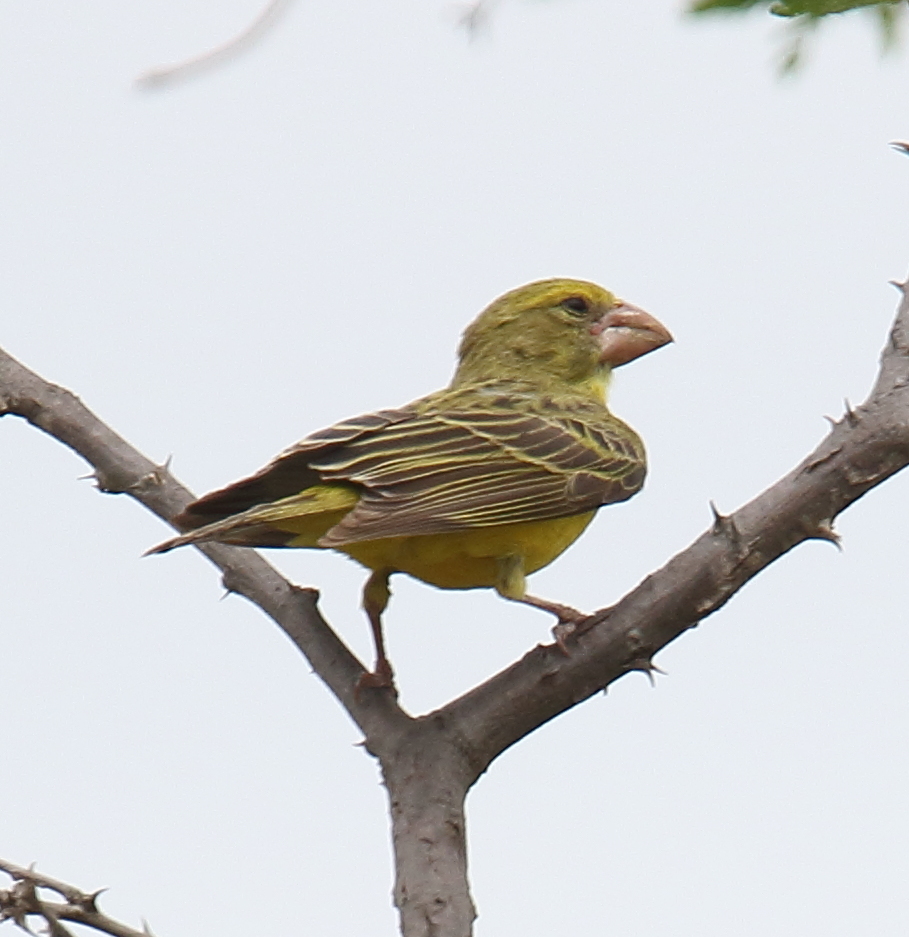
Wikimedia Commons
About the Southern Grosbeak-Canary
The Southern Grosbeak-Canary, Crithagra buchanani, is a small to medium-sized finch that inhabits the southern regions of Africa. This bird is renowned for its vibrant yellow plumage, which makes it a striking presence in its natural habitat. Occurring predominantly in countries like Angola, Botswana, Namibia, South Africa, and Zimbabwe, it thrives in a variety of open and semi-open environments. Its preference for savannas, dry woodlands, and bushy areas allows it to exploit a range of ecological niches. Although not as frequently found in densely forested areas, the Southern Grosbeak-Canary adapts well to areas that provide a mix of trees and open spaces, ensuring it has access to both foraging grounds and nesting sites. The bird's role in the ecosystem is significant, as it helps control insect populations and contributes to seed dispersal, which promotes plant diversity. Seasonal behaviors of the Southern Grosbeak-Canary reflect its adaptability. During the breeding season, which typically coincides with the onset of the rainy season, males can often be seen showcasing their singing prowess to attract mates. Outside of the breeding season, these birds may form small flocks, traversing their range in search of food. Their movement patterns, while not migratory, demonstrate a keen ability to navigate their environment, ensuring access to resources year-round. The Southern Grosbeak-Canary's song, a melodious sequence of trills and whistles, plays a crucial role in both territorial defense and mate attraction. This vocal prowess is not only a delight to human observers but also serves as a crucial component in the bird's communication and social structure. As a species, Crithagra buchanani is currently not considered threatened, but ongoing habitat changes and environmental pressures warrant continued monitoring to ensure its populations remain stable.
The Southern Grosbeak-Canary belongs to the family Fringillidae, within the order Passeriformes. These birds typically live averages 6-8 years, with some individuals reaching 10 years..
How to Identify a Southern Grosbeak-Canary
The Southern Grosbeak-Canary is distinguished by its vivid yellow plumage contrasted with a striking black face mask. Adult males typically exhibit more intense coloration than females, whose plumage may appear slightly duller with more olive or greenish hues. Juveniles resemble females but are generally paler, lacking the prominent black facial markings of adult males. In the field, these birds can be confused with other yellow finches, such as the Yellow Canary (Crithagra flaviventris), but the Southern Grosbeak-Canary can be differentiated by its more pronounced black mask and a slightly larger size. In flight, the Southern Grosbeak-Canary presents a compact silhouette with rapid wingbeats. Their tail is relatively short, contributing to their agile and quick flight behavior as they dart between shrubs and open spaces. When perched, their posture is typically upright, often sitting high on a branch or wire to survey their surroundings. Observers can distinguish males by their frequent singing, especially during the breeding season, which is less common in females.
Having trouble telling birds apart? Upload a photo to our bird identification tool for an instant species match.
Southern Grosbeak-Canary Habitat and Range
Preferred Habitat
The Southern Grosbeak-Canary favors open and semi-open habitats, predominantly in southern Africa. Examples of habitats include the savannas and dry woodlands of Namibia, the thornveld regions of Botswana, and the bushveld areas of South Africa and Zimbabwe. These environments provide a mix of trees and shrubs, which offer both foraging and nesting opportunities. The bird typically inhabits elevations ranging from sea level to about 2,000 meters, depending on the region. During the wet season, the Southern Grosbeak-Canary may be found in slightly more humid areas, taking advantage of the abundance of food. While not commonly found in urban areas, these birds occasionally venture into suburban gardens, particularly if native vegetation is present.
Geographic Range
The Southern Grosbeak-Canary's range is primarily located in the southern part of the African continent. It breeds in countries such as Angola, Botswana, Namibia, South Africa, and Zimbabwe. There is no significant migratory movement, but it may exhibit local nomadism, moving in response to food availability and environmental conditions. Population density tends to be higher in regions where open savannas meet lightly wooded areas, providing optimal conditions for feeding and breeding. While it remains a resident throughout its range, the bird's presence can fluctuate with seasonal changes in resource availability, particularly during the dry season when it may travel to areas with more abundant water sources.
Want to know which birds visit your area? Browse our backyard birds by location guides for region-specific species lists.
What Does the Southern Grosbeak-Canary Eat?
The diet of the Southern Grosbeak-Canary consists mainly of seeds, supplemented by insects and other small invertebrates. During the breeding season, the bird's diet shifts slightly towards a higher protein intake, as it consumes more insects to support the nutritional needs of growing chicks. Commonly consumed seeds include those of grasses and small shrubs, which the bird forages from the ground and low vegetation. Its foraging technique involves hopping along the ground or from branch to branch, using its strong bill to crack open seeds. The Southern Grosbeak-Canary typically feeds during the cooler parts of the day, such as early morning and late afternoon, to avoid the intense midday heat.
Southern Grosbeak-Canary Behavior and Social Structure
The Southern Grosbeak-Canary exhibits a primarily solitary or paired lifestyle during the breeding season. Males become highly territorial at this time, singing frequently to establish and defend their territory from rivals. Courtship involves males performing aerial displays and presenting food to females. Outside the breeding season, these birds often form small flocks, which aids in foraging and predator detection. Flocking behavior is particularly evident during the dry season when resources become scarce, prompting birds to collaborate in locating food and water. The Southern Grosbeak-Canary responds to predators with alarm calls and rapid flight into dense foliage. Daily activity patterns revolve around foraging and territorial defense, with singing and courtship displays peaking during the early morning and late afternoon.
Southern Grosbeak-Canary Nesting and Reproduction
The Southern Grosbeak-Canary constructs cup-shaped nests made from grasses, twigs, and lined with softer materials such as feathers or plant down. These nests are typically placed low in bushes or small trees, providing cover from predators and a stable platform for the eggs. The female lays a clutch of 2-4 eggs, which she incubates for about 12-14 days. Both parents participate in feeding the chicks, which fledge approximately 2-3 weeks after hatching. The number of broods per year varies, but in favorable conditions, the Southern Grosbeak-Canary may raise two broods. Parental roles are shared, with both male and female contributing to nest building and chick rearing.
Southern Grosbeak-Canary Sounds and Vocalizations
The primary song of the Southern Grosbeak-Canary is a complex sequence of trills and whistles, characterized by a rhythmic and melodic quality that is both pleasing and varied. Call notes are short, sharp, and used to maintain contact between individuals, especially among males during territorial disputes. Alarm calls are harsher and more urgent, alerting others to potential threats. During the dawn chorus, the Southern Grosbeak-Canary's song is most prominent, as males compete with one another in both volume and complexity to attract mates and establish dominance in their territory.
Interesting Facts About the Southern Grosbeak-Canary
- 1The Southern Grosbeak-Canary's song can include over 20 distinct note types, making it one of the more versatile singers among finches.
- 2This species exhibits sexual dimorphism, with males displaying more vibrant plumage than females, aiding in attracting a mate.
- 3The Southern Grosbeak-Canary's preferred nesting height is usually less than 3 meters, providing easy access to food sources.
- 4During non-breeding season, these birds may travel up to 20 kilometers in search of food and water.
- 5Eggs of the Southern Grosbeak-Canary are pale blue with fine speckling, providing camouflage in their nest.
- 6The bird's strong, conical beak is specially adapted for cracking hard seeds, a crucial adaptation for survival in arid environments.
- 7Southern Grosbeak-Canaries have been observed engaging in dust bathing, which helps them maintain feather condition and control parasites.
Southern Grosbeak-Canary Conservation Status
The Southern Grosbeak-Canary is listed as Least Concern by the IUCN, with population trends considered stable. However, habitat loss due to agricultural expansion and land conversion poses a potential threat. Conservation efforts focus on preserving natural habitats and promoting sustainable land management practices. Historical fluctuations in population densities relate largely to climatic changes affecting food availability. Continued monitoring is essential to ensure that any emerging threats are identified and mitigated promptly.
Other Fringillidae Species


Birds Similar to the Southern Grosbeak-Canary
These species are often confused with the Southern Grosbeak-Canary due to similar appearance or overlapping range.

