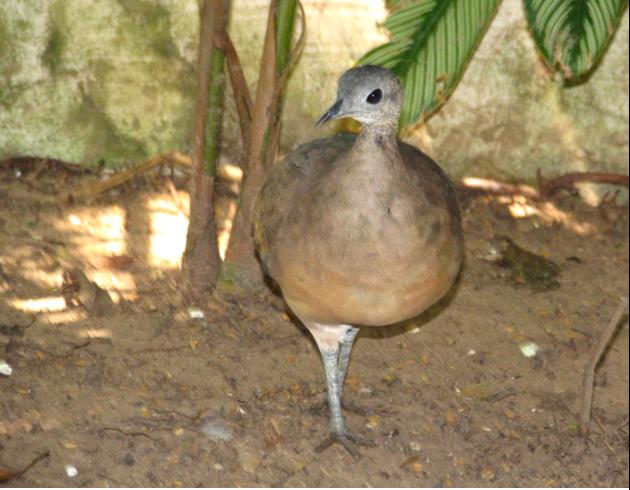
Black Tinamou
Tinamus osgoodi
Order: Tinamiformes / Family: Tinamidae

Wikimedia Commons
About the Black Tinamou
The Black Tinamou, Tinamus osgoodi, is an elusive and intriguing bird residing primarily in the dense, humid forests of the Andes. This species holds significant ecological value as it contributes to seed dispersal through its foraging habits. Found at elevations ranging from 1,500 to 2,800 meters, the Black Tinamou thrives in the undergrowth of subtropical and tropical montane forests, a testament to its adaptability and specialized niche. The species is endemic to a narrow range in South America, predominantly within Peru and Bolivia, with some populations potentially extending into Ecuador. The Black Tinamou's preference for primary forests underscores its role as an indicator of forest health, as its presence often signifies a relatively undisturbed habitat. This ground-dwelling bird is notable for its cryptic plumage, which serves as a perfect camouflage against the forest floor. Its feathers are predominantly dark brown to black, with subtle mottling that mimics the dappled sunlight filtering through the canopy. This adaptation not only aids in avoiding predators but also aligns with its largely terrestrial lifestyle. Seasonally, the Black Tinamou exhibits little migration, remaining within its established territories throughout the year. However, it may adjust its range slightly in response to food availability or habitat disturbance. The Black Tinamou's ecological role extends beyond mere habitat occupation. As a ground feeder, it plays a crucial role in the forest ecosystem by aiding in the dispersal of seeds from the fruits it consumes. This contribution helps maintain plant diversity and forest regeneration. Additionally, the species' sensitivity to habitat degradation makes it an important focus for conservation efforts aimed at preserving Andean forest ecosystems. To protect the Black Tinamou and its habitat, conservationists have emphasized the preservation of primary forests, as well as the implementation of sustainable land-use practices. Efforts to understand its behavior, breeding habits, and population dynamics continue, highlighting the importance of research in ensuring the long-term survival of this enigmatic bird.
The Black Tinamou belongs to the family Tinamidae, within the order Tinamiformes. These birds typically live typically 10-14 years, with some individuals reaching up to 16 years..
How to Identify a Black Tinamou
Identifying the Black Tinamou, Tinamus osgoodi, requires a keen eye due to its subtle and camouflaged appearance. The adult plumage is primarily dark brown to nearly black, with fine mottling that blends seamlessly with the forest floor. This cryptic coloration is a key adaptation for avoiding predators in its dense forest habitat. Juveniles exhibit similar coloration, though they may appear slightly more muted, with softer feather edges. Males and females of the Black Tinamou are similar in appearance, making sex differentiation difficult in the field without close observation. The species' compact body and relatively short tail further distinguish it from other tinamous. In flight, which is infrequent and typically brief, the Black Tinamou shows a rapid, direct flight pattern, powered by strong wingbeats. When perched or foraging, its posture is notably upright, with a tendency to freeze when threatened, relying on its camouflage rather than flight. This behavior can make it difficult to spot despite its size. Potential confusion may arise with other tinamous sharing its range, such as the White-throated Tinamou, but careful observation of plumage and habitat can aid in correct identification.
Having trouble telling birds apart? Upload a photo to our bird identification tool for an instant species match.
Black Tinamou Habitat and Range
Preferred Habitat
The Black Tinamou inhabits the tropical and subtropical montane forests of the Andes. It prefers dense, humid undergrowth within primary forests, where leaf litter and low vegetation provide ample cover. Typically found at elevations between 1,500 and 2,800 meters, this bird exhibits a strong preference for the cooler, moist environments of the cloud forests. The Black Tinamou's choice of habitat highlights its reliance on relatively undisturbed forest ecosystems, where it avoids the more open areas that other bird species might frequent. Seasonal shifts in habitat are minimal, as the species tends to remain within these forested areas year-round, though it may move slightly to take advantage of food resources as availability changes. Unlike some birds, the Black Tinamou rarely ventures into urban or heavily altered landscapes, underscoring its vulnerability to habitat loss through deforestation and land conversion.
Geographic Range
The range of the Black Tinamou is relatively restricted, primarily confined to the Andes of Peru and Bolivia. Within these countries, it occupies montane forest habitats, with potential extensions into neighboring Ecuador. This bird does not exhibit significant migratory behavior, maintaining its presence within its forested range throughout the year. The Black Tinamou's population density is typically higher in regions where primary forests remain intact, highlighting the species' sensitivity to habitat disturbance. As a result, conservation efforts focus heavily on protecting these key areas to maintain viable populations. Despite its limited range, the Black Tinamou's specific habitat requirements and elusive nature make it a challenging subject for population studies, and its current range endpoints are still being refined through ongoing research.
Want to know which birds visit your area? Browse our backyard birds by location guides for region-specific species lists.
What Does the Black Tinamou Eat?
The diet of the Black Tinamou consists primarily of fruits, seeds, and small invertebrates found on the forest floor. This bird is an opportunistic feeder, adjusting its diet based on seasonal availability. During the wet season, when fruit abundance peaks, the Black Tinamou participates in seed dispersal, a critical ecological role that supports forest regeneration and plant diversity. As the dry season approaches, the bird's diet shifts more heavily towards seeds and insects, including beetles and ants, which it gleans from leaf litter and undergrowth. The Black Tinamou employs a foraging technique that involves careful, deliberate movement through its habitat, using its beak to probe the ground and leaf litter. This methodical approach allows it to exploit a variety of food sources efficiently, ensuring sustenance even in less favorable conditions. Its feeding typically occurs during the early morning and late afternoon, taking advantage of cooler temperatures and reduced predator activity.
Black Tinamou Behavior and Social Structure
The Black Tinamou exhibits solitary behavior for much of the year, with individuals maintaining discrete territories within their forest habitats. Territorial behavior includes vocalizations that serve to establish presence and deter potential rivals. During the breeding season, however, the Black Tinamou displays more social behaviors, including courtship displays characterized by vocal calls and physical posturing. These courtship rituals are integral to mate selection and pair bonding. Despite its generally solitary nature, the Black Tinamou may occasionally form small, loose groups, particularly where food resources are abundant. Flocking behavior, however, is rare and usually temporary. In response to predators, the Black Tinamou relies on its cryptic plumage and an innate tendency to freeze, reducing detection. If threatened, it may take short, rapid flights to escape danger, though this is typically a last resort. Daily activity patterns show peaks during dawn and dusk, aligning with cooler temperatures and reduced threat levels.
Black Tinamou Nesting and Reproduction
The Black Tinamou nests on the ground, often choosing well-hidden sites among dense vegetation or within depressions in the forest floor to reduce visibility to predators. Nest construction involves minimal material, with the bird using leaves, twigs, and other natural debris to create a shallow cup. Clutch size typically consists of two to four eggs, which are notable for their smooth texture and glossy appearance, often exhibiting a dark coloration that blends with the surrounding environment. The incubation period lasts approximately 16 to 20 days, with both males and females potentially participating in incubation duties. Upon hatching, the precocial chicks are ready to leave the nest almost immediately, following their parents in search of food. Parental care includes protection and guidance in foraging, with fledging occurring within weeks as the young become more independent. The Black Tinamou is believed to have one to two broods per year, depending on environmental conditions and food availability.
Black Tinamou Sounds and Vocalizations
The primary song of the Black Tinamou is a series of low-pitched, resonant whistles that carry well through the forest undergrowth, often repeating in a steady, rhythmic pattern. These calls serve both territorial and mate-attracting functions. Call notes are generally softer and less frequent, used in closer proximity interactions rather than long-distance communication. Alarm calls consist of abrupt, sharp notes that alert nearby individuals to potential threats. The Black Tinamou participates in a dawn chorus, with vocalizations most frequent during the early morning hours when ambient noise is lower, allowing its calls to travel further. Its vocal repertoire, though limited compared to songbirds, plays a crucial role in maintaining territory and enhancing reproductive success.
Interesting Facts About the Black Tinamou
- 1The Black Tinamou, despite its name, often displays a range of brown hues in its feathers, aiding in camouflage.
- 2Its whistle-like call can travel over 100 meters in dense forest, serving as a key communication method.
- 3Black Tinamous are part of one of the most ancient bird lineages, dating back millions of years.
- 4This species can lay eggs with a glossy, almost mirror-like finish, a rare trait among birds.
- 5The Black Tinamou's diet helps control insect populations, indirectly benefiting forest health.
- 6Tinamous are among the few ground birds capable of sustained flight, though they prefer to walk.
- 7They are known to freeze rather than flee when threatened, a unique adaptation to avoid detection.
Black Tinamou Conservation Status
The Black Tinamou is currently classified as Near Threatened by the IUCN, with population trends indicating a decline primarily due to habitat loss from deforestation and land-use changes. The species faces significant pressure from agricultural expansion and logging, which reduce the availability of suitable montane forest habitats. Conservation efforts focus on protecting remaining primary forests and promoting sustainable land management practices. Historical population changes have been difficult to quantify due to the species' elusive nature and limited range, but ongoing research aims to better understand its ecological needs and inform conservation strategies. International collaboration and community engagement are crucial to ensuring the long-term survival of the Black Tinamou.
Other Tinamidae Species


Birds Similar to the Black Tinamou
These species are often confused with the Black Tinamou due to similar appearance or overlapping range.