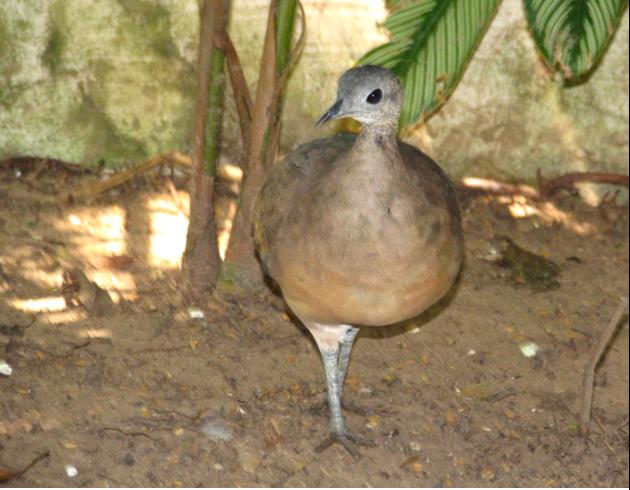
Great Tinamou
Tinamus major
Order: Tinamiformes / Family: Tinamidae

Wikimedia Commons
About the Great Tinamou
The Great Tinamou (Tinamus major) holds a significant place within the avian world as one of the most primitive living bird species, offering a glimpse into the evolutionary past of birds. This bird inhabits the humid tropical forests of Central and South America, from southern Mexico through the Amazon Basin, encompassing countries like Brazil, Colombia, and Peru. Known for its shy demeanor, the Great Tinamou often remains hidden in dense understory, relying on its cryptic plumage to evade detection. Its ecological role is pivotal, acting as both a seed disperser and a prey species within its ecosystem, contributing to the health and balance of tropical forests. During the breeding season, which typically aligns with the rainy season, their haunting calls become more frequent as they establish territories and attract mates. These calls, often described as a series of low, mournful whistles, resonate through the forest, sometimes audible from up to a kilometer away. The Great Tinamou’s presence in these forests is also an indicator of ecosystem health, as it requires large, undisturbed areas of primary forest to thrive. The bird's ability to consume a variety of fruits, seeds, and small invertebrates makes it a key player in seed dispersal, aiding in forest regeneration. Despite its elusive nature, the Great Tinamou significantly enriches the biodiversity of its habitat. Its seasonal behaviors are closely linked to the availability of food and breeding opportunities. During the dry season, they are more terrestrial and may venture into secondary forests or edge habitats in search of food.
The Great Tinamou belongs to the family Tinamidae, within the order Tinamiformes. These birds typically live typically 12-15 years, with some individuals known to live up to 18 years..
How to Identify a Great Tinamou
The Great Tinamou's plumage is primarily a muted brown with a subtle speckled pattern that provides excellent camouflage against the forest floor. Adult males and females look alike, although females are slightly larger. The bird's back and wings exhibit a warm brown hue with fine dark barring, while the underparts are lighter, showcasing a paler, buff color. Juveniles resemble adults but may appear more uniformly colored with less distinct barring. A distinguishing feature is its robust, slightly curved bill, adapted for foraging among leaf litter. In flight, the Great Tinamou presents a compact, rounded silhouette, with rapid, shallow wingbeats due to its relatively short wings. On the ground, it adopts a low posture, moving with deliberate, measured steps, which aids in its stealthy movement through dense vegetation. While similar in appearance to other tinamous, such as the Little Tinamou, the Great Tinamou can be distinguished by its larger size and deeper, more resonant vocalizations.
Having trouble telling birds apart? Upload a photo to our bird identification tool for an instant species match.
Great Tinamou Habitat and Range
Preferred Habitat
The Great Tinamou thrives in humid, tropical lowland forests, often found at elevations ranging from sea level to about 1,500 meters. It prefers primary forests with dense understory, offering ample cover and abundant food resources. Unlike some other bird species, the Great Tinamou is less adaptable to fragmented habitats, making it less common in secondary growth or disturbed areas. In areas like the Amazon Basin, it frequents terra firme forests, avoiding seasonally flooded varzea forests. While it is primarily a forest dweller, it occasionally ventures into edge habitats during the dry season when food resources are scarce. Rarely seen in urban or heavily altered landscapes, its presence is a marker of relatively undisturbed wilderness areas.
Geographic Range
The Great Tinamou's range extends from southern Mexico through Central America, including countries such as Guatemala, Belize, Honduras, and Costa Rica, down into South America. In South America, its range covers a wide swath of the Amazon Basin, including Peru, Ecuador, Colombia, Venezuela, Brazil, and parts of Bolivia. It is a resident species, with no significant migratory movements. However, local movements may occur in response to seasonal changes in food availability or habitat conditions. Population densities are highest in large expanses of continuous forest, particularly in the Amazon, where suitable habitat is abundant. In areas with significant deforestation, such as parts of Central America and the Atlantic Forest in Brazil, the Great Tinamou has become increasingly scarce.
Want to know which birds visit your area? Browse our backyard birds by location guides for region-specific species lists.
What Does the Great Tinamou Eat?
The diet of the Great Tinamou is diverse, primarily consisting of fruits and seeds, supplemented by small invertebrates. Seasonal variations in fruit availability influence its diet, with a higher intake of insects and other invertebrates during periods of fruit scarcity. Foraging occurs mainly on the forest floor, where it uses its bill to probe through leaf litter and soil. The bird exhibits a methodical foraging behavior, often seen turning over leaves to uncover hidden food items. It consumes a variety of prey sizes, from small beetles to sizeable fallen fruits, demonstrating its adaptability in foraging strategies. Feeding typically occurs during early morning and late afternoon, aligning with the cooler parts of the day.
Great Tinamou Behavior and Social Structure
The Great Tinamou is primarily solitary, although it may form loose associations with others during the non-breeding season. Territorial in nature, males establish and defend territories through vocal displays, using their distinctive whistles to communicate presence and readiness to mate. Courtship involves simple displays, with males calling persistently to attract females. Once a pair forms, the male often takes on the primary role in nest protection and incubation. When threatened by predators, such as raptors or larger mammals, the Great Tinamou relies on its camouflage and stealth, freezing or quietly slipping into dense cover rather than taking flight. Daily activity peaks in the early morning and late afternoon, with periods of rest during the hottest part of the day.
Great Tinamou Nesting and Reproduction
The Great Tinamou's nesting habits are unique in the avian world. Nests are simple, consisting of shallow depressions on the forest floor, lined with leaves and other debris. Preferred nesting sites are well-concealed under dense vegetation or near fallen logs, providing protection and camouflage. Clutch size typically ranges from 3 to 5 eggs, with the eggs being glossy and vibrant in color, varying from blue-green to dark purple. The incubation period lasts about 19 to 21 days, during which the male assumes most of the incubation duties. Chicks are precocial, leaving the nest shortly after hatching, although they remain under the male's care until they are capable of independent survival. Generally, the Great Tinamou raises one brood per year, with the timing closely linked to the rainy season, ensuring ample food resources for the growing chicks.
Great Tinamou Sounds and Vocalizations
The Great Tinamou's primary vocalization is a series of deep, resonant whistles, often described as haunting and mournful. These calls consist of a rhythmic sequence of notes, each lasting a couple of seconds, gradually descending in pitch. The call can carry over long distances, making it an effective tool for territory establishment and mate attraction. Besides the primary song, the Great Tinamou produces softer contact calls to maintain communication between individuals, especially during foraging. Alarm calls are less common but are sharp and abrupt, designed to alert others to potential dangers. The dawn chorus prominently features their calls, contributing to the rich soundscape of tropical forests.
Interesting Facts About the Great Tinamou
- 1The Great Tinamou is one of the oldest living bird species, with evolutionary roots tracing back over 100 million years, providing a living link to prehistoric avian ancestors.
- 2Despite its chicken-like appearance, the Great Tinamou is more closely related to ostriches and emus, showcasing a unique evolutionary lineage within the bird world.
- 3Great Tinamous are remarkable for their vocal prowess, with calls that can be heard over a kilometer away, aiding in communication across dense forest environments.
- 4In some indigenous cultures, the Great Tinamou's distinctive call is believed to be a voice of the forest spirits, highlighting its cultural significance.
- 5The glossy, brightly colored eggs of the Great Tinamou are among the most visually striking of any bird species, ranging from turquoise to deep violet.
- 6Unlike many bird species, the male Great Tinamou takes on the primary role of incubating eggs and caring for young, showcasing an interesting reversal of typical avian parental roles.
- 7The Great Tinamou's ability to consume large seeds and fruits makes it a vital seed disperser, promoting forest regeneration and biodiversity.
Great Tinamou Conservation Status
As of the latest assessments, the Great Tinamou is listed as Near Threatened on the IUCN Red List. Its population trend is decreasing, primarily due to habitat loss from deforestation and agricultural expansion. In some areas, hunting for food further pressures populations. Conservation efforts focus on habitat protection and restoration, with initiatives to establish and maintain protected areas in key parts of its range. Historically, the species was more widespread, but significant habitat fragmentation has led to local extirpations. Effective conservation requires international cooperation across its range to manage and preserve the large tracts of forest essential for its survival.
Other Tinamidae Species


Birds Similar to the Great Tinamou
These species are often confused with the Great Tinamou due to similar appearance or overlapping range.