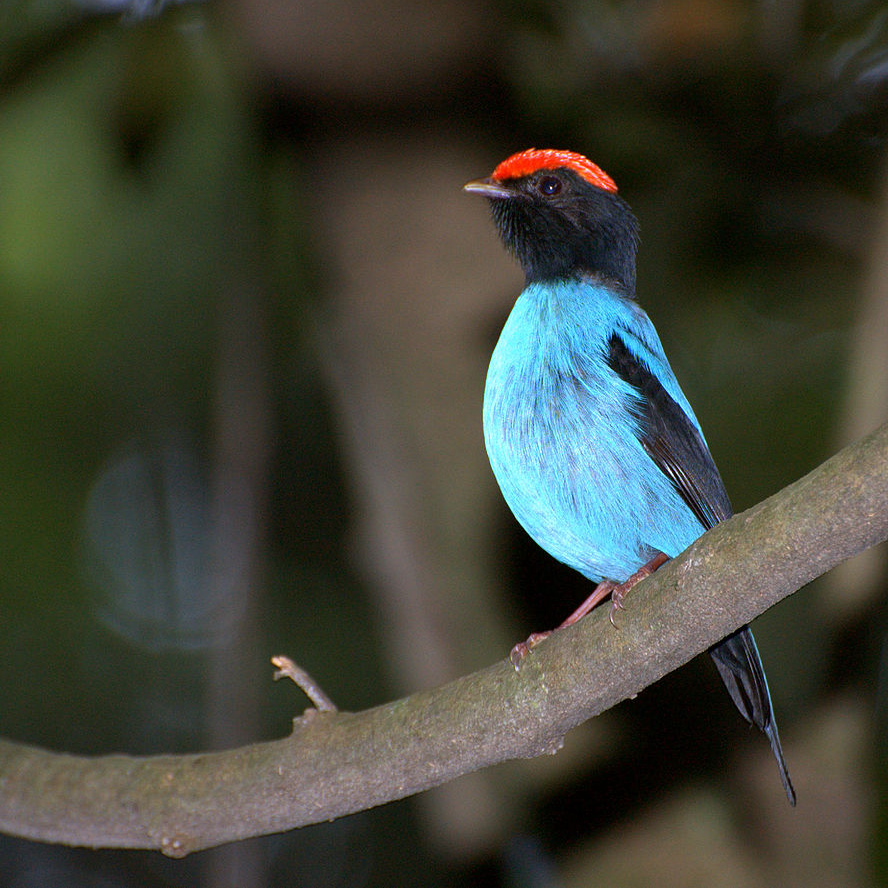
Blue-backed Manakin
Chiroxiphia pareola
Order: Passeriformes / Family: Pipridae

Wikimedia Commons
About the Blue-backed Manakin
The Blue-backed Manakin (Chiroxiphia pareola) is a small passerine bird found primarily in South America, with a range extending into Central America. This species is renowned for its striking blue back and engaging courtship behaviors, making it a favorite among birdwatchers and researchers alike. The bird inhabits lowland tropical forests and often prefers areas with dense understory, which provide ample cover and feeding opportunities.
Throughout its range, which includes countries such as Brazil, Venezuela, Colombia, and Guyana, the Blue-backed Manakin plays a critical role in seed dispersal. By consuming a diet rich in fruit, these birds help maintain the health and diversity of their forest ecosystems. During the breeding season, males gather in leks, communal areas where they perform elaborate displays to attract females. These displays are not only a spectacle of vibrant color and movement but also a key driver of genetic diversity within the species.
The ecological significance of the Blue-backed Manakin extends beyond their visual displays. As a member of the Pipridae family, the species contributes to the control of insect populations, providing a balance in the food web. Their presence in a variety of habitats, from the Atlantic Forest of Brazil to the foothills of the Andes, underscores their adaptability and importance. Seasonal behaviors include altitudinal movements in response to fruit availability, ensuring their survival even as environmental conditions change.
The Blue-backed Manakin belongs to the family Pipridae, within the order Passeriformes. These birds typically live average 8 years with a maximum recorded of 10 years..
How to Identify a Blue-backed Manakin
Identifying the Blue-backed Manakin requires attention to its distinctive plumage and size. Adult males showcase a brilliant blue back that contrasts sharply with their black wings and tail. The head and underparts are black, with a striking red crown, a signature feature that adds to their allure. Females and juveniles differ significantly in appearance, sporting olive-green plumage that offers effective camouflage in their forested habitats.
The sexual dimorphism in this species can lead to confusion with other manakins, such as the Red-capped Manakin (Ceratopipra mentalis). However, the Blue-backed Manakin's unique blue coloration and specific vocalizations aid in accurate identification. In flight, the bird exhibits a compact silhouette with rapid, direct flight patterns. When perched, the male's posture often highlights its vibrant back and crown, especially during courtship displays, which further aids in identification.
Having trouble telling birds apart? Upload a photo to our bird identification tool for an instant species match.
Blue-backed Manakin Habitat and Range
Preferred Habitat
The Blue-backed Manakin thrives in tropical and subtropical forests, favoring areas with dense undergrowth. These birds occupy elevations ranging from sea level up to 1,500 meters, particularly in regions like the Amazon Basin and the Atlantic Forest. Their habitat preference includes forest edges and secondary growth, where fruiting trees and shrubs are plentiful.
While primarily a forest dweller, the Blue-backed Manakin occasionally ventures into more open areas, especially during the non-breeding season when food resources dictate movement. Urban presence is rare, as the species tends to avoid highly disturbed environments. Seasonal habitat shifts occur in response to fruit availability, with some populations moving to higher elevations during certain times of the year.
Geographic Range
The Blue-backed Manakin boasts an extensive range spanning several countries in South America, including Brazil, Venezuela, Colombia, and the Guianas. This bird's presence in Central America is more localized, with populations found in Panama and Costa Rica. Within these regions, the species occupies both continuous tracts of forest and fragmented landscapes, though it shows a preference for undisturbed areas.
The Blue-backed Manakin does not undertake long-distance migrations, but local movements are common, especially in response to seasonal changes in food supply. Population density hotspots include the Amazon Basin and the Atlantic Forest, where high fruit abundance supports larger numbers. Breeding and non-breeding ranges often overlap, allowing for year-round observation in many areas.
Want to know which birds visit your area? Browse our backyard birds by location guides for region-specific species lists.
What Does the Blue-backed Manakin Eat?
The Blue-backed Manakin primarily consumes a diet of fruit, which constitutes the bulk of its nutritional intake. The species displays a preference for small berries and drupes, often foraging in the mid to upper canopy layers where these food sources are abundant. In addition to fruit, the Blue-backed Manakin occasionally supplements its diet with insects, particularly during the breeding season when protein demands increase.
Foraging techniques include short, agile flights to pluck fruit from branches or hovering briefly to glean insects from leaves. This bird typically feeds during daylight hours, with peak activity observed in the early morning and late afternoon. The size of prey items ranges from tiny insects to larger fruit, which the bird handles with adeptness.
Blue-backed Manakin Behavior and Social Structure
The social structure of the Blue-backed Manakin is characterized by its lekking behavior, where males congregate to perform courtship displays. These gatherings are highly competitive, with males executing a series of jumps, flights, and calls designed to attract females. Territories within leks are small, yet fiercely defended during the breeding season.
Outside of the lekking context, the Blue-backed Manakin exhibits more solitary or small group behavior, particularly when foraging. The bird's response to predators includes rapid flight and seeking cover within the dense understory. Daily activity patterns show a preference for the early morning and late afternoon, aligning with the availability of food resources and optimal conditions for courtship activity.
Blue-backed Manakin Nesting and Reproduction
The Blue-backed Manakin constructs a shallow, cup-shaped nest using fine plant materials such as twigs, leaves, and rootlets. Located typically in the fork of a tree, the nest is well concealed by surrounding foliage to protect against predators. Preferred nest sites are found in the lower to mid-canopy layers, where cover is dense.
The typical clutch size consists of two eggs, which the female incubates alone over a period of approximately two weeks. Once hatched, the chicks remain in the nest for another two to three weeks, during which time the female provides all necessary care. The species generally raises one brood per year, although favorable conditions may occasionally allow for a second.
Blue-backed Manakin Sounds and Vocalizations
The vocal repertoire of the Blue-backed Manakin includes a series of sharp, high-pitched notes that serve both social and territorial purposes. The primary song is a rhythmic sequence of clear notes, often described as a 'pew-pew-pew' sound. Males use these calls extensively during courtship displays, with variations in pitch and intensity indicating their fitness and readiness to mate.
Call notes are shorter and include a variety of whistles and trills, which facilitate communication between individuals. Alarm calls are distinctively harsher and serve to alert nearby birds to potential threats. During the dawn chorus, the Blue-backed Manakin's calls blend with those of other forest species, creating a vibrant soundscape.
Interesting Facts About the Blue-backed Manakin
- 1Blue-backed Manakins can perform up to 30 jumps per minute during courtship displays.
- 2Despite their small size, Blue-backed Manakins can cover significant distances when searching for food.
- 3The lekking behavior of Blue-backed Manakins involves elaborate displays that can last several hours.
- 4Blue-backed Manakins' vibrant plumage provides camouflage in dappled sunlight, blending with sky and shadow.
- 5Females choose mates based on the quality and intensity of the males' displays, ensuring strong genetic traits.
- 6The Blue-backed Manakin's diet of fruit makes it a key seed disperser in its ecosystem.
- 7Males spend more time on grooming their feathers than females, enhancing their appearance for displays.
Blue-backed Manakin Conservation Status
The Blue-backed Manakin currently holds a conservation status of Least Concern according to the IUCN Red List. While the population trend remains stable, habitat destruction poses a significant threat, particularly in regions experiencing rapid deforestation. Conservation efforts focus on preserving critical habitats and establishing protected areas within the bird's range. Historically, the Blue-backed Manakin has shown resilience in adapting to fragmented landscapes, although continuous monitoring is essential to ensure long-term viability. Educational programs and habitat restoration projects aim to mitigate the effects of human activity and safeguard the species' future.