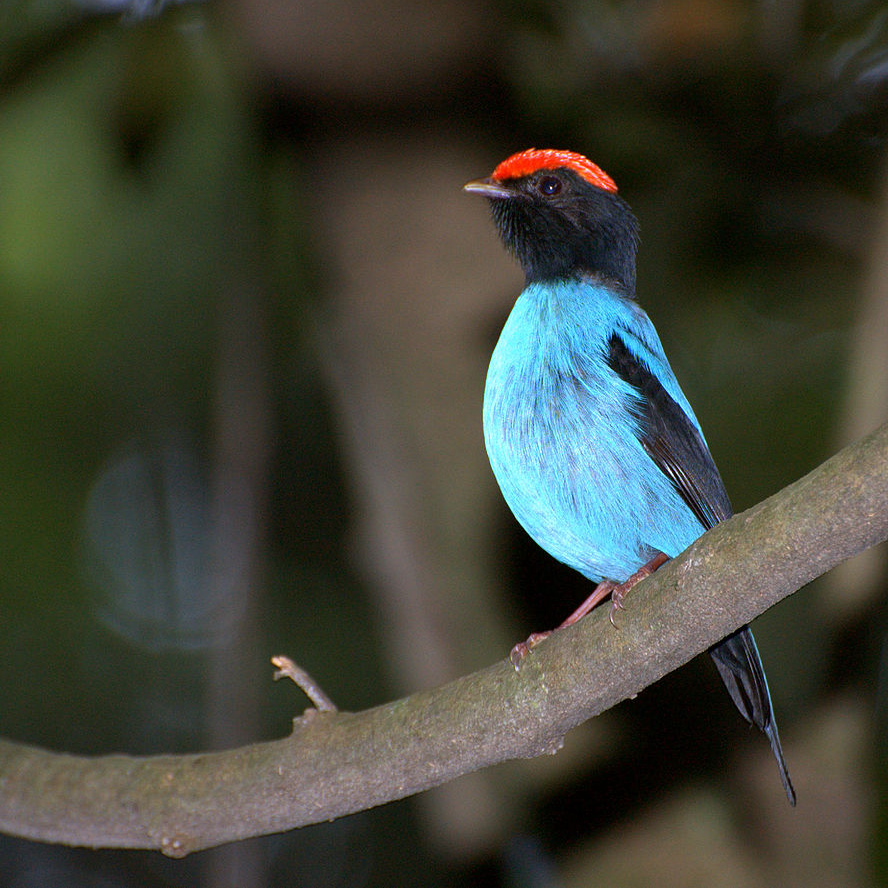
Blue-crowned Manakin
Lepidothrix coronata
Order: Passeriformes / Family: Pipridae

Wikimedia Commons
About the Blue-crowned Manakin
The Blue-crowned Manakin (Lepidothrix coronata) is a captivating species found primarily in the lowland tropical forests of South America. This bird is part of the Pipridae family, which is renowned for its vibrant plumage and elaborate courtship displays. The Blue-crowned Manakin is no exception, as males sport a striking iridescent blue crown that contrasts dramatically with their otherwise dark plumage. This bird primarily inhabits countries such as Colombia, Ecuador, Peru, and Brazil, thriving in the dense understory of tropical forests.
The ecological role of the Blue-crowned Manakin is significant due to its role as both a seed disperser and an insect predator. By consuming a varied diet of fruits and insects, it contributes to the maintenance of its ecosystem. The seeds that pass through its digestive system are often deposited in new locations, promoting forest regeneration. Furthermore, its insectivorous habits help control insect populations, maintaining a balance in its habitat.
Seasonally, the Blue-crowned Manakin exhibits fascinating behaviors, particularly during the breeding season when males engage in elaborate courtship displays. These displays, often involving complex vocalizations and acrobatics, are essential for attracting mates. Outside of the breeding season, these birds are relatively solitary, only gathering in small groups when feeding or during migration. Their presence in the ecosystem highlights the interconnectedness of tropical forest biodiversity, as they interact with a variety of plant and animal species.
Efforts to conserve the Blue-crowned Manakin are crucial given the threats posed by deforestation and habitat loss. As tropical forests continue to face pressures from agriculture and urban development, the preservation of these birds and their habitat remains a priority for conservationists. Their presence serves as an indicator of forest health, making the protection of their environment essential for maintaining biodiversity in the regions they inhabit.
The Blue-crowned Manakin belongs to the family Pipridae, within the order Passeriformes. These birds typically live average 6 years with a maximum recorded of 8 years..
How to Identify a Blue-crowned Manakin
The Blue-crowned Manakin is a small bird, approximately 10-12 cm in length, noted for its vibrant plumage and distinctive markings. Adult males are easily distinguished by their iridescent blue crown, which stands in stark contrast to their predominantly black body. Their wings and tail are also black, while the underparts are a subtle olive hue. Females and juveniles, however, are less conspicuous, displaying a more uniform olive-green coloration across their bodies, which provides effective camouflage in the dense forest understory.
One of the key identification markers for the Blue-crowned Manakin is its flight pattern and silhouette. These birds exhibit a fluttering flight with rapid, shallow wingbeats, typical of small passerines. When perched, they often adopt an upright posture, showcasing their striking crowns, particularly during breeding displays.
In terms of distinguishing between sexes, the difference is most apparent in the coloration of their crowns and body plumage. While males have the vibrant blue crown, females lack this feature and are instead more cryptically colored. Similar species within the Pipridae family may cause confusion, such as the White-crowned Manakin, which differs notably in crown coloration and overall body hue. Observing these subtle differences is key for accurate identification in the field.
Having trouble telling birds apart? Upload a photo to our bird identification tool for an instant species match.
Blue-crowned Manakin Habitat and Range
Preferred Habitat
The Blue-crowned Manakin thrives in the tropical lowland forests of South America, particularly in the Amazon Basin. These birds prefer the dense undergrowth of primary and secondary forests, where they find abundant food and ample cover. They are most commonly found at elevations ranging from sea level up to 1,200 meters, although they can occasionally be spotted at higher altitudes in certain regions.
Seasonal habitat shifts are minimal for the Blue-crowned Manakin, as they are non-migratory and tend to remain in the same general area year-round. However, they may move locally within their habitat to follow food availability, particularly fruiting trees.
While predominantly forest dwellers, these birds occasionally venture into more open or disturbed areas, such as forest edges and clearings, but they are rarely found in urban settings. Their reliance on forest environments makes them vulnerable to habitat destruction, emphasizing the importance of preserving tropical forest ecosystems.
Geographic Range
The Blue-crowned Manakin's range is primarily confined to the northern and western regions of the Amazon Basin, encompassing parts of Colombia, Venezuela, Ecuador, Peru, and Brazil. Within these countries, their presence is most concentrated in the Amazonian lowland forests, although they are also found in the Andean foothills and along river corridors.
These birds do not undertake long-distance migrations, instead remaining within their natal territories or moving locally in response to food availability. Their range is relatively stable, although specific population densities can vary based on habitat quality and availability.
In areas where they are locally abundant, Blue-crowned Manakins can form small, loose aggregations, particularly during the breeding season. However, outside of these periods, they are generally solitary or found in pairs. The continuity of their range across several countries underscores the importance of cross-border conservation efforts to ensure their survival.
Want to know which birds visit your area? Browse our backyard birds by location guides for region-specific species lists.
What Does the Blue-crowned Manakin Eat?
The diet of the Blue-crowned Manakin is primarily frugivorous, with fruit constituting the majority of its food intake. These birds favor small fruits and berries, which they deftly pluck while hovering or perching. They play a crucial role in seed dispersal, as the seeds often pass through their digestive system unharmed.
In addition to fruits, the Blue-crowned Manakin occasionally supplements its diet with insects, particularly during the breeding season when protein demand is higher. They employ a sallying technique, darting from perches to capture insects mid-air or gleaning them from foliage.
Their feeding activity typically peaks during the early morning and late afternoon when both fruits and insects are more readily available. Seasonal changes in their diet are minimal in their stable tropical environment, although they may shift focus between different fruiting trees or insect sources as availability fluctuates.
Blue-crowned Manakin Behavior and Social Structure
The Blue-crowned Manakin exhibits a variety of intriguing behaviors, especially during the breeding season. Males are renowned for their elaborate courtship displays, which showcase their acrobatic prowess and vocal skills. These displays often occur in small leks, where multiple males gather to perform for visiting females. Each male attempts to outshine his competitors by executing intricate dance moves combined with rapid wing snaps and melodious calls.
Outside the breeding season, these birds lead relatively solitary lives, although they may forage in loose groups when food is plentiful. The Blue-crowned Manakin is territorial, with males defending small territories primarily during breeding times. They signal territory ownership with vocalizations and visual displays, ensuring their space against rivals.
In response to predators, these birds rely on their agility and dense forest habitat for protection. They maintain a low profile, often remaining motionless to avoid detection. Their daily activity patterns center around feeding bouts in the morning and late afternoon, with periods of rest and preening during the hottest parts of the day.
Blue-crowned Manakin Nesting and Reproduction
The Blue-crowned Manakin constructs small, cup-shaped nests, typically located in the fork of a branch or suspended from a low-hanging vine. These nests, made from fine plant fibers, leaves, and spider silk, are skillfully camouflaged to blend in with the surrounding foliage.
Females are solely responsible for nest building and incubation, laying a clutch of two eggs on average. The incubation period lasts approximately 18-21 days, during which the female remains vigilant, leaving the nest only briefly to feed.
Once hatched, the altricial chicks remain in the nest for about 15-20 days before fledging. During this time, the female continues to provide food and protection. The number of broods per year can vary, but typically, Blue-crowned Manakins raise one or two broods annually, depending on environmental conditions and food availability.
Blue-crowned Manakin Sounds and Vocalizations
The Blue-crowned Manakin's vocal repertoire includes a variety of sounds, most notably its primary song, which is a series of rapid, high-pitched notes delivered in a rhythmic and melodious sequence. These songs are most prominent during the morning hours, forming an essential part of their courtship and territorial displays.
Their call notes are sharp and metallic, often described as 'tink' or 'zip' sounds, which serve as contact calls between individuals, especially during foraging. Alarm calls, although less frequent, are short and harsh, intended to alert conspecifics to potential threats.
While the Blue-crowned Manakin does not typically participate in dawn chorus with the intensity of other songbirds, its distinct calls contribute to the rich tapestry of sounds within its tropical forest habitat.
Interesting Facts About the Blue-crowned Manakin
- 1The Blue-crowned Manakin's courtship display can involve up to 20 individual males in a single lek, each performing to attract a female.
- 2Despite its vibrant appearance, the Blue-crowned Manakin is adept at blending into its surroundings, using its olive-green plumage for camouflage.
- 3The species' diet assists in the dispersal of seeds from over 50 different plant species, contributing to forest regeneration.
- 4Females can lay two eggs per clutch, with incubation lasting up to 21 days, a period during which the male plays no role in caregiving.
- 5Their flight style, characterized by rapid, fluttery wingbeats, allows them to maneuver adeptly through dense forest canopies.
Blue-crowned Manakin Conservation Status
The Blue-crowned Manakin is currently listed as a species of least concern by the IUCN, with a stable population trend. However, ongoing threats such as deforestation, habitat fragmentation, and agricultural expansion pose significant risks to their long-term survival. Conservation efforts focus on preserving tropical forest habitats through protected areas and sustainable land management practices. Historical changes in population have been minimal, but localized declines have been noted in areas experiencing rapid habitat loss. Efforts to monitor and research the Blue-crowned Manakin's ecology and habitat requirements are essential for informed conservation strategies. Community engagement and education play vital roles in promoting the protection of these birds and their habitats, emphasizing the importance of biodiversity and ecosystem health in the regions they inhabit.