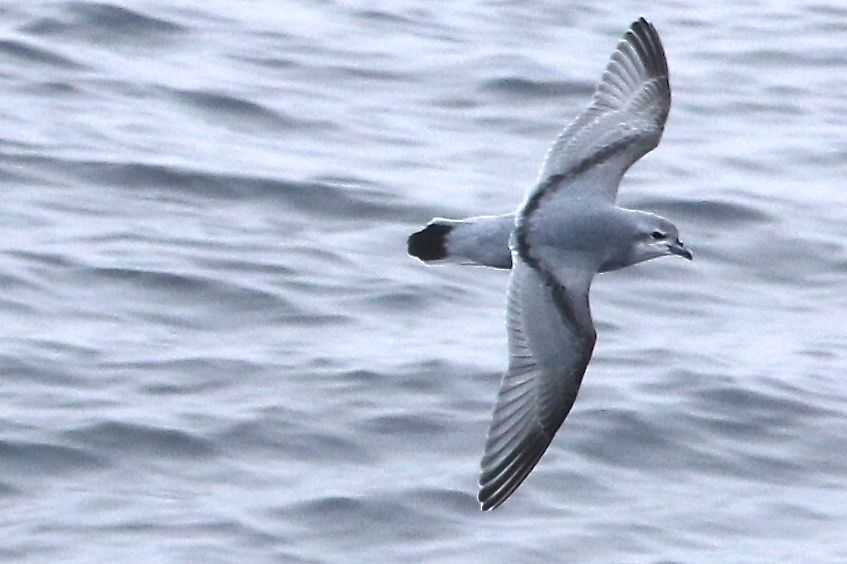
Blue Petrel
Halobaena caerulea
Order: Procellariiformes / Family: Procellariidae

Wikimedia Commons
About the Blue Petrel
The Blue Petrel, scientifically known as Halobaena caerulea, is a medium-sized seabird belonging to the Procellariidae family. This bird is well adapted to the harsh conditions of the Southern Ocean, where it spends most of its life. The Blue Petrel’s existence is intricately tied to the cold, nutrient-rich waters of the sub-Antarctic region, where it plays a crucial role in the marine ecosystem. Its presence helps maintain the ecological balance by participating in nutrient cycling and serving as prey for larger predators. These birds are pelagic, meaning they spend a majority of their life over open ocean waters. They are known to be highly migratory, traveling vast distances to follow the availability of food sources. During the breeding season, which takes place from November to April, Blue Petrels return to land to nest in colonies on remote islands such as South Georgia, Kerguelen, Crozet, and Marion Island. These islands, often located in the Southern Hemisphere's temperate or polar regions, provide the isolated and predator-free environment necessary for raising their young. The seasonal behaviors of the Blue Petrel are synchronized with the oceanic patterns. In summer, they breed and rear chicks on the islands, while in winter, they are known to disperse northward, taking advantage of the productive waters found further away from their breeding grounds. This seasonal migration is essential for their survival, as it ensures access to abundant food resources. Blue Petrels are integral to their ecosystem, influencing both the marine and terrestrial environments they inhabit. Their guano enriches island soils, fostering unique plant communities that benefit other animal species. Thus, the Blue Petrel is not only a remarkable seabird but also a vital component of its ecological community.
The Blue Petrel belongs to the family Procellariidae, within the order Procellariiformes. These birds typically live average 15 years, with a maximum recorded age of over 20 years..
How to Identify a Blue Petrel
The Blue Petrel is a striking bird with distinctive field marks that aid in its identification. Adults possess a blue-gray plumage that covers most of their body, providing excellent camouflage against the ocean's surface. The bird's upperparts are accented by a dark 'M' pattern across the wings and back, a key characteristic that distinguishes it from other petrel species. The underparts are primarily white, with a subtle blue tint on the chest and flanks. Juveniles resemble adults but may have slightly duller plumage. Male and female Blue Petrels appear similar, making it difficult to distinguish between the sexes in the field. Among the petrels, the Blue Petrel can be confused with the Fairy Prion and the Antarctic Prion, but its unique wing pattern and size set it apart. In flight, the Blue Petrel exhibits a graceful, gliding motion, often riding the wind in long arcs. Its silhouette is characterized by long, narrow wings, a short, stout bill, and a moderately forked tail. When perching, the Blue Petrel displays a relaxed posture, with wings slightly drooped, a habit common to many seabirds.
Having trouble telling birds apart? Upload a photo to our bird identification tool for an instant species match.
Blue Petrel Habitat and Range
Preferred Habitat
Blue Petrels inhabit open ocean environments and are rarely seen near land except during the breeding season. They prefer the cold waters of the Southern Ocean, particularly around the Antarctic Convergence, where nutrient upwelling supports abundant marine life. During breeding, they nest on sub-Antarctic islands such as South Georgia and the Kerguelen Islands. These islands offer rugged terrains with tussock grass and sparse vegetation, providing suitable nesting sites. Blue Petrels typically nest in burrows dug into the soft peat or sand, often at elevations ranging from sea level to 200 meters. While primarily oceanic, during non-breeding periods, they can be found in more temperate waters, shifting their habitat preference as food availability changes. Their presence in urban areas is non-existent due to their pelagic nature.
Geographic Range
The Blue Petrel's range is largely confined to the Southern Hemisphere. During the breeding season, they are found on sub-Antarctic islands such as South Georgia, Kerguelen, and Crozet. Outside of this period, they disperse across the Southern Ocean, reaching as far north as the subtropical waters off South Africa, Australia, and South America. Migration corridors are mostly oceanic, with limited land interactions. These birds are known to cover extensive distances, often traveling thousands of kilometers in search of food. The population density of Blue Petrels is highest around their breeding islands, but they are considered uncommon due to their remote habitats. However, they are widespread across the Southern Ocean, utilizing a range of habitats within this vast area.
Want to know which birds visit your area? Browse our backyard birds by location guides for region-specific species lists.
What Does the Blue Petrel Eat?
The Blue Petrel primarily feeds on marine zooplankton and small fish. Their diet consists largely of krill, which they hunt by skimming the ocean's surface or performing shallow dives. They also consume squid and various crustaceans, supplementing their diet when prey availability shifts. Blue Petrels are known for their adept foraging techniques, often using their sense of smell to locate food patches over vast oceanic distances. During the breeding season, their diet remains consistent, as they continue to forage in nearby waters to feed their chicks. In winter, when they migrate to more temperate regions, their diet may diversify slightly, but krill remains a staple. Prey size typically ranges from a few millimeters to several centimeters, allowing Blue Petrels to exploit a variety of marine life. They feed primarily during daylight hours, taking advantage of the increased visibility to locate and capture prey efficiently.
Blue Petrel Behavior and Social Structure
Blue Petrels exhibit a blend of solitary and social behaviors, reflecting their adaptation to the vast and variable conditions of the ocean. Outside the breeding season, they are mostly solitary, covering large distances alone. However, during the breeding season, they form dense colonies on islands, where they exhibit strong site fidelity, returning to the same nesting sites year after year. Their courtship displays involve synchronized flights and vocalizations, strengthening pair bonds. Flocking patterns are more pronounced at sea when they gather in loose associations around feeding grounds, leveraging the collective knowledge of the group to locate prey. Blue Petrels are non-territorial at sea, but on land, they defend their burrow sites from intruders. Their response to predators includes evasive aerial maneuvers and, in the case of land predators, retreating to the safety of their burrows. Daily activity patterns are primarily diurnal, with peak activity occurring during daylight when they forage and engage in social interactions.
Blue Petrel Nesting and Reproduction
Blue Petrels nest in burrows, which they excavate in soft soil on sub-Antarctic islands. These burrows provide protection from predation and harsh weather, ensuring a stable environment for their eggs and chicks. A typical clutch consists of a single egg, which both parents incubate for approximately 45 days. Parental roles are shared, with each parent taking turns incubating the egg and foraging at sea. Once hatched, the chick remains in the burrow and is fed regurgitated food by both parents. The fledging period lasts about 55 days, after which the young petrel ventures out to sea. Blue Petrels typically produce one brood per year, with breeding success closely tied to food availability and environmental conditions.
Blue Petrel Sounds and Vocalizations
The Blue Petrel's vocalizations are integral to its breeding interactions. The primary song consists of a series of soft, cooing notes delivered in a rhythmic sequence. These calls are often heard at night when adults return to their colonies to feed their chicks. Alarm calls are sharper and more abrupt, serving as warnings to nearby birds. During the dawn chorus, the air around the colonies fills with a medley of overlapping calls, creating a distinctive soundscape. The Blue Petrel's vocalizations are reminiscent of the gentle cooing of doves, but with a unique, oceanic resonance.
Interesting Facts About the Blue Petrel
- 1The Blue Petrel's dark 'M' pattern on its wings is a unique feature that helps identify it at great distances.
- 2Blue Petrels are known to travel over 10,000 kilometers during their annual migrations.
- 3Despite their small size, Blue Petrels are capable of diving to depths of up to 5 meters in search of food.
- 4Their sense of smell is highly developed, allowing them to detect prey from several kilometers away.
- 5Blue Petrels have a lifespan of up to 20 years, with some individuals living even longer.
- 6They are one of the few bird species that can drink seawater, thanks to specialized glands that expel excess salt.
- 7Blue Petrels often use the same nesting burrow for multiple years, showcasing strong site fidelity.
Blue Petrel Conservation Status
The Blue Petrel is currently listed as Least Concern by the IUCN, with populations considered stable. However, they face threats from habitat disturbance, introduced predators on breeding islands, and climate change. Conservation efforts focus on eradicating invasive species and protecting critical breeding habitats. Historically, populations have fluctuated in response to these threats, but recent measures have improved their outlook. Continued monitoring and habitat restoration are vital to ensuring their long-term survival.
Other Procellariidae Species


Birds Similar to the Blue Petrel
These species are often confused with the Blue Petrel due to similar appearance or overlapping range.