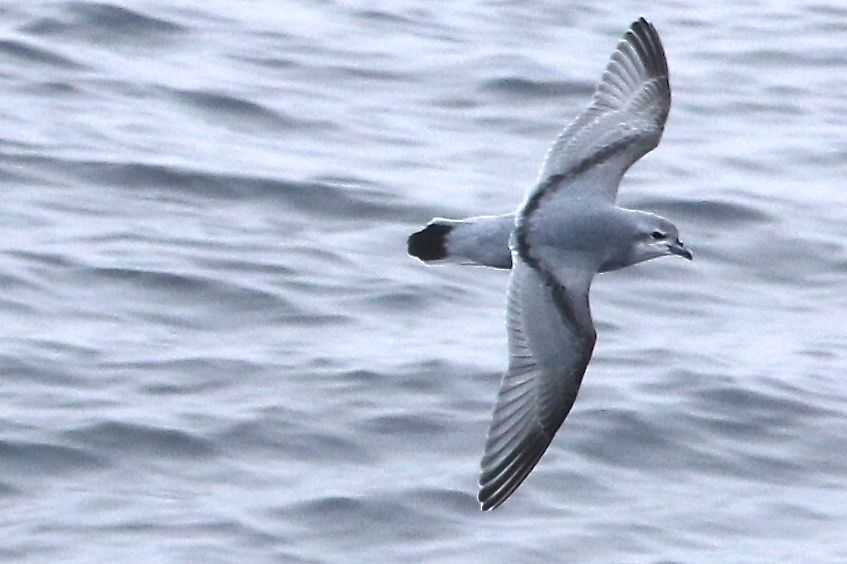
Slender-billed Prion
Pachyptila belcheri
Order: Procellariiformes / Family: Procellariidae

Wikimedia Commons
About the Slender-billed Prion
The Slender-billed Prion (Pachyptila belcheri) is a small seabird found predominantly in the southern oceans, belonging to the family Procellariidae. This bird is a member of the prion group, known for their specialized bill structures adapted for filter feeding. Slender-billed Prions are particularly noted for their distinctive slender bills, which enable them to expertly skim and filter zooplankton from the ocean surface. These birds are integral components of the marine ecosystem, playing a crucial role in the food web by converting planktonic energy into biomass accessible to higher trophic levels. Predominantly pelagic, they are rarely seen from land except during breeding seasons. During this time, they nest on remote islands in the Southern Hemisphere, such as the Falkland Islands and South Georgia. Here, they form large colonies, often intermingling with other seabird species, which can lead to complex interspecies interactions. The Slender-billed Prion's ecological significance extends beyond its role as a consumer. It acts as an indicator species, signaling the health of the oceanic environment. Changes in their population can reflect alterations in marine food availability and water quality. This makes them an essential subject of study for ornithologists and marine biologists monitoring the impacts of climate change and human activities on ocean ecosystems. Seasonally, the Slender-billed Prion exhibits notable behavioral adaptations. Outside the breeding season, it disperses widely across the Southern Ocean, following the nutrient-rich waters that support its dietary needs. Their migratory patterns are closely linked to ocean currents and the availability of prey, demonstrating their profound adaptation to the marine environment.
The Slender-billed Prion belongs to the family Procellariidae, within the order Procellariiformes. These birds typically live average 15 years, with some living up to 20 years..
How to Identify a Slender-billed Prion
The Slender-billed Prion is a medium-sized seabird, measuring about 25 to 30 cm in length, with a wingspan ranging from 55 to 60 cm. Its plumage is predominantly gray above, with a lighter underside that can appear almost white, especially in flight. A key field mark is its slim, dark-tipped bill, which is narrower than that of other prion species. The head features a distinct dark cap and a subtle, dark eye stripe that runs from the base of the bill through the eye. Male and female Slender-billed Prions are similar in appearance, making it challenging to differentiate between sexes through plumage alone. Juveniles resemble adults but may have slightly duller plumage. When observing in the field, note the bird's agile flight, characterized by quick, shallow wingbeats and gliding. Compared to similar species, such as the Broad-billed Prion, the Slender-billed Prion's bill is noticeably more tapered, and its overall build is less robust. This species often rests on the water, where its buoyant posture and narrow bill are distinctive.
Having trouble telling birds apart? Upload a photo to our bird identification tool for an instant species match.
Slender-billed Prion Habitat and Range
Preferred Habitat
The preferred habitat of the Slender-billed Prion includes open oceanic waters and remote island environments where they breed. These birds are primarily found in the Southern Ocean, thriving in cold, nutrient-rich waters. During the breeding season, they nest on rocky islands with sparse vegetation, such as tussock grass or low shrubs, which provide cover and protection for their nests. Elevation is typically low, as they favor coastal cliffs and slopes near the water. Although they are pelagic outside the breeding season, Slender-billed Prions rarely venture into urban or heavily trafficked coastal areas, maintaining a strong preference for undisturbed, remote marine environments.
Geographic Range
The breeding range of the Slender-billed Prion includes islands in the southern Atlantic and Indian Oceans. Notably, they breed on the Falkland Islands, South Georgia, and islands scattered through the Scotia Sea. During the non-breeding season, they disperse across the Southern Ocean, traveling as far north as the subtropical front, where warmer waters meet the cold Antarctic currents. Their migratory pathways are influenced by ocean current systems and the distribution of their planktonic prey, leading to seasonal shifts in range that can cover thousands of kilometers. Population densities tend to concentrate around breeding colonies during nesting periods, with lower densities observed as they disperse across the vast oceanic waters.
Want to know which birds visit your area? Browse our backyard birds by location guides for region-specific species lists.
What Does the Slender-billed Prion Eat?
The diet of the Slender-billed Prion primarily consists of small planktonic organisms, including copepods and krill, which they capture using their specialized bills. These birds are adept at skimming the ocean surface, employing a unique filter-feeding technique that allows them to efficiently extract food from water. Seasonal changes in the availability of prey can lead to shifts in their diet composition, with some variability in prey size and type depending on local abundance. While their feeding is predominantly diurnal, Slender-billed Prions may also feed at night, taking advantage of diel vertical migration patterns of their prey.
Slender-billed Prion Behavior and Social Structure
Slender-billed Prions exhibit social, colonial behavior, particularly during the breeding season when they form large nesting colonies. This social structure facilitates cooperative defense against predators and enhances foraging efficiency. Courtship displays include synchronized flight patterns and vocalizations to attract mates. Once paired, these birds exhibit strong site fidelity, often returning to the same nesting area annually. Outside the breeding season, their social behavior shifts to a more solitary or small group dynamic, although they can still be seen in loose flocks when foraging. In response to predators such as skuas and gulls, Slender-billed Prions rely on their agile flight and open water to avoid capture. Their daily activity patterns are closely tied to the availability of plankton, leading to peaks in foraging activity during periods of high prey abundance.
Slender-billed Prion Nesting and Reproduction
Slender-billed Prions nest in burrows or crevices, which provide protection from predators and harsh weather. These nests are often lined with grass, feathers, and other available materials to provide insulation. The typical clutch consists of a single egg, which both parents incubate over a period of approximately 45 days. Post-hatching, both parents continue to share feeding and brooding duties, ensuring the chick receives adequate nutrition and warmth. Fledging occurs about 50 to 60 days after hatching, depending on food availability and environmental conditions. Generally, Slender-billed Prions raise one brood per year, with breeding success heavily dependent on the stability of their food supply.
Slender-billed Prion Sounds and Vocalizations
The Slender-billed Prion is known for its soft, repetitive calls, often described as a series of 'prr-prr-prr' sounds, which serve as contact calls between mates and within colonies. These calls are low-pitched and can be difficult to hear over the sound of crashing waves. During courtship, vocalizations become more varied and include higher-pitched notes. Alarm calls, triggered by the presence of predators, are sharper and more urgent, alerting nearby birds to potential danger. While they are not known for a dawn chorus, vocal activity increases around nesting sites during the breeding season.
Interesting Facts About the Slender-billed Prion
- 1The Slender-billed Prion can travel over 10,000 kilometers between breeding and feeding grounds in a single year.
- 2Despite being small, the Slender-billed Prion's wingspan can reach up to 60 cm, allowing efficient long-distance flight.
- 3These birds can dive to depths of up to 5 meters in pursuit of prey, though they primarily feed at the surface.
- 4The Slender-billed Prion’s bill is specially adapted with lamellae, fine comb-like structures, for filtering plankton.
- 5Breeding colonies of Slender-billed Prions can number in the tens of thousands, creating a bustling community of activity.
- 6During non-breeding seasons, Slender-billed Prions are known to follow cold ocean fronts, where productivity is high.
- 7They are one of the few prion species to breed on the Falkland Islands, showcasing their adaptability to diverse habitats.
Slender-billed Prion Conservation Status
Currently, the Slender-billed Prion is classified as Least Concern by the IUCN, with a stable population trend. However, they face threats from introduced predators, such as rats and cats, on breeding islands, which can impact nesting success. Climate change poses a long-term threat by altering oceanic conditions and prey availability. Conservation efforts focus on habitat protection and invasive species management to secure breeding sites. Historically, fluctuations in population numbers have been linked to changes in ocean productivity, underscoring the importance of monitoring environmental changes.
Other Procellariidae Species


Birds Similar to the Slender-billed Prion
These species are often confused with the Slender-billed Prion due to similar appearance or overlapping range.