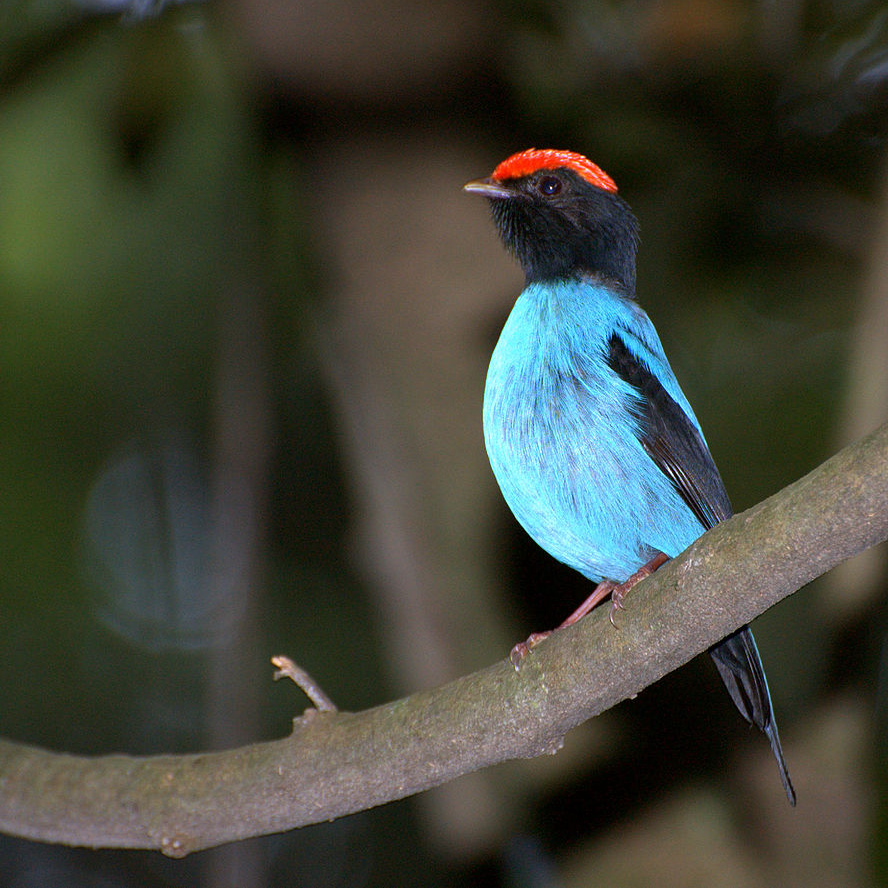
Blue-rumped Manakin
Lepidothrix isidorei
Order: Passeriformes / Family: Pipridae

Wikimedia Commons
About the Blue-rumped Manakin
The Blue-rumped Manakin (Lepidothrix isidorei) is a charismatic bird that captivates with its vibrant colors and intricate courtship displays. Found primarily in the humid montane forests of the Andes, this species plays a vital role in the ecosystem as both a pollinator and seed disperser. The male's electric blue rump and velvety black body contrast starkly with the subtler coloration of the female, who sports more muted greens and yellows. The species is found in Colombia, Ecuador, and Peru, where its presence signals the health of the subtropical forest ecosystems it inhabits. These birds are generally non-migratory, although they may undertake altitudinal movements following seasonal fruit availability. Often seen flitting through the understory, the Blue-rumped Manakin contributes significantly to forest regeneration by consuming a variety of fruits and indirectly aiding in seed dispersal. The importance of the Blue-rumped Manakin to its ecosystem cannot be overstated. Besides its role in seed dispersal, the bird's feeding habits aid in maintaining plant diversity within its habitat. As it forages, it also serves as a pollinator for several plant species. This relationship highlights the interconnectedness of tropical forest species, with the manakin acting as a crucial link in the ecological chain. The Blue-rumped Manakin's presence in forested regions is often seen as an indicator of biodiversity health, as these birds are sensitive to habitat degradation. In recent years, conservationists have focused on preserving the habitats of these and other Andean birds, recognizing their ecological importance. The Blue-rumped Manakin engages in fascinating seasonal behaviors, reflecting its adaptation to the dynamic forest environment. During the breeding season, males perform elaborate displays to attract females, which involve acrobatic flights and distinctive vocalizations. These displays not only serve as courtship rituals but also reinforce social hierarchies within male groups. Outside of breeding season, Blue-rumped Manakins may form small feeding flocks, often joining mixed-species groups that traverse the forest in search of food. These seasonal adaptations help the species thrive in an ever-changing environment, showcasing their resilience and adaptability.
The Blue-rumped Manakin belongs to the family Pipridae, within the order Passeriformes. These birds typically live average 6-8 years..
How to Identify a Blue-rumped Manakin
The Blue-rumped Manakin is a small bird with a compact build, measuring approximately 9-10 cm in length. Adult males are strikingly colored, with a deep black body contrasted by a bright blue rump and crown. Their eyes are a vivid red, adding to their dramatic appearance. Females, on the other hand, are less conspicuous, displaying an olive green plumage that provides effective camouflage in the dense foliage. Juveniles resemble females but may have slightly duller coloration. Male and female Blue-rumped Manakins exhibit sexual dimorphism, making them relatively easy to distinguish. The males' vibrant plumage and unique coloration make them unmistakable, whereas females and juveniles may be confused with other green-plumaged species in the forest understory. However, the male's distinctive blue rump and crown are key identifying features that set them apart. In flight, the Blue-rumped Manakin's silhouette is compact, with short, rounded wings and a short tail, contributing to its highly maneuverable flight style. When perched, these birds often adopt an upright posture, showcasing their vibrant rump to potential mates and rivals. This posture, combined with their striking coloration, makes them highly visible during courtship displays.
Having trouble telling birds apart? Upload a photo to our bird identification tool for an instant species match.
Blue-rumped Manakin Habitat and Range
Preferred Habitat
The Blue-rumped Manakin inhabits the subtropical and tropical montane forests of the Andes, thriving at elevations typically ranging from 500 to 2000 meters. These birds prefer dense, humid forests with a rich understory, which provides ample foraging opportunities and protection from predators. They are most commonly found in regions with a high degree of forest cover, such as the cloud forests of Colombia, Ecuador, and Peru. While primarily forest-dwelling, Blue-rumped Manakins may occasionally venture into more open areas adjacent to their forest habitats, particularly if food sources are abundant. However, they are generally absent from urban areas and heavily disturbed landscapes. Seasonal habitat shifts are minimal, as these birds are largely non-migratory. Instead, they may move altitudinally, ascending or descending within their range to follow the fruiting cycles of key plant species. This adaptability allows them to exploit different microhabitats within the forest, ensuring their survival in a dynamic environment.
Geographic Range
The Blue-rumped Manakin is native to the Andean regions of Colombia, Ecuador, and Peru, where it occupies a relatively restricted range. Its distribution corresponds closely with the montane forests that line the eastern slopes of the Andes, a region characterized by high biodiversity and complex ecosystems. Within this range, the Blue-rumped Manakin exhibits a patchy distribution, often concentrated in areas with optimal habitat conditions such as dense understory and abundant fruit-bearing plants. The bird's range does not extend significantly into lowland areas, and it remains absent from the Amazon basin. Due to its preference for specific forest types, the Blue-rumped Manakin is not found in regions with extensive deforestation or habitat fragmentation. Although it is non-migratory, the species may undertake short-distance altitudinal movements in response to seasonal variations in food availability. These movements are generally limited to its established range, ensuring that populations remain concentrated within their core habitat zones.
Want to know which birds visit your area? Browse our backyard birds by location guides for region-specific species lists.
What Does the Blue-rumped Manakin Eat?
The diet of the Blue-rumped Manakin primarily consists of fruits, which it forages for in the understory of dense forests. It shows a preference for small, fleshy fruits, which it plucks while hovering or perching on slender branches. The manakin plays a crucial role in seed dispersal, as it consumes a variety of fruit species and passes the seeds through its digestive system, aiding in forest regeneration. In addition to fruits, the Blue-rumped Manakin occasionally supplements its diet with small insects and other invertebrates, particularly during the breeding season when protein demands increase. The bird employs a flycatching technique to capture these prey items, snapping them up in mid-air with agile flights. Seasonal changes in fruit availability influence the manakin's diet, prompting it to shift its foraging behavior and target different plant species throughout the year. This flexibility in diet helps the Blue-rumped Manakin maintain its energy needs despite fluctuations in food resources.
Blue-rumped Manakin Behavior and Social Structure
The Blue-rumped Manakin exhibits a fascinating array of behaviors, particularly during the breeding season when males engage in elaborate courtship displays to attract females. These displays involve acrobatic flights, wing snaps, and vocalizations, all designed to showcase the male's fitness and secure a mate. Males often gather in leks, where they compete for the attention of visiting females. This social structure fosters intense competition among males, with the most successful performers securing the highest number of mates. Outside of the breeding season, Blue-rumped Manakins display a more solitary lifestyle, although they may occasionally join mixed-species flocks to forage. These flocks offer safety in numbers and increased foraging efficiency as the birds move through the forest in search of food. The Blue-rumped Manakin is generally non-territorial, focusing instead on maintaining access to key resources such as food and lekking sites. In response to predators, these birds rely on their agility and dense forest cover to evade capture. They are most active during daylight hours, with peak activity occurring in the early morning and late afternoon when temperatures are cooler and food availability is high.
Blue-rumped Manakin Nesting and Reproduction
Blue-rumped Manakins construct small, cup-shaped nests, carefully woven from fine plant fibers, moss, and spider silk. These nests are strategically placed in the fork of a slender branch, typically 1 to 3 meters above the ground, providing both camouflage and protection from ground predators. Females are solely responsible for nest construction, choosing discreet locations within dense foliage to reduce the risk of predation. The typical clutch size is two eggs, which are incubated by the female for about 18-21 days. During this period, the female remains highly attentive, rarely leaving the nest except to forage. Once the eggs hatch, the female continues to provide care for the nestlings, feeding them a diet rich in fruits and insects to ensure rapid growth. The fledging period lasts approximately 15-20 days, after which the young birds leave the nest, although they may remain dependent on the female for a short period before becoming fully independent. The Blue-rumped Manakin typically raises one to two broods per year, with breeding efforts closely tied to the availability of food resources.
Blue-rumped Manakin Sounds and Vocalizations
The primary song of the Blue-rumped Manakin is a series of high-pitched, melodic notes delivered in rapid succession. This song serves both as a territorial call and as part of the male's courtship display. The rhythm is complex, with a lively tempo that captures the attention of nearby females. In addition to their songs, Blue-rumped Manakins produce a variety of call notes, including sharp, metallic 'chip' sounds used for communication within flocks. Alarm calls are less frequent but consist of abrupt, harsh notes signaling the presence of predators. During the dawn chorus, the Blue-rumped Manakin contributes to the forest soundscape with its distinctive vocalizations, joining other bird species in a symphony that marks the beginning of the day.
Interesting Facts About the Blue-rumped Manakin
- 1The Blue-rumped Manakin's courtship display includes a unique dance where males leap into the air and snap their wings to create a popping sound.
- 2Blue-rumped Manakins have a lekking system where multiple males display in close proximity, making competition intense and visually impressive.
- 3Despite their vibrant colors, Blue-rumped Manakins are often difficult to spot due to their preference for dense forest interiors.
- 4The bright blue coloration of the male Blue-rumped Manakin is not due to pigments but structural coloration, reflecting light in specific ways.
- 5Researchers have documented Blue-rumped Manakins engaging in cooperative lekking, where subordinate males assist a dominant male in displays.
- 6The Blue-rumped Manakin's diet of fruits makes it a key seed disperser, helping to maintain plant diversity in the Andean forests.
- 7These birds are known for their acrobatic flight, which aids in both foraging and complex courtship displays.
Blue-rumped Manakin Conservation Status
The Blue-rumped Manakin is currently listed as 'Least Concern' by the IUCN, with populations considered stable across its range. However, habitat loss due to deforestation and land conversion remains a primary threat to its long-term survival. Conservation efforts focus on preserving key habitats within the montane forests of the Andes, emphasizing the protection of regions with high biodiversity. Historical population changes have been influenced by both natural and anthropogenic factors, with some areas experiencing declines due to logging and agricultural expansion. Despite these challenges, local and international conservation organizations continue to work towards sustainable management practices that benefit the Blue-rumped Manakin and other forest-dependent species.