
Bolivian Slaty-Antshrike
Thamnophilus sticturus
Order: Passeriformes / Family: Thamnophilidae

Wikimedia Commons
About the Bolivian Slaty-Antshrike
The Bolivian Slaty-Antshrike (Thamnophilus sticturus) is a captivating bird species endemic to Bolivia, particularly thriving in the subtropical and tropical moist lowland forests of the region. This bird belongs to the Thamnophilidae family, which is renowned for its role in controlling insect populations within its ecosystem. The Bolivian Slaty-Antshrike plays a crucial ecological role as an insectivore, preying primarily on ants, beetles, and other small invertebrates. This diet not only keeps insect populations in check but also aids in forest health maintenance by reducing herbivory pressure on plants. Endemic to Bolivia, this antshrike is predominantly found in the departments of La Paz, Beni, and Cochabamba, where it inhabits dense understories of primary and secondary forests. Often seen foraging in mixed-species flocks, the Bolivian Slaty-Antshrike is an integral part of the forest bird community, contributing to the diversity and stability of its habitat. Seasonal variations influence its behavior and range, with slight altitudinal migrations observed in response to food availability. During the wet season, when insect abundance peaks, these birds are more frequently observed foraging in lower forest strata. In contrast, the dry season may prompt them to explore higher elevations or more varied habitats. Their presence is particularly significant in areas undergoing rapid deforestation, as they serve as indicators of forest health. Conservation of their natural habitats is vital to preserving the ecological balance and biodiversity of the regions they inhabit.
The Bolivian Slaty-Antshrike belongs to the family Thamnophilidae, within the order Passeriformes. These birds typically live average 4-6 years, with a maximum recorded of 8 years..
How to Identify a Bolivian Slaty-Antshrike
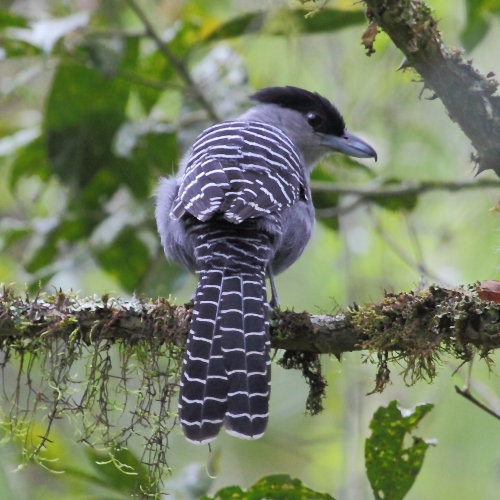
The Bolivian Slaty-Antshrike is a medium-sized bird characterized by its distinct slaty-gray plumage, which provides excellent camouflage among the forest understory. Adult males exhibit a deep gray coloration with a slightly darker crown and nape, while females have a more subdued appearance with brownish tones on their underparts. Juveniles display a mix of both parents' colors, with mottled gray and brown feathers. One distinguishing feature of this species is its slightly curved, stout bill, adapted for probing into bark and leaf litter for insects. In flight, the Bolivian Slaty-Antshrike reveals broad, rounded wings that facilitate maneuvering through dense foliage. Perched, it maintains an upright posture, often flicking its tail as it surveys its surroundings. When compared to similar species, the Bolivian Slaty-Antshrike can be confused with the Plain Antvireo, but the latter lacks the distinctive slaty coloring and has a more uniform appearance. Field identification relies heavily on the bird's vocalizations and habitat, as its calls are unique within its range.
Having trouble telling birds apart? Upload a photo to our bird identification tool for an instant species match.
Bolivian Slaty-Antshrike Habitat and Range
Preferred Habitat
The Bolivian Slaty-Antshrike predominantly inhabits subtropical and tropical moist lowland forests, thriving in the dense understory where insect prey is abundant. This bird is typically found at elevations ranging from 200 to 1500 meters, with a preference for areas with ample leaf litter and fallen branches that host diverse arthropod communities. Seasonal habitat shifts are minimal, as the species tends to remain within forested areas year-round. However, during the dry season, it may occasionally venture into slightly more open or disturbed habitats, such as forest edges, to exploit alternative food sources. While primarily forest-dwelling, the Bolivian Slaty-Antshrike does not typically inhabit urban environments, preferring the shelter and resources provided by continuous forest cover. Its presence in rural areas is mostly confined to patches of intact forest or large tracts of secondary growth.
Geographic Range
The Bolivian Slaty-Antshrike is endemic to Bolivia, with its range confined to the country's tropical and subtropical regions. Notable populations exist in the departments of La Paz, Beni, and Cochabamba, where it inhabits the lowland and foothill forests. Its distribution is primarily centered around the Amazon Basin, with some records from the eastern slopes of the Andes. This species is non-migratory, maintaining a stable presence within its preferred habitats throughout the year. However, small-scale altitudinal movements may occur in response to seasonal changes in prey availability. Population density tends to be higher in undisturbed forest regions, particularly those with a well-developed understory and abundant insect prey. Conservation efforts focus on preserving these key habitats, as deforestation and land conversion pose significant threats to the species' range.
Want to know which birds visit your area? Browse our backyard birds by location guides for region-specific species lists.
What Does the Bolivian Slaty-Antshrike Eat?
The diet of the Bolivian Slaty-Antshrike consists primarily of insects, with ants, beetles, and spiders making up the bulk of its prey. It forages actively by gleaning insects from leaves, branches, and the forest floor, often employing a methodical, deliberate approach. Seasonal variations in diet are influenced by the availability of prey, with an increase in insect diversity during the wet season allowing for greater dietary breadth. The bird's foraging technique involves short, purposeful hops and brief flights within the understory, as it searches for hidden arthropods. The prey size typically ranges from small to medium, aligning with the bird's bill size and strength. Feeding occurs throughout the day, with peak activity observed during the early morning and late afternoon when insects are most active.
Bolivian Slaty-Antshrike Behavior and Social Structure
The Bolivian Slaty-Antshrike exhibits a largely solitary or paired lifestyle, forming monogamous bonds during the breeding season. Territorial behavior is pronounced, with males vigorously defending their chosen areas through vocalizations and displays. Courtship involves a series of complex interactions, including mutual feeding and synchronized movements, strengthening pair bonds. Although primarily solitary, these birds occasionally join mixed-species flocks, benefiting from the increased foraging opportunities and predator vigilance. In response to threats, the Bolivian Slaty-Antshrike employs cryptic behavior, freezing or retreating into dense cover. Daily activity patterns are diurnal, with a distinct peak in activity during the cooler morning hours, tapering off during the heat of midday. The bird remains relatively quiet outside the breeding season, with vocalizations primarily serving to maintain territory and contact between mates.
Bolivian Slaty-Antshrike Nesting and Reproduction
The nesting habits of the Bolivian Slaty-Antshrike involve constructing a cup-shaped nest made of twigs, leaves, and rootlets, often placed in low shrubs or saplings within the forest understory. The choice of nesting site emphasizes concealment and protection from predators, with nests typically situated 1 to 3 meters above ground. The female lays a clutch of 2 to 3 eggs, characterized by a pale background with darker speckles. Incubation duties are shared between both parents, lasting approximately 14 days until hatching. Once hatched, the chicks remain in the nest for about 11 to 14 days before fledging. Parental care continues post-fledging, with both parents actively involved in feeding and protecting the young. The species generally raises one brood per year, with breeding activity peaking during the early wet season when food resources are plentiful.
Bolivian Slaty-Antshrike Sounds and Vocalizations
The primary song of the Bolivian Slaty-Antshrike is a melodious series of clear, rising whistles, varying in pitch and rhythm, often described as a 'toot-toot-toot' sequence. This song serves both territorial and mate attraction purposes, resounding through the forest understory. In addition to its song, the bird produces a variety of call notes, including sharp 'chip' sounds used for communication between mates or to express alarm. Alarm calls are more abrupt and staccato, signaling potential threats to conspecifics. During the dawn chorus, the Bolivian Slaty-Antshrike's song is particularly prominent, contributing to the vibrant acoustic landscape of its forest habitat.
Interesting Facts About the Bolivian Slaty-Antshrike
- 1The Bolivian Slaty-Antshrike has a specialized bill shape that allows it to extract insects from tight crevices in bark and foliage.
- 2Unlike many antshrikes, the Bolivian Slaty-Antshrike often joins mixed-species flocks, benefiting from increased foraging efficiency.
- 3Its song is so distinct that experienced birders can identify its presence without visual confirmation, even in dense forest.
- 4During courtship, the male and female Bolivian Slaty-Antshrike engage in synchronized dances, showcasing their pair bond.
- 5This species is a vital component of its ecosystem, controlling insect populations and contributing to forest health.
- 6The Bolivian Slaty-Antshrike's nesting success is heavily dependent on the availability of dense understory vegetation for concealment.
- 7Despite its limited range, the Bolivian Slaty-Antshrike adapts well to secondary growth forests, demonstrating resilience in changing environments.
Bolivian Slaty-Antshrike Conservation Status
Currently, the Bolivian Slaty-Antshrike is listed as Least Concern by the IUCN, with its population considered stable. However, ongoing deforestation and habitat fragmentation pose significant threats to its future. Primary threats include agricultural expansion, logging, and infrastructure development, which reduce and degrade its natural habitat. Conservation efforts focus on protecting large tracts of forest and promoting sustainable land-use practices to ensure the species' long-term survival. Historical population data indicate relative stability, but continued habitat loss could jeopardize this trend. Monitoring and habitat preservation are essential for maintaining this species' ecological role and population health.
Other Thamnophilidae Species



Birds Similar to the Bolivian Slaty-Antshrike
These species are often confused with the Bolivian Slaty-Antshrike due to similar appearance or overlapping range.

