
Natterer's Slaty-Antshrike
Thamnophilus stictocephalus
Order: Passeriformes / Family: Thamnophilidae

Wikimedia Commons
About the Natterer's Slaty-Antshrike
The Natterer's Slaty-Antshrike (Thamnophilus stictocephalus) occupies a unique niche within the tropical forests of South America, particularly thriving in regions like the Amazon Basin. This bird plays a vital role in the ecosystem as an insectivore, helping to manage insect populations and thus contributing to the health of its habitat. The antshrike can often be found in dense understory vegetation where it forages for insects and other small invertebrates. This species is not only significant due to its ecological role but also because it serves as an indicator of the health of the forest environments it inhabits. The Natterer's Slaty-Antshrike shows some fascinating behaviors, especially during different seasons. During the breeding season, which aligns with the onset of the rainy season, it becomes particularly vocal and active, establishing territories and engaging in courtship displays. Outside of the breeding season, it may participate in mixed-species foraging flocks, a common strategy among birds in the dense forests of the Amazon to increase foraging efficiency and reduce predation risks. The bird's presence is crucial in the ecosystems of countries such as Brazil, Bolivia, and Peru, where these forests are most prevalent. The preservation of the Natterer's Slaty-Antshrike is intrinsically linked to the conservation of tropical forests, making it an ambassador for these vital ecosystems.
The Natterer's Slaty-Antshrike belongs to the family Thamnophilidae, within the order Passeriformes. These birds typically live average 4-6 years, with a maximum recorded of 9 years..
How to Identify a Natterer's Slaty-Antshrike
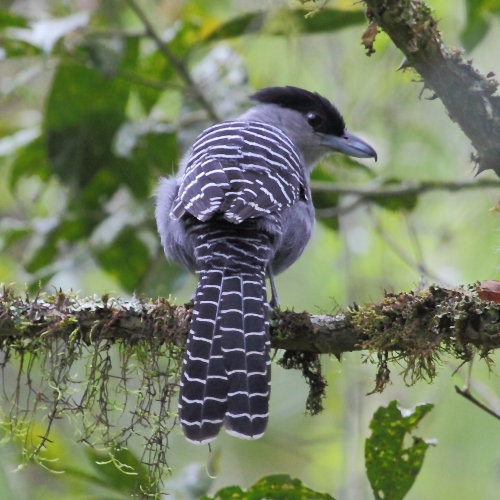
Identifying the Natterer's Slaty-Antshrike requires keen observation of its distinct field marks. Adult males boast a striking slate-gray plumage, providing excellent camouflage against the forest's shadows. In contrast, females present a more subdued coloration with brownish-gray tones and a slightly paler underside, which helps in differentiating the sexes. Juveniles resemble females but tend to have a more mottled appearance with streaks, especially on the chest. The antshrike's beak is relatively stout and hooked at the tip, a typical characteristic of the Thamnophilidae family, aiding in its insectivorous diet. A comparison with similar species, such as the Spot-winged Antshrike, reveals differences mainly in plumage patterns; the Natterer's lacks the conspicuous wing bars found in its relatives. In flight, the Natterer's Slaty-Antshrike exhibits a direct and somewhat labored flight pattern due to its short, rounded wings. When perched, it maintains a horizontal posture with a slightly raised tail, a posture that aids in its quick, darting movements through the understory.
Having trouble telling birds apart? Upload a photo to our bird identification tool for an instant species match.
Natterer's Slaty-Antshrike Habitat and Range
Preferred Habitat
The Natterer's Slaty-Antshrike primarily inhabits tropical lowland evergreen forests, favoring dense understory and edge habitats where it can easily forage for insects. It thrives at elevations ranging from sea level to about 900 meters, often venturing into secondary growth and overgrown clearings. This antshrike shows a preference for regions with substantial leaf litter and tangled vines, which provide ample cover and feeding opportunities. While predominantly a forest-dwelling species, it occasionally appears in more degraded habitats, demonstrating some adaptability. However, it remains absent from urban environments, underscoring its reliance on natural forested areas. During seasonal shifts, particularly with the onset of the rainy season, the Natterer's Slaty-Antshrike may move slightly to avoid flooded areas, though it remains within its preferred dense cover.
Geographic Range
The range of the Natterer's Slaty-Antshrike encompasses much of the Amazon Basin, with established populations found in Brazil, Bolivia, and Peru. Its breeding range is primarily confined to these countries, where it occupies vast tracts of continuous forest. The bird does not undertake significant migratory movements, instead exhibiting resident behavior throughout the year. Within its range, population densities are highest in regions with undisturbed forest cover, such as the central Amazon. In contrast, populations diminish towards the periphery of its range where habitat fragmentation is more common. Although it does not migrate, some local movements occur in response to seasonal flooding in the Amazon, prompting individuals to seek slightly higher ground.
Want to know which birds visit your area? Browse our backyard birds by location guides for region-specific species lists.
What Does the Natterer's Slaty-Antshrike Eat?
The diet of the Natterer's Slaty-Antshrike consists predominantly of insects and other small invertebrates, which it captures using a technique known as 'gleaning.' This method involves picking prey off leaves and branches while perched or during short flights. Its diet includes beetles, ants, spiders, and occasionally small lizards, with prey size usually small enough to be swallowed whole. The bird's foraging schedule peaks during the cooler hours of the morning and late afternoon, periods when prey is most active. Seasonal changes have little impact on its diet, though the abundance of certain prey types may vary, influencing its foraging strategy and success.
Natterer's Slaty-Antshrike Behavior and Social Structure
Socially, the Natterer's Slaty-Antshrike tends to be monogamous, maintaining territories that both partners defend vigorously. Territorial disputes often involve vocal displays and visual posturing. During courtship, males may perform displays that include wing fluttering and tail fanning to attract females. Outside the breeding season, the Natterer's Slaty-Antshrike often participates in mixed-species flocks, benefiting from the increased vigilance and foraging success these groups provide. When confronted with predators, the antshrike relies on its cryptic plumage and quick, evasive movements rather than aggressive defense. Its daily activity pattern sees peak activity during the early morning and late afternoon, aligning with cooler temperatures and greater prey availability.
Natterer's Slaty-Antshrike Nesting and Reproduction
The Natterer's Slaty-Antshrike builds a cup-shaped nest, constructed from fine plant materials such as grasses and leaves, and often lined with softer materials for insulation. Nests are typically placed low in shrubs or small trees, well-concealed within dense foliage. The clutch size generally consists of two to three eggs, which both parents incubate over a period of approximately 14-16 days. After hatching, chicks fledge in about 12-15 days, during which both parents actively feed and protect the young. The species typically raises one brood per year, although under favorable conditions, some pairs may attempt a second.
Natterer's Slaty-Antshrike Sounds and Vocalizations
The primary song of the Natterer's Slaty-Antshrike is a series of rapid, melodious whistles with a clear, descending pitch, often described as 'whee-whee-whee.' These vocalizations serve to establish territory and attract mates. In addition to its song, the bird emits sharp call notes, often heard as 'chip' or 'chack,' used for communication between mates and as alarm calls. During the dawn chorus, the antshrike's song becomes most prominent, contributing to the rich tapestry of forest sounds. Its calls, although repetitive, carry a unique quality that sets it apart from similar species.
Interesting Facts About the Natterer's Slaty-Antshrike
- 1The Natterer's Slaty-Antshrike is named after the German naturalist Johann Natterer, who collected specimens in South America.
- 2Despite its name, the Natterer's Slaty-Antshrike does not specialize in preying on ants but rather on a variety of insects.
- 3This antshrike's song can be heard up to 100 meters away, a necessary trait for effective territory establishment in dense forests.
- 4The Natterer's Slaty-Antshrike is known to follow army ant swarms, taking advantage of insects flushed out by the ants.
- 5Females of the species play a crucial role in territory defense, often engaging in vocal duets with their mates.
- 6The Natterer's Slaty-Antshrike has adapted to thrive in both primary and secondary forests, demonstrating considerable ecological flexibility.
- 7During courtship, males may present food items to females as part of their display, a behavior known as courtship feeding.
Natterer's Slaty-Antshrike Conservation Status
The Natterer's Slaty-Antshrike is currently listed as Least Concern by the IUCN, with its population considered stable. However, habitat loss due to deforestation and land conversion poses significant threats to its long-term survival. Conservation efforts focus on preserving large tracts of continuous forest to ensure the species' habitat remains intact. Historically, its population has fluctuated with changes in land use, highlighting the importance of sustainable forestry practices. Protected areas within its range have proven effective in safeguarding populations, though continued vigilance is necessary.
Other Thamnophilidae Species



Birds Similar to the Natterer's Slaty-Antshrike
These species are often confused with the Natterer's Slaty-Antshrike due to similar appearance or overlapping range.

