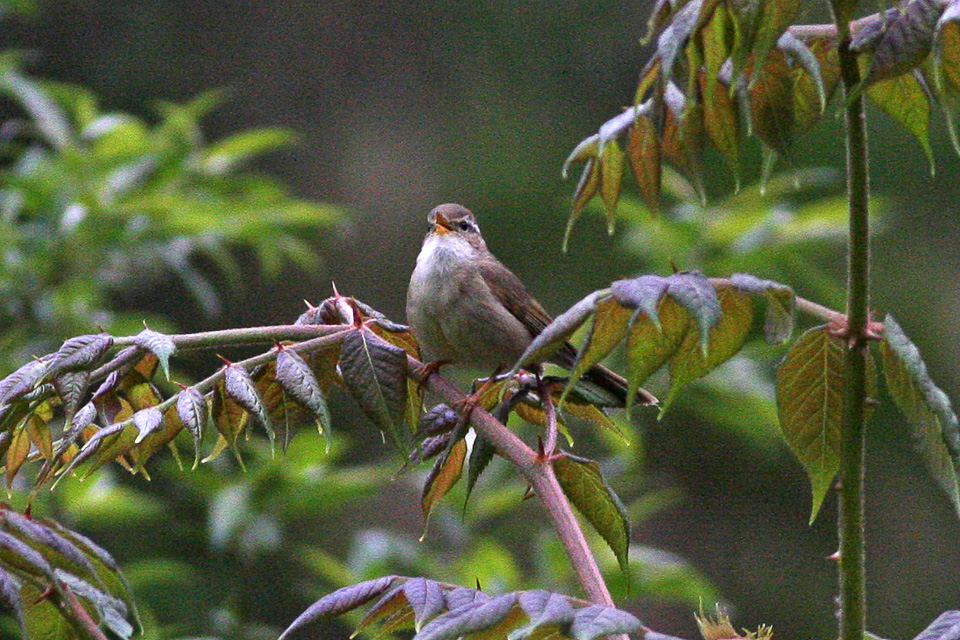
Brooks's Leaf Warbler
Phylloscopus subviridis
Order: Passeriformes / Family: Phylloscopidae

Wikimedia Commons
About the Brooks's Leaf Warbler
The Brooks's Leaf Warbler is a small passerine bird within the Phylloscopidae family, known for its striking green plumage and vibrant yellowish supercilium, which make it stand out among the dense foliage of its habitat. This species is primarily found in South Asia, including parts of Pakistan and northwestern India, particularly in regions such as the Himalayas where it thrives in temperate forests. The Brooks's Leaf Warbler plays an integral role in its ecosystem by controlling insect populations, as it primarily feeds on small invertebrates. In addition to its ecological role, this warbler is of particular interest to birdwatchers due to its elusive nature and melodious calls.
Seasonal behaviors of Brooks's Leaf Warbler include migration patterns that see it move to lower altitudes during the winter months. The bird breeds at higher elevations, often between 1,500 and 3,000 meters, where the cooler climate supports the growth of dense, leafy forests that provide ample food and nesting opportunities. Its preference for such specific habitats highlights the importance of preserving these environments amidst increasing deforestation pressures.
The Brooks's Leaf Warbler also contributes to the biodiversity of the regions it inhabits by acting as an indicator species for the health of forest ecosystems. Its presence or absence can reflect changes in habitat quality and availability, making it a valuable species for ecological monitoring. Additionally, as a member of the diverse Phylloscopus genus, it adds to the rich tapestry of avian diversity in South Asia, a region renowned for its birdlife.
The Brooks's Leaf Warbler belongs to the family Phylloscopidae, within the order Passeriformes. These birds typically live average 3-5 years, with a maximum recorded of 7 years..
How to Identify a Brooks's Leaf Warbler
Adult Brooks's Leaf Warblers are characterized by their bright green upperparts and pale underparts, with a distinct yellowish supercilium that distinguishes them from similar species. Their small size, typically around 10 centimeters in length, and their slender build make them agile fliers as well as adept at navigating dense foliage. Juveniles tend to have slightly duller plumage but retain the characteristic supercilium.
Both males and females share similar plumage, making gender differentiation challenging without close observation. This lack of sexual dimorphism is somewhat uncommon among warblers, where males often display brighter colors. In flight, the Brooks's Leaf Warbler exhibits a rapid and somewhat erratic flight pattern, often seen flitting from branch to branch in search of food.
Confusion with other Phylloscopus species, such as the Greenish Warbler, is possible due to their overlapping ranges and similar colorations. However, the Brooks's Leaf Warbler's distinct vocalizations and slightly more vibrant green hue help in accurate identification. When perched, this warbler often adopts a horizontal stance, which, combined with its vocal activity, can aid in field identification.
Having trouble telling birds apart? Upload a photo to our bird identification tool for an instant species match.
Brooks's Leaf Warbler Habitat and Range
Preferred Habitat
The Brooks's Leaf Warbler predominantly inhabits temperate and subtropical forests, with a strong affinity for broadleaf and mixed woodlands. These habitats, which provide abundant cover and food resources, are crucial for their survival. Within these forests, the warbler is most commonly found at elevations ranging from 1,500 to 3,000 meters, making it a bird of the mid to high altitudes.
During the breeding season, it favors dense, leafy canopies that offer protection and nesting sites, while in the winter, it may descend to lower elevations in search of milder climates. Unlike some other warblers, the Brooks's Leaf Warbler rarely ventures into urban areas, preferring the seclusion and resources of rural and forested environments.
Seasonal shifts in habitat are primarily altitude-based, with the bird moving to take advantage of the varying climates and food availability offered by different elevations throughout the year. This adaptability in habitat preference underscores the importance of diverse forest ecosystems in supporting its populations.
Geographic Range
The Brooks's Leaf Warbler is native to South Asia, with its breeding range concentrated in the northwestern regions of the Indian subcontinent. It is predominantly found in Pakistan and northern India, where it occupies the temperate forests of the Himalayan foothills. The bird's breeding range is closely aligned with the availability of suitable forest habitats in these mountainous regions.
During the non-breeding season, the warbler migrates to lower altitudes, often within the same geographical area, extending its range slightly southward. This altitudinal migration helps it avoid the harsher conditions of higher elevations during winter months. Although its range is relatively restricted compared to some other Phylloscopus species, within its preferred ecosystem, it can be locally common, especially in areas with extensive forest cover.
Population density hotspots include parts of the Indian states of Himachal Pradesh and Uttarakhand, where suitable habitats are abundant. These regions provide the optimal conditions for the Brooks's Leaf Warbler, supporting its life cycle needs throughout the year.
Want to know which birds visit your area? Browse our backyard birds by location guides for region-specific species lists.
What Does the Brooks's Leaf Warbler Eat?
The Brooks's Leaf Warbler primarily subsists on a diet of insects and other small invertebrates, playing a crucial role in controlling pest populations within its habitat. Common prey items include caterpillars, beetles, and various arthropods, which it gleans from the foliage using its agile movements and keen eyesight.
During the breeding season, the warbler's diet may shift slightly as it requires more protein to support reproductive activities. The abundance of insects during this period aligns well with its increased nutritional needs. In the winter months, when insect availability may decrease at higher elevations, the warbler descends to lower altitudes where it continues to forage actively.
Foraging techniques include flitting energetically through branches and occasionally hovering to pick insects off leaves. The bird is predominantly diurnal in its feeding habits, with peak activity occurring in the early morning and late afternoon when insect activity is highest. This consistent foraging behavior underscores its role as an insectivore within its ecosystem.
Brooks's Leaf Warbler Behavior and Social Structure
Brooks's Leaf Warblers exhibit a solitary or paired social structure, particularly during the breeding season when territorial behaviors are most pronounced. Males establish and defend territories through vocal displays and physical posturing, ensuring access to resources and attracting mates.
Courtship displays include a combination of song and subtle flight patterns designed to demonstrate vitality and appeal to potential partners. Once paired, both male and female engage in nest-building and rearing of young, displaying a moderate level of parental cooperation uncommon in many warblers.
Outside the breeding season, Brooks's Leaf Warblers may join mixed-species foraging flocks, which offer increased protection from predators and enhanced foraging efficiency. Their response to predators includes a suite of alarm calls and evasive flight maneuvers designed to alert conspecifics and evade capture.
Daily activity patterns are largely diurnal, with peak activity during the cooler hours of the day. During these times, the warbler is most vocal, using its song to communicate and establish its presence within the habitat.
Brooks's Leaf Warbler Nesting and Reproduction
The Brooks's Leaf Warbler constructs a neat, cup-shaped nest composed of grasses, moss, and fine twigs, often lined with softer materials such as feathers. Nest sites are typically concealed within dense foliage or low shrubs, providing protection from predators and environmental elements.
Preferred nesting locations include the forks of small branches or in the dense undergrowth of temperate forests. Clutch sizes generally range from 4 to 6 eggs, with the female primarily responsible for incubation over a period of roughly 12 to 14 days.
After hatching, both parents share in feeding and caring for the chicks, which fledge approximately two weeks post-hatching. The family group remains together for some time after fledging, allowing the young to develop essential survival skills. In a typical year, Brooks's Leaf Warblers may raise one or two broods, depending on environmental conditions and resource availability.
Brooks's Leaf Warbler Sounds and Vocalizations
The primary song of the Brooks's Leaf Warbler is a series of high-pitched, melodious notes that rise and fall in a rhythmic sequence, somewhat reminiscent of a musical trill. This song serves as both a territorial marker and a mating call, particularly prominent during the breeding season.
Call notes include a sharp 'tseep' or 'chit,' often used to maintain contact with mates or signal alarm. Alarm calls are more urgent and rapid, designed to alert nearby birds to potential threats. During the dawn chorus, the Brooks's Leaf Warbler contributes a distinctive, repetitive sequence that can be heard echoing through the forest.
Compared to other Phylloscopus species, the Brooks's Leaf Warbler's song is slightly more varied and complex, which can aid in field identification by experienced birders familiar with its vocal repertoire.
Interesting Facts About the Brooks's Leaf Warbler
- 1The Brooks's Leaf Warbler was first described scientifically in 1872, highlighting its long-standing recognition among ornithologists.
- 2Despite its small size, the Brooks's Leaf Warbler travels significant distances during its altitudinal migrations, adapting to seasonal changes.
- 3The species is named in honor of William Edwin Brooks, a notable 19th-century ornithologist who contributed extensively to Indian bird studies.
- 4Brooks's Leaf Warblers are known for their energetic foraging techniques, often capturing insects in mid-air with impressive agility.
- 5Their distinct yellow supercilium not only aids in identification but also plays a role in intraspecific communication during mating displays.
- 6Unlike many warblers, the Brooks's Leaf Warbler does not exhibit significant sexual dimorphism, making field identification of gender challenging.
- 7During the breeding season, males sing continuously to establish and defend their territory, often engaging in vocal duels with rivals.
Brooks's Leaf Warbler Conservation Status
The Brooks's Leaf Warbler currently holds a status of Least Concern on the IUCN Red List, with populations considered stable across its range. However, ongoing threats such as habitat degradation and deforestation pose significant risks to its preferred forest environments. Conservation efforts focus on habitat preservation, particularly in the Himalayan regions where forest cover is rapidly diminishing. These efforts include the establishment of protected areas and community-based forest management programs aimed at sustainable resource use. Historically, the population of Brooks's Leaf Warbler has remained relatively stable, though localized declines have been noted in areas with extensive habitat disturbance. Continued monitoring and conservation initiatives are crucial to ensuring the long-term viability of this species within its native range.