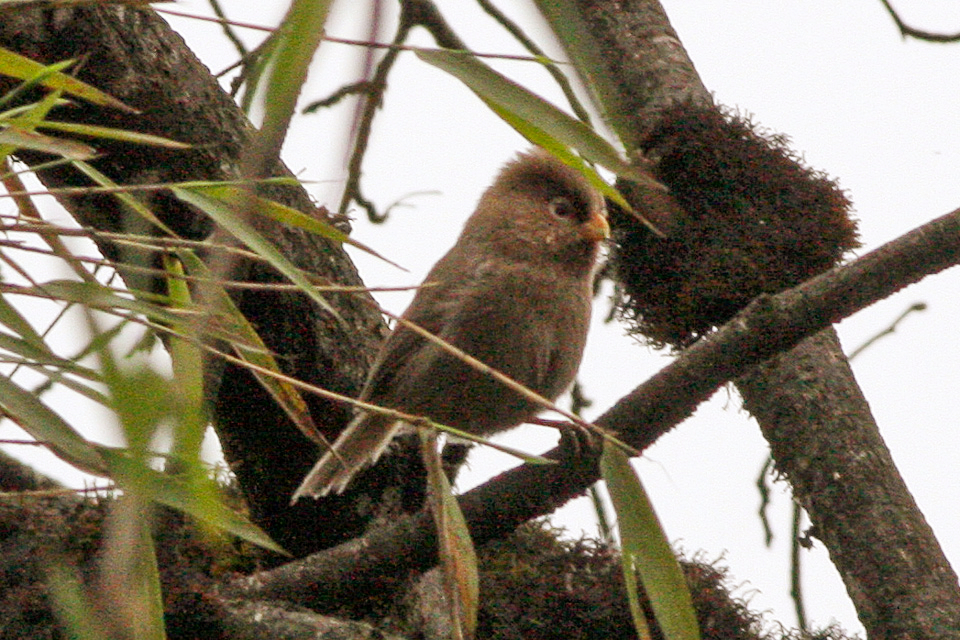
Brown-winged Parrotbill
Sinosuthora brunnea
Order: Passeriformes / Family: Sylviidae

Wikimedia Commons
About the Brown-winged Parrotbill
The Brown-winged Parrotbill, scientifically known as Sinosuthora brunnea, is a small passerine bird belonging to the family Sylviidae. It is predominantly found in the subtropical and temperate forests of Southeast Asia, with a significant presence in countries such as China, Myanmar, and Vietnam. This bird prefers dense understory vegetation, often inhabiting bamboo thickets and secondary growth forests where it can forage and nest with relative safety from predators.
Ecologically, the Brown-winged Parrotbill plays a crucial role in its habitat. It contributes to seed dispersal and insect population control, which helps maintain a balanced ecosystem. The bird's presence is often a good indicator of forest health, as it requires a rich diversity of flora for food and nesting. During the breeding season, which typically spans from March to July, these birds are particularly vocal as they establish territories and attract mates.
The Brown-winged Parrotbill's adaptability to various forest conditions enhances its ecological significance. While primarily a resident species, some populations may exhibit altitudinal migration, moving to lower elevations during colder months. This movement helps sustain their populations across diverse environments. As a species not currently facing significant conservation threats, the Brown-winged Parrotbill continues to thrive in its preferred habitats, contributing to the biodiversity of the regions it inhabits.
The Brown-winged Parrotbill belongs to the family Sylviidae, within the order Passeriformes. These birds typically live average 5-7 years with a maximum recorded of 9 years.
How to Identify a Brown-winged Parrotbill
The Brown-winged Parrotbill is a small bird, measuring approximately 14 cm in length. Its most striking feature is its chestnut-brown wings, which contrast with its otherwise grayish-brown plumage. The head is marked by a pale supercilium and a darker eye stripe, giving it a distinctive facial pattern. Adults have a short, stout bill that is well-suited for their diet of seeds and insects.
Juveniles resemble adults but may present slightly duller coloration and less distinct facial markings. Male and female Brown-winged Parrotbills are similar in appearance, making sex differentiation in the field challenging without closer observation during the breeding season, when behavioral cues are more evident.
In flight, the Brown-winged Parrotbill exhibits a rapid, fluttering wingbeat. Its perching posture is upright, often with a slight forward lean as it clings to stems and branches within dense vegetation. The bird can be confused with other parrotbill species, but the unique combination of its wing coloration and facial markings helps distinguish it from relatives.
Having trouble telling birds apart? Upload a photo to our bird identification tool for an instant species match.
Brown-winged Parrotbill Habitat and Range
Preferred Habitat
The Brown-winged Parrotbill thrives in subtropical and temperate forests, particularly favoring areas with dense understory and bamboo thickets. It is commonly found at elevations ranging from 300 to 2500 meters, adjusting its habitat preference based on seasonal climate changes. During colder months, the bird may descend to lower elevations, seeking warmer environments with abundant food supplies.
While it predominantly resides in rural forested regions, the Brown-winged Parrotbill can sometimes be spotted in semi-urban areas where suitable vegetative cover exists. Its presence in these varied habitats highlights its adaptability and underscores the importance of habitat conservation for its continued survival.
Geographic Range
The Brown-winged Parrotbill is native to Southeast Asia, with a distribution that includes southern China, Myanmar, Thailand, Laos, and Vietnam. Within these regions, it occupies specific areas like the Yunnan province in China and the Annamite Range spanning Laos and Vietnam. The species is largely sedentary, with some populations showing localized movements in response to climatic conditions.
While not known for extensive migratory behavior, the Brown-winged Parrotbill's range remains consistently populated throughout the year. Population densities are highest in regions with intact forest cover, where the bird can find ample resources for foraging and nesting. Conservation of these habitats is critical to maintaining viable populations across its range.
Want to know which birds visit your area? Browse our backyard birds by location guides for region-specific species lists.
What Does the Brown-winged Parrotbill Eat?
The diet of the Brown-winged Parrotbill primarily consists of seeds and small insects, which it forages for within the dense foliage of its forest habitat. During the breeding season, the bird's diet shifts slightly to include a higher proportion of protein-rich insects, supporting the nutritional needs of developing chicks.
Foraging behavior is active and methodical. The parrotbill moves through vegetation, often hanging upside down to reach hidden food sources. It displays a preference for bamboo seeds and small arthropods, such as caterpillars and beetles. Feeding typically occurs throughout the day, with peak activity in the early morning and late afternoon when temperatures are cooler.
Brown-winged Parrotbill Behavior and Social Structure
The Brown-winged Parrotbill exhibits a complex social structure, often seen in small, cohesive flocks outside of the breeding season. These flocks facilitate foraging efficiency and provide protection against predators. During the breeding season, pairs establish territories and demonstrate increased vocal activity to ward off rivals and attract mates.
Courtship displays involve a combination of vocalizations and physical posturing, with males often performing short flights and wing displays to entice females. The species is generally non-aggressive, with territorial disputes rarely escalating to physical confrontation. When faced with predators, the Brown-winged Parrotbill relies on its dense habitat for cover, often freezing or silently slipping away to avoid detection.
Daily activity patterns align with diurnal rhythms, with birds becoming most active at dawn and dusk. During these times, the parrotbill engages in foraging, preening, and social interactions.
Brown-winged Parrotbill Nesting and Reproduction
Brown-winged Parrotbills construct cup-shaped nests, typically positioned low in dense shrubbery or bamboo. They use materials like grasses, leaves, and small twigs, binding them together with spider silk for added stability. Nesting sites are often selected for their concealment, minimizing predation risks.
The female usually lays a clutch of 3 to 5 eggs, with both parents participating in incubation, which lasts approximately 12 to 14 days. After hatching, the chicks are altricial and rely heavily on parental care, receiving frequent feedings of insects for optimal growth. Fledging occurs about two weeks after hatching, although the young often remain under parental supervision for an extended period to learn essential survival skills. The Brown-winged Parrotbill typically raises one to two broods per year, depending on environmental conditions and food availability.
Brown-winged Parrotbill Sounds and Vocalizations
The vocal repertoire of the Brown-winged Parrotbill includes a series of high-pitched, melodic notes that are both rhythmic and varied in pitch. Its primary song consists of rapid sequences that can resemble the tinkling of small bells, often heard during the breeding season as males advertise their presence.
In addition to its song, the parrotbill emits sharp call notes used for communication within flocks. These calls serve as contact signals, helping maintain group cohesion. Alarm calls, characterized by a rapid, chattering sequence, alert others to potential threats. The species contributes to the dawn chorus, its song blending harmoniously with other forest inhabitants.
Interesting Facts About the Brown-winged Parrotbill
- 1The Brown-winged Parrotbill can often be seen hanging upside down as it forages, showcasing its acrobatic skills.
- 2Despite its small size, the Brown-winged Parrotbill's vocalizations can be remarkably loud, helping it communicate over long distances.
- 3This species' preference for bamboo thickets makes it an important player in the bamboo forest ecosystems of Southeast Asia.
- 4The Brown-winged Parrotbill's nesting strategy includes using spider silk to bind its nest materials, enhancing stability.
- 5Its diet includes bamboo seeds, which plays a role in seeding dispersal, contributing to forest regeneration.
- 6The Brown-winged Parrotbill is one of the few bird species that remain relatively unaffected by habitat fragmentation.
- 7Although primarily a forest dweller, the Brown-winged Parrotbill can sometimes adapt to semi-urban environments.
Brown-winged Parrotbill Conservation Status
Currently classified as Least Concern by the IUCN, the Brown-winged Parrotbill faces a stable population trend. However, habitat degradation due to deforestation poses a potential threat to its future. Conservation efforts focus on habitat preservation and management, ensuring the protection of the diverse ecosystems it inhabits. Historical records suggest that the species has maintained stable populations over recent decades, benefiting from its adaptability to various forest conditions. Continued monitoring and conservation initiatives are essential to prevent future declines, particularly in areas experiencing rapid environmental changes.