Buff-barred Warbler
Phylloscopus pulcher
Order: Passeriformes / Family: Phylloscopidae

Wikimedia Commons
About the Buff-barred Warbler
The Buff-barred Warbler (Phylloscopus pulcher) is a small, agile bird known for its vibrant plumage and active behavior in the dense forests of South and Southeast Asia. It plays a vital role in its ecosystem, acting as both predator and prey. The species thrives in subtropical and temperate forest habitats, where its presence indicates a healthy, biodiverse environment. Found primarily in countries like Nepal, Bhutan, and northern India, the Buff-barred Warbler spends much of its time foraging among the leaves and branches, contributing to pest control by consuming a large number of insects. During the breeding season, typically from April to July, the warbler becomes increasingly vocal and territorial, displaying its distinctive song to attract mates and defend its territory. In the winter, the Buff-barred Warbler may migrate slightly southwards or to lower elevations, adjusting its range according to food availability and climatic conditions. The warbler's adaptability to various forest types, from moist deciduous to mixed broadleaf forests, underscores its ecological importance. As a member of the Phylloscopidae family, it shares characteristics with other leaf warblers, such as a preference for high canopy vegetation and a diet rich in small invertebrates. Its presence across diverse geographical regions highlights the interconnectedness of these ecosystems and the need for comprehensive conservation efforts to protect such habitats from deforestation and climate change impacts.
The Buff-barred Warbler belongs to the family Phylloscopidae, within the order Passeriformes. These birds typically live averages 2-5 years in the wild..
How to Identify a Buff-barred Warbler
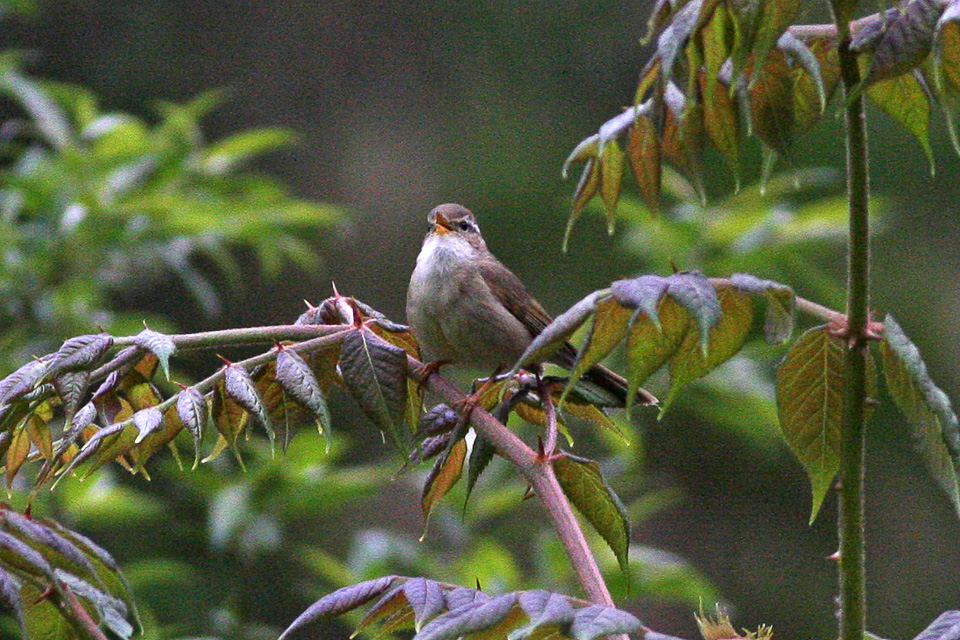
The Buff-barred Warbler is easily identifiable by its bright yellow wing bars, which contrast sharply with its olive-green upperparts and pale underparts. The adult's plumage is largely consistent across sexes, with both males and females exhibiting similar coloration, although males may appear slightly brighter during the breeding season. Juveniles, on the other hand, have a duller appearance, lacking the striking wing bars of adults. Observers may confuse the Buff-barred Warbler with the similar-looking Lemon-rumped Warbler, but the latter lacks the distinct buff-colored bars. In flight, the Buff-barred Warbler presents a compact silhouette, with rapid wingbeats and agile maneuvers that reflect its active foraging style. When perched, it maintains an upright posture, often flicking its wings and tail as it surveys its surroundings.
Having trouble telling birds apart? Upload a photo to our bird identification tool for an instant species match.
Buff-barred Warbler Habitat and Range
Preferred Habitat
The Buff-barred Warbler inhabits a range of forest types, including subtropical and temperate broadleaf forests. It thrives at elevations between 1,500 and 3,500 meters, where dense foliage provides ample insect prey and nesting sites. In regions like the Himalayas, it occupies mixed montane forests, preferring areas with a rich understory. During winter months, the warbler may descend to lower elevations or migrate to slightly warmer locales, though it largely remains within forested areas. While primarily a forest dweller, it occasionally ventures into wooded gardens and parks, especially during migration.
Geographic Range
The Buff-barred Warbler breeds across the Himalayan range, from Nepal and Bhutan to northern India and southern Tibet. In winter, it migrates to lower altitudes within its breeding range or moves southwards to parts of northeastern India and northern Myanmar. The warbler's migration is influenced by food availability and climatic conditions, ensuring that it remains within regions that provide suitable habitat year-round. Population densities are highest in the eastern Himalayas, where diverse forest ecosystems support a wide array of avian species.
Want to know which birds visit your area? Browse our backyard birds by location guides for region-specific species lists.
What Does the Buff-barred Warbler Eat?
Primarily insectivorous, the Buff-barred Warbler feeds on small insects and other invertebrates found in the foliage of trees and shrubs. Its diet varies seasonally, with a focus on caterpillars, spiders, and small beetles during the breeding season, when protein-rich food is essential for chick development. The warbler employs a gleaning technique, flitting quickly from branch to branch to pick insects off leaves. It forages actively throughout the day, taking advantage of peak insect activity during the morning and late afternoon. During leaner months, it may supplement its diet with small seeds and berries.
Buff-barred Warbler Behavior and Social Structure
The Buff-barred Warbler exhibits a solitary or paired lifestyle, particularly during the breeding season when it becomes highly territorial. Males perform elaborate courtship displays, singing vigorously to defend their territory and attract females. These vocalizations are a key component of their social behavior, used to communicate and deter rivals. Outside of breeding, the warbler may participate in mixed-species foraging flocks, benefiting from communal vigilance against predators. Diurnal by nature, it is most active during the early morning and late afternoon, when it engages in foraging and social interactions. When faced with predators, it relies on its agility and cryptic coloration to evade capture.
Buff-barred Warbler Nesting and Reproduction
Buff-barred Warblers construct cup-shaped nests using fine twigs, grasses, and moss, typically placing them in dense foliage to conceal them from predators. These nests are often located at mid-canopy level in trees or shrubs. The female lays a clutch of 3 to 5 eggs, which she incubates for about 12 to 14 days. During this period, the male may assist in defending the territory. Once hatched, the chicks remain in the nest for approximately 10 to 12 days before fledging. Both parents contribute to feeding the young, which are fed a diet rich in insects. The species usually raises one brood per year, although favorable conditions may allow for a second.
Buff-barred Warbler Sounds and Vocalizations
The Buff-barred Warbler's song is a rapid series of high-pitched notes, delivered with a clear and melodious rhythm. This song serves as both a territorial call and a courtship display. In addition to its primary song, the warbler emits a variety of call notes, including sharp 'tsee-tsee' sounds used to maintain contact with mates or signal alarm. During the dawn chorus, its vocalizations become particularly prominent, contributing to the symphony of sounds that marks the start of the day in its forest habitat.
Interesting Facts About the Buff-barred Warbler
- 1The Buff-barred Warbler can cover up to 20 kilometers a day searching for food during peak breeding season.
- 2Despite its small size, it plays a significant role in controlling insect populations, consuming hundreds daily.
- 3The warbler's vivid wing bars are an adaptation for signaling in dense forest environments.
- 4Buff-barred Warblers are known to join mixed-species flocks, enhancing foraging efficiency and predator avoidance.
- 5Their nests, often camouflaged with moss, are constructed to blend seamlessly into the surrounding foliage.
- 6During migration, they can be found at altitudes ranging from 500 to 3,500 meters, showcasing remarkable adaptability.
- 7The Buff-barred Warbler's song is one of the most recognizable in its range, often heard before the bird is seen.
Buff-barred Warbler Conservation Status
Currently, the Buff-barred Warbler is classified as 'Least Concern' by the IUCN, with a stable population trend. However, habitat loss due to deforestation and land conversion poses potential threats to its future. Conservation efforts focus on preserving forest habitats through protected areas and sustainable land management practices. Historically, the warbler's populations have remained relatively stable, benefiting from large tracts of undisturbed habitat in the Himalayan region. Continued vigilance is necessary to ensure that its populations do not decline due to human activities.