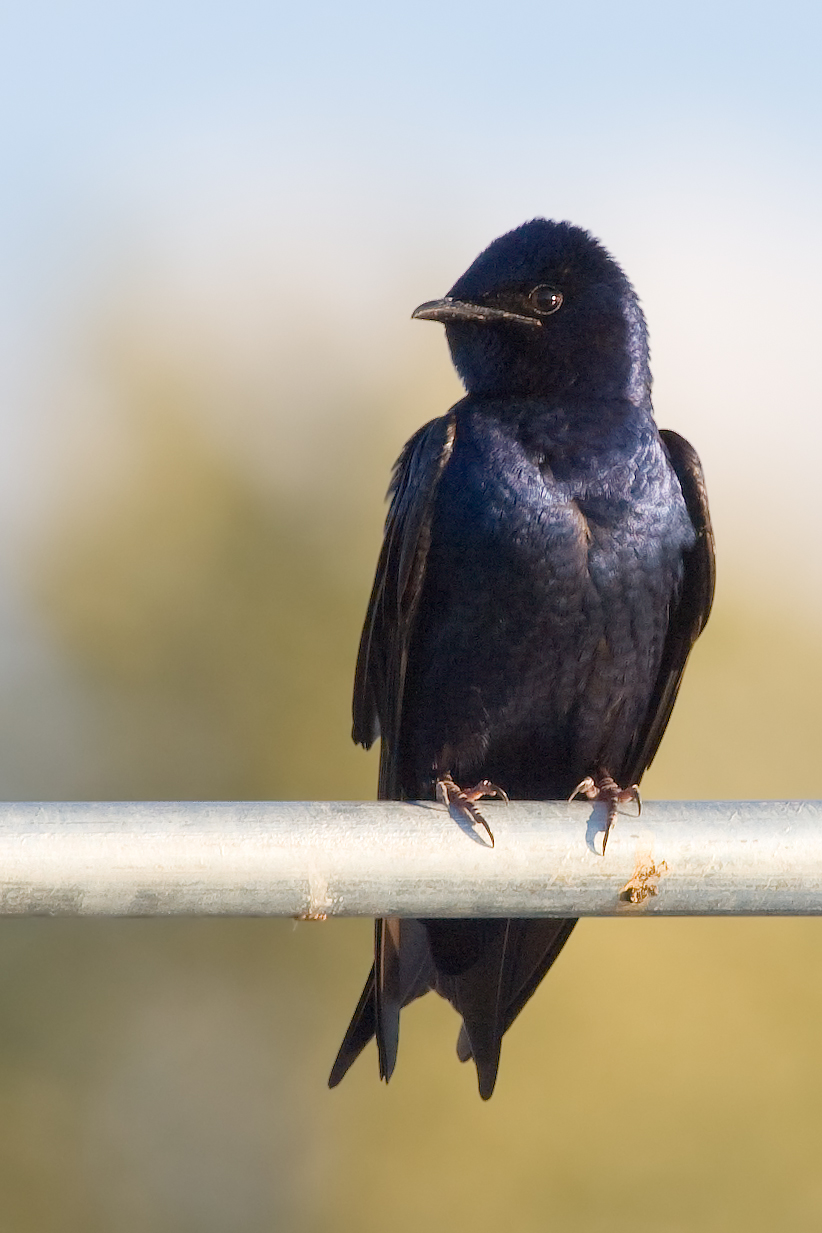
Caribbean Martin
Progne dominicensis
Order: Passeriformes / Family: Hirundinidae

Wikimedia Commons
About the Caribbean Martin
The Caribbean Martin, or Progne dominicensis, is a striking member of the swallow family Hirundinidae, easily recognized by its glossy blue-black plumage. This bird plays a significant ecological role as an aerial insectivore across its range. Endemic to the Caribbean, it is particularly abundant in the Greater Antilles. The Caribbean Martin thrives in open areas near water, including coastal regions, mangroves, and wetlands. It is also found in urban environments, where it capitalizes on the abundance of flying insects.
During the breeding season, which typically spans from March to August, Caribbean Martins establish territories in suitable habitats. They often nest in colonies, utilizing cavities in buildings, cliffs, or tree holes. The species exhibits a degree of adaptability, often benefiting from human-made structures that provide nesting opportunities. Outside of the breeding season, these birds may form flocks, moving to different areas within their range in pursuit of food.
The Caribbean Martin contributes significantly to the control of insect populations, feeding on a variety of flying insects. This feeding behavior aids in maintaining ecological balance in its habitats. Although not classified as threatened, the Caribbean Martin faces habitat loss due to urban development and deforestation. Conservation efforts focus on safeguarding critical habitats and promoting sustainable land-use practices to ensure the species' long-term survival.
The Caribbean Martin belongs to the family Hirundinidae, within the order Passeriformes. These birds typically live average 5-7 years, with a maximum recorded of 9 years..
How to Identify a Caribbean Martin
The Caribbean Martin is a medium-sized swallow, easily identified by its glossy blue-black plumage. Adult males exhibit a deep iridescent blue-black coloration across their entire bodies, contrasting with their lighter underparts. Females and juveniles display a more muted appearance, with grayish-white underparts and less intense blue-black on their upperparts. Despite these differences, both sexes share the same sleek body shape and long, pointed wings that contribute to their agile flight.
In flight, the Caribbean Martin's silhouette is distinctive, with a slightly forked tail and rapid, graceful wing beats. When perched, these birds sit upright, often on exposed branches or wires, providing excellent views of their striking plumage. Confusion with other swallow species is possible, particularly with the Tree Swallow and Purple Martin. However, the Caribbean Martin's larger size and particular coloration help differentiate it from these species.
Juvenile Caribbean Martins can be particularly challenging to identify due to their more subdued plumage, but their size and flight pattern remain consistent indicators. Observers should note the contrast between the darker upperparts and lighter underparts, which remains a reliable field mark for both adults and juveniles.
Having trouble telling birds apart? Upload a photo to our bird identification tool for an instant species match.
Caribbean Martin Habitat and Range
Preferred Habitat
The Caribbean Martin inhabits a range of environments, favoring open areas close to water. Coastal regions, mangroves, and wetlands provide ideal conditions, offering abundant food resources and nesting sites. This species is also common in urban areas, where it utilizes man-made structures for nesting. In these settings, Caribbean Martins often nest in buildings, bridges, and other structures that mimic natural cavities.
While primarily a lowland species, the Caribbean Martin can be found at varying elevations, particularly in areas where suitable nesting sites are available. Seasonal habitat shifts occur as food availability changes, with birds moving to regions that support higher insect populations. This adaptability to diverse environments allows the species to thrive across its range.
In rural landscapes, these martins can be spotted over fields and open woodlands, where they forage for insects. Their presence in such diverse habitats highlights their ecological versatility and ability to exploit different environments throughout the year.
Geographic Range
The Caribbean Martin's range primarily encompasses the Caribbean islands, with populations established in the Greater Antilles, including Cuba, Hispaniola, and Puerto Rico. These islands serve as the core breeding grounds for the species. Some populations extend to the Lesser Antilles, although less frequently.
During the non-breeding season, Caribbean Martins may exhibit local movements within the islands, although they are generally considered non-migratory. They shift to areas with abundant food resources, often forming mixed flocks with other swallow species during this time.
Population density hotspots include urban centers where suitable nesting sites and food sources are concentrated. In these areas, the Caribbean Martin benefits from the abundance of insects drawn to artificial lighting, making urban environments particularly attractive. Despite their relatively limited range, the species is widespread within its core areas, adapting well to both natural and developed landscapes.
Want to know which birds visit your area? Browse our backyard birds by location guides for region-specific species lists.
What Does the Caribbean Martin Eat?
The Caribbean Martin primarily feeds on flying insects, which it catches deftly in mid-air. Its diet includes a variety of prey such as beetles, flies, and moths, which are abundant in its preferred habitats. The bird employs an agile and acrobatic flight style to pursue and capture these insects, often feeding in open areas near water where prey is plentiful.
Seasonal changes in prey availability can influence the diet of the Caribbean Martin, with shifts occurring as different insect species emerge. During the breeding season, the demand for food increases, prompting these birds to forage more frequently and over larger areas.
The size of the prey can vary, although the Caribbean Martin typically targets small to medium-sized insects. Foraging occurs throughout the day, with peaks often observed in the early morning and late afternoon when insect activity is highest. This opportunistic feeding strategy allows the Caribbean Martin to exploit a wide range of food sources, contributing to its success across diverse habitats.
Caribbean Martin Behavior and Social Structure
The Caribbean Martin exhibits a highly social structure, particularly evident during the breeding season when it forms colonies. These colonies, often located in places with abundant nesting sites, serve as the focal point for breeding activities. Within these groups, Caribbean Martins maintain territories that they defend from intruders, engaging in aerial chases and vocal displays to assert dominance.
Courtship displays involve elaborate aerial maneuvers, with males showcasing their agility and plumage to attract females. Once paired, the birds exhibit strong pair bonds, working together to construct nests and raise young. Outside of the breeding season, Caribbean Martins become more gregarious, forming flocks that can include hundreds of individuals.
In response to predators, such as raptors, these martins rely on their agile flight to evade capture. They may also engage in mobbing behavior, collectively harassing a predator to drive it away. Daily activity patterns are dictated by food availability, with the birds most active during the day and resting at night.
Caribbean Martin Nesting and Reproduction
Caribbean Martins nest in cavities, utilizing both natural and artificial structures. They often choose sites in cliffs, tree holes, or buildings, demonstrating adaptability in nesting preferences. The birds construct nests from twigs, grass, and mud, lining them with softer materials for insulation.
A typical clutch consists of 3 to 5 eggs, which are incubated primarily by the female for about two weeks. During this period, the male provides food to the female, allowing her to remain on the nest. Once hatched, the chicks grow rapidly, fledging about 28 days after hatching. Both parents participate in feeding and caring for the young, ensuring their survival through the demanding early stages of life.
Caribbean Martins usually produce one brood per year, although in favorable conditions, they may attempt a second. The choice of nesting site and materials can vary depending on local availability, reflecting the species' capacity to adapt to different environmental conditions.
Caribbean Martin Sounds and Vocalizations
The primary song of the Caribbean Martin is a series of melodious warbles and chirps, delivered in a rapid, rhythmic pattern. This song, often heard during the breeding season, serves to establish territory and attract mates. Call notes are sharp and distinct, used for communication among individuals, particularly within colonies.
Alarm calls are more urgent, comprising harsh and repetitive notes that alert other birds to potential threats. During the dawn chorus, Caribbean Martins join other avian species, contributing their voices to the morning soundscape. This behavior underscores their social nature and the importance of vocal communication in maintaining group cohesion.
The sound of the Caribbean Martin's song, while unique, can be compared to the chatter of other swallows, providing a familiar auditory cue for birdwatchers. These vocalizations are integral to their social interactions and play a crucial role in their daily lives.
Interesting Facts About the Caribbean Martin
- 1The Caribbean Martin can consume hundreds of insects in a single day, playing a vital role in controlling pest populations.
- 2This species often nests in colonies that can number up to 100 pairs, showcasing its highly social nature.
- 3Caribbean Martins are known to return to the same nesting sites year after year, demonstrating strong site fidelity.
- 4Unlike some other swallow species, Caribbean Martins are largely non-migratory, remaining in the Caribbean year-round.
- 5The glossy plumage of the Caribbean Martin helps it stand out among other swallows, particularly in sunlight.
- 6Caribbean Martins can be found in both urban and rural environments, highlighting their adaptability.
- 7Their impressive aerial displays are not only a courtship ritual but also a means of establishing territory.
Caribbean Martin Conservation Status
The Caribbean Martin is currently classified as Least Concern by the IUCN, with population trends considered stable. However, habitat loss due to urban expansion and deforestation poses ongoing threats. Conservation efforts aim to mitigate these impacts by protecting key habitats and promoting sustainable development practices. Historically, the species has shown resilience to environmental changes, adapting to urban landscapes and benefiting from artificial structures for nesting. Despite this adaptability, continued monitoring is essential to ensure that populations remain robust, particularly in areas facing rapid environmental change. Collaborative conservation initiatives in the Caribbean focus on habitat preservation, emphasizing the importance of preserving natural ecosystems that support not only the Caribbean Martin but a wide range of biodiversity.
Other Hirundinidae Species


Birds Similar to the Caribbean Martin
These species are often confused with the Caribbean Martin due to similar appearance or overlapping range.