
Cinereous Antshrike
Thamnomanes caesius
Order: Passeriformes / Family: Thamnophilidae

Wikimedia Commons
About the Cinereous Antshrike
The Cinereous Antshrike (Thamnomanes caesius) is a small but formidable bird native to the dense, humid forests of the Amazon Basin. This bird plays a critical role in the ecosystem as a specialized insectivore, often participating in mixed-species foraging flocks. These flocks are a quintessential feature of the Amazonian understory where the Cinereous Antshrike acts as a sentinel, alerting other birds to predators. Found primarily in lowland tropical rainforests, its range extends across northern South America, including countries like Brazil, Peru, Colombia, Venezuela, and Ecuador.
The ecological significance of the Cinereous Antshrike is immense. As a sentinel species, it influences the dynamics of avian communities, improving the feeding efficiency of its associates by offering warning calls. Its presence indicates a healthy, biodiverse forest, as it often declines in disturbed habitats. Seasonal behaviors include adaptations to fruiting and insect abundance, where dietary flexibility becomes essential during different times of the year. During the wet season, when insect populations surge, the Cinereous Antshrike expands its feeding repertoire, contributing to its survival and reproductive success.
This antshrike's role extends beyond avian communities. By controlling insect populations, it indirectly supports plant health and growth, showcasing the interconnectedness of rainforest ecosystems. The bird's adaptability to various forest strata, from understory to mid-canopy, makes it an integral part of its habitat. The Cinereous Antshrike exemplifies the complex interdependencies found within tropical rainforests and remains a species of interest for ecologists and ornithologists alike.
The Cinereous Antshrike belongs to the family Thamnophilidae, within the order Passeriformes. These birds typically live typically 5-8 years, with some individuals reaching up to 10 years..
How to Identify a Cinereous Antshrike
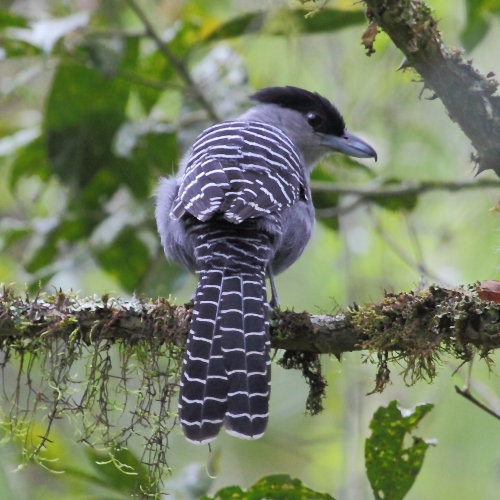
The Cinereous Antshrike can be recognized by its smooth gray plumage, which gives it its name. Males exhibit a consistent slate-gray color, while females have a slight brownish tint on their wings, offering a subtle distinction between the sexes. Juveniles resemble adults but display a duller coloration, making them less conspicuous in the dense foliage.
An important field mark is the bird's short, stout bill, which is adapted for its insectivorous diet. The eyes are distinctly pale, standing out against its dark face. In flight, the Cinereous Antshrike maintains a low profile, with a rounded tail and broad wings, providing agility within the forest understory. Its perching posture is slightly hunched, a common trait among Thamnomanes species.
Observers might confuse the Cinereous Antshrike with similar species like the Dusky-throated Antshrike. However, the latter tends to have a darker throat patch and a more rufous tone in its plumage. Recognizing these subtle distinctions is key for accurate identification in the field.
Having trouble telling birds apart? Upload a photo to our bird identification tool for an instant species match.
Cinereous Antshrike Habitat and Range
Preferred Habitat
The Cinereous Antshrike predominantly inhabits lowland tropical rainforests, thriving in the Amazon Basin's dense, humid foliage. It prefers the understory and mid-canopy layers, where it can effectively forage for insects. Typical habitats include terra firme and várzea forests, where seasonal flooding influences vegetation structure and food availability.
This species generally avoids open areas and heavily disturbed habitats, indicating its preference for mature forest environments. Its elevation range is typically below 1,000 meters, aligning with the Amazon's geographic and climatic conditions. Although primarily a forest dweller, the Cinereous Antshrike occasionally ventures into forest edges and secondary growth, provided there is sufficient cover.
The bird's presence in urban environments is rare, highlighting its reliance on extensive forest ecosystems. During the dry season, when resources become scarce, the antshrike may shift slightly within its habitat to areas with higher insect activity, showcasing its adaptability.
Geographic Range
The range of the Cinereous Antshrike encompasses the Amazon Basin, covering parts of northern South America. Key countries include Brazil, where it is widely distributed across the Amazon rainforest, as well as Peru, Colombia, Venezuela, and Ecuador. In these nations, it occupies vast tracts of primary and secondary forests.
Its breeding range coincides with its year-round habitat, as the species does not exhibit significant migratory behavior. However, local movements may occur in response to seasonal changes in food availability and habitat conditions. The Cinereous Antshrike's presence is most concentrated in the dense rainforest interiors, where it finds optimal foraging grounds.
Population density hotspots align with areas of undisturbed forest, indicating a preference for pristine environments. Regions like the Amazonian lowlands of northeastern Peru and the central Amazon Basin in Brazil are particularly abundant in this species, making them prime locations for avian studies and ecotourism.
Want to know which birds visit your area? Browse our backyard birds by location guides for region-specific species lists.
What Does the Cinereous Antshrike Eat?
The Cinereous Antshrike feeds primarily on insects, forming the core of its diet. Beetles, grasshoppers, and spiders are among its preferred prey, with occasional consumption of small vertebrates like lizards. This bird employs a sit-and-wait foraging technique, often perching quietly before darting out to capture unsuspecting prey.
Dietary shifts occur with seasonal changes, especially during the wet season when insect abundance peaks. During these times, the antshrike may expand its diet to include more diverse arthropods, optimizing its energy intake. Its role in mixed-species foraging flocks allows it to exploit a wider range of food sources, as it follows larger woodcreepers and tanagers that disturb insects.
Feeding primarily occurs during the early morning and late afternoon when insect activity is highest. This schedule maximizes feeding efficiency and minimizes competition, showcasing the bird's adaptability to its environment. Prey size generally ranges from small to medium, aligning with the bird's ability to handle various insects effectively.
Cinereous Antshrike Behavior and Social Structure
The Cinereous Antshrike exhibits a complex social structure, often participating in mixed-species flocks that traverse the Amazonian understory. Within these groups, it assumes a sentinel role, providing warning calls that elevate the collective vigilance against predators like hawks and snakes.
Territorial behavior is pronounced during the breeding season, when pairs aggressively defend their nesting sites from intruders. Courtship displays involve mutual feeding and vocalizations that strengthen pair bonds.
Flocking patterns vary with season, as the antshrike adapts to changing ecological pressures. During periods of plentiful food, it may reduce flock participation, foraging independently or in pairs. Response to predators is swift and coordinated, with alarm calls triggering a cohesive retreat.
Daily activity patterns include periods of intense foraging interspersed with intervals of rest. The bird is diurnal, with peak activity coinciding with insect availability. Its behavior underscores the importance of social interactions and adaptability in the dynamic rainforest environment.
Cinereous Antshrike Nesting and Reproduction
Cinereous Antshrikes build their nests in dense foliage, typically in the understory or mid-canopy layers. The nest is cup-shaped, constructed from twigs, leaves, and plant fibers, providing camouflage and protection from predators.
Preferred nest locations include the fork of a tree branch or within dense vines, ensuring stability and concealment. Clutch size usually comprises two eggs, which are white with brown speckles, blending seamlessly into the nest's surroundings.
The incubation period lasts approximately 14-16 days, with both parents sharing duties. After hatching, the chicks remain in the nest for about 12-14 days before fledging. Parental roles are shared, with both sexes involved in feeding and protecting the young.
The number of broods per year is typically one, reflecting the species' focus on ensuring the survival of each offspring. This nesting strategy is adapted to the unpredictable nature of rainforest environments, where resource availability can fluctuate.
Cinereous Antshrike Sounds and Vocalizations
The primary song of the Cinereous Antshrike is a series of sharp, metallic notes that are often repeated in rapid succession. This song serves both territorial and mating purposes, resonating through the dense forest understory.
Call notes are short, sharp 'chip' sounds that maintain contact within mixed-species flocks. Alarm calls differ, being harsher and more urgent, signaling the presence of predators.
The dawn chorus sees the Cinereous Antshrike contributing its distinctive voice, adding to the symphony of sounds typical of tropical forests. The rhythm and pitch of its calls are reminiscent of a bird tapping on a tin can, echoing through the lush environment.
Compared to other forest dwellers, its calls are notably consistent, aiding in identification even when the bird is not visible.
Interesting Facts About the Cinereous Antshrike
- 1The Cinereous Antshrike's role as a sentinel in mixed-species flocks highlights its importance in the ecosystem.
- 2Male and female Cinereous Antshrikes can be distinguished by subtle differences in plumage coloration.
- 3This antshrike's primary habitat is the Amazon Basin, a region known for its immense biodiversity.
- 4The Cinereous Antshrike's diet consists mainly of insects, showcasing its specialization as an insectivore.
- 5Unlike many birds, the Cinereous Antshrike remains in its range year-round, with no significant migratory behavior.
- 6Its vocalizations are a key feature, helping researchers identify it amidst the dense rainforest canopy.
- 7Conservation efforts for the Cinereous Antshrike focus on protecting its rainforest habitat from deforestation.
Cinereous Antshrike Conservation Status
The IUCN currently lists the Cinereous Antshrike as a species of Least Concern, reflecting a stable population trend. However, habitat destruction due to logging and agriculture poses significant threats to its long-term survival. Conservation efforts focus on preserving large tracts of tropical rainforest, essential for maintaining its habitat. Protected areas and reserves in the Amazon Basin are crucial for safeguarding this species. Historical population changes have been minimal, but ongoing deforestation could alter its status if not addressed. Conservationists advocate for sustainable land-use practices to mitigate habitat loss and ensure the continued existence of the Cinereous Antshrike in its natural environment.
Other Thamnophilidae Species



Birds Similar to the Cinereous Antshrike
These species are often confused with the Cinereous Antshrike due to similar appearance or overlapping range.

