
Saturnine Antshrike
Thamnomanes saturninus
Order: Passeriformes / Family: Thamnophilidae

Wikimedia Commons
About the Saturnine Antshrike
The Saturnine Antshrike, or Thamnomanes saturninus, inhabits the dense understory of tropical forests across South America. This bird is a member of the Thamnophilidae family, a group known for their ant-following behavior. Predominantly found in the Amazon Basin, its range extends through countries such as Brazil, Peru, and Bolivia. It plays a significant role in its ecosystem by participating in mixed-species foraging flocks, often serving as a sentinel for other birds. This antshrike's ecological role involves its interaction with swarming ants, as it capitalizes on the disturbance these insects cause to flush out hidden prey. Its presence in the ecosystem highlights the complex relationships between species in tropical environments.
The Saturnine Antshrike exhibits seasonal behaviors that reflect its adaptability to varying environmental conditions. During the rainy season, it may move deeper into the forest to exploit new foraging opportunities. Conversely, in the dry season, it tends to remain close to water sources, where insect prey remains abundant. These seasonal movements underscore the bird’s reliance on the availability of food resources and its adaptability to changing environmental conditions. Its role in mixed-species flocks becomes even more crucial during these times, as it helps maintain flock cohesion and enhances foraging success for all members involved.
The Saturnine Antshrike’s significance extends beyond its ecological contributions. As a bioindicator species, its presence or absence can signal changes in forest health and biodiversity. Conservationists and researchers often monitor its populations to gain insights into the impacts of deforestation and climate change on tropical ecosystems. The antshrike’s ability to thrive in undisturbed forests yet struggle in heavily altered landscapes makes it a key species for understanding the broader impacts of human activities on biodiversity in the Amazon Basin.
The Saturnine Antshrike belongs to the family Thamnophilidae, within the order Passeriformes. These birds typically live generally 5-7 years, with some individuals living up to 9 years..
How to Identify a Saturnine Antshrike
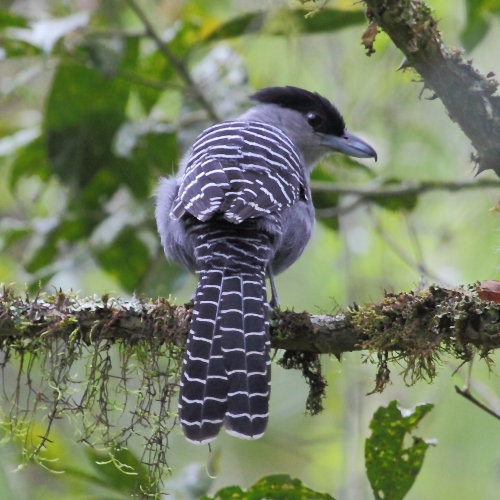
The Saturnine Antshrike can be identified by its slate-gray plumage, which provides excellent camouflage in the shadowy understory of tropical forests. Adult males and females exhibit similar coloring, although females may sometimes display slightly browner tones on the wings. The bird's plumage is uniform, lacking the contrasting patterns seen in some other antbird species, which aids in its stealthy movements through dense foliage. Juveniles resemble adults but are typically duller, with less defined coloration, which gradually becomes more pronounced as they mature.
In the field, the Saturnine Antshrike's silhouette is compact and stout, with a short tail and a slightly rounded head. Its perching posture is often horizontal, with the bird remaining motionless for extended periods as it scans for insects disturbed by ant swarms. This posture, combined with its muted coloration, makes it difficult to spot unless actively foraging or vocalizing. When in flight, the antshrike demonstrates a rapid, direct motion through the understory, rarely venturing into open spaces.
Confusion with similar species, such as the Cinereous Antshrike, is possible but can be resolved by noting the Saturnine’s slightly darker hue and more consistent slate-gray coloration. The Saturnine Antshrike's vocalizations also aid identification, as its calls are distinct from those of its close relatives, helping birders and researchers differentiate between similar-looking species in the field.
Having trouble telling birds apart? Upload a photo to our bird identification tool for an instant species match.
Saturnine Antshrike Habitat and Range
Preferred Habitat
The Saturnine Antshrike thrives in the humid lowland forests of the Amazon Basin, favoring areas with dense understory and ample cover. These forests provide the bird with a rich array of insect prey, particularly around swarming ant colonies. The species is typically found at elevations ranging from sea level to about 1,000 meters, preferring undisturbed primary forests over secondary or heavily logged areas.
Within these forests, the antshrike shows a preference for areas near water bodies, such as streams or rivers, particularly during drier periods. This habitat selection ensures a steady supply of insect prey even when other areas may become less productive. Although primarily a forest dweller, the Saturnine Antshrike occasionally ventures into adjacent shrubland or edge habitats, especially when participating in mixed-species flocks.
Urban environments do not typically support populations of Saturnine Antshrikes, as these areas lack the dense forest cover essential for their survival. However, rural areas with intact forest patches may occasionally host this species, provided that sufficient undisturbed habitat remains.
Geographic Range
The range of the Saturnine Antshrike is primarily confined to the vast expanses of the Amazon Basin. Its distribution covers several countries, including Brazil, Peru, Bolivia, and parts of Colombia. This range illustrates its reliance on the rich, biodiverse forests of the region, where it can find abundant insect prey.
While not a migratory bird, the Saturnine Antshrike exhibits some degree of local movement in response to seasonal changes in food availability. During the wet season, when the forest floor is teeming with insect life, the bird may explore different parts of its territory. In contrast, the dry season often restricts it to areas with reliable water sources. This seasonal movement, however, does not extend beyond its typical range, as the species remains within the boundaries of the Amazon Basin year-round.
The population density of the Saturnine Antshrike is highest in regions where the forest remains largely undisturbed. Areas such as the central Brazilian Amazon and parts of Peru are considered population strongholds. In these regions, the bird benefits from extensive, continuous tracts of pristine forest that provide ideal conditions for foraging and breeding.
Want to know which birds visit your area? Browse our backyard birds by location guides for region-specific species lists.
What Does the Saturnine Antshrike Eat?
The Saturnine Antshrike primarily feeds on insects and other small arthropods, with its diet closely tied to the activity of swarming ants. This ant-following behavior allows it to capture prey flushed out by the ants’ passage through the forest understory. The bird’s diet includes a variety of insects, such as beetles, spiders, and caterpillars, which are abundant in its tropical habitat.
Seasonal changes impact its diet, with wet season rains increasing the availability of certain prey types. During these times, the antshrike may consume a higher proportion of soft-bodied insects, which are more prevalent. In contrast, the dry season often sees the bird relying more on hard-shelled insects, which remain available even when other prey becomes scarce.
Foraging techniques involve quiet, deliberate movements as the bird watches and waits for prey disturbed by ants. It uses its short, stout bill to snatch insects from leaves and branches with precision. The antshrike is typically most active during the early morning and late afternoon, aligning its foraging schedule with the peak activity times of its prey.
Saturnine Antshrike Behavior and Social Structure
The Saturnine Antshrike exhibits a solitary or paired social structure, with pairs maintaining defined territories within the forest. These territories are defended through vocalizations and displays, particularly during the breeding season, when the need to secure resources for raising young is greatest. The antshrike’s courtship displays are subtle, often involving synchronized movements and soft calls between mates.
Despite its territorial nature, the Saturnine Antshrike frequently participates in mixed-species foraging flocks. In these flocks, it often takes on a sentinel role, alerting other birds to potential predators or disturbances. This behavior enhances the foraging efficiency and safety of all flock members, showcasing the bird's importance in maintaining mixed-species flock dynamics.
When faced with predators, the Saturnine Antshrike relies on its cryptic plumage and stealthy movements to avoid detection. It may freeze in place or retreat into dense cover if a threat is detected. Daily activity patterns reflect its reliance on insect prey, with peak activity occurring during periods of high insect availability, such as early morning and late afternoon.
Saturnine Antshrike Nesting and Reproduction
The nesting habits of the Saturnine Antshrike are closely tied to its forested environment. It typically constructs its nest in dense undergrowth or low shrubs, using materials like twigs, leaves, and rootlets to form a small, cup-shaped structure. This nest is well-camouflaged, blending seamlessly with the surrounding foliage.
A typical clutch consists of two eggs, which are incubated by both parents for approximately 14-16 days. The eggs are pale with speckled markings, providing some degree of camouflage. After hatching, the chicks remain in the nest for about 12-14 days before fledging, during which both parents actively feed and protect the young.
Parental roles are shared, with both adults taking turns incubating the eggs and feeding the chicks. The Saturnine Antshrike generally raises one brood per year, although in areas with abundant resources, a second brood is occasionally possible. This reproductive strategy reflects the bird's adaptation to the fluctuating resource availability of its forest environment.
Saturnine Antshrike Sounds and Vocalizations
The Saturnine Antshrike's primary song is a series of soft, melodious whistles that descend in pitch, creating a haunting and somewhat melancholic sound. This song is often delivered from a concealed perch within the forest understory and serves both to defend territory and to communicate with a mate.
In addition to its song, the antshrike emits various call notes, including sharp, chipping sounds used to alert others to potential dangers. Alarm calls are rapid and more urgent, designed to warn of immediate threats. During the dawn chorus, the antshrike’s vocalizations are more frequent, contributing to the rich tapestry of sound that characterizes tropical forests at daybreak.
The sounds of the Saturnine Antshrike, while not as loud or complex as those of some other forest birds, are distinctive enough to aid in the identification and study of this elusive species.
Interesting Facts About the Saturnine Antshrike
- 1The Saturnine Antshrike is named for its somber plumage, with 'saturninus' referring to the Roman god of agriculture, Saturn, often associated with gloom.
- 2Unlike many birds, the Saturnine Antshrike often forages in mixed-species flocks, benefiting from the vigilance of other bird species.
- 3While not migratory, the Saturnine Antshrike exhibits local movements within its range, adjusting to seasonal changes in prey availability.
- 4The antshrike's reliance on army ant swarms makes it an integral part of the complex food web in Amazonian forests.
- 5Despite its secretive nature, the Saturnine Antshrike plays a crucial role in alerting mixed-species flocks to predators with its sharp calls.
Saturnine Antshrike Conservation Status
The Saturnine Antshrike is currently listed as Least Concern by the IUCN, indicating a stable population across much of its range. However, ongoing deforestation and habitat fragmentation in the Amazon Basin pose significant threats to its long-term survival. As forests are cleared for agriculture and development, the antshrike loses critical habitat, leading to localized declines. Conservation efforts focus on preserving large tracts of continuous forest and promoting sustainable land-use practices. Initiatives to establish protected areas and support reforestation projects are essential to maintaining the ecological integrity of the Amazon Basin and the species it supports. While the Saturnine Antshrike's population remains stable for now, continued monitoring is necessary to detect any changes in population trends. Historical data indicate that the species has been able to persist in relatively undisturbed areas, but increased human activity could alter this balance.
Other Thamnophilidae Species



Birds Similar to the Saturnine Antshrike
These species are often confused with the Saturnine Antshrike due to similar appearance or overlapping range.

