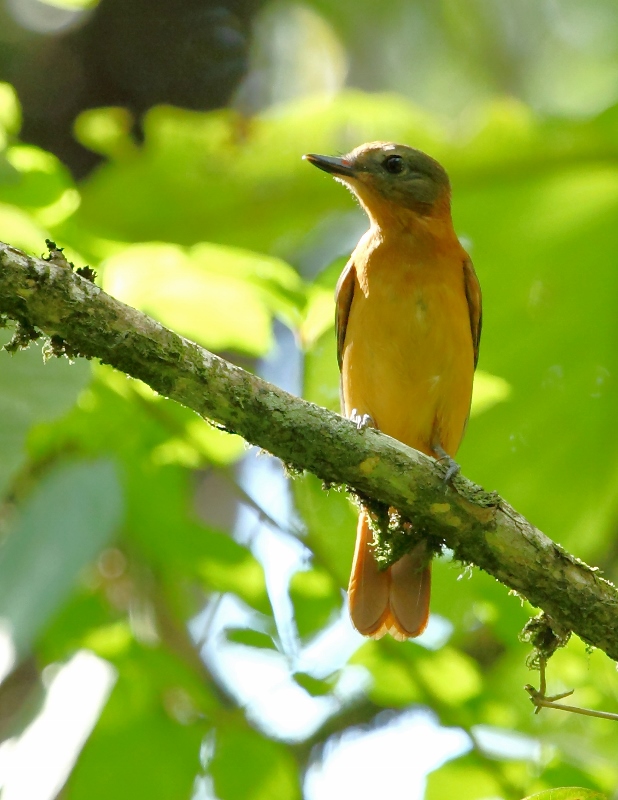
Cinnamon Attila
Attila cinnamomeus
Order: Passeriformes / Family: Tyrannidae

Wikimedia Commons
About the Cinnamon Attila
The Cinnamon Attila (Attila cinnamomeus) is a fascinating bird species belonging to the Tyrannidae family, known for its distinctive cinnamon-colored plumage. This species predominantly inhabits the dense tropical and subtropical forests of South America, with a range that spans countries such as Colombia, Venezuela, and parts of Brazil. Its preference for elevated forest canopies makes it a challenging bird to observe, yet its unique vocalizations often give away its presence. The Cinnamon Attila plays a crucial role in its ecosystem by controlling insect populations and contributing to seed dispersal, which enhances forest regeneration.
During the breeding season, which generally occurs in the wet season, the Cinnamon Attila becomes more vocal and territorial. This behavior ensures that it maintains control over a prime feeding and nesting territory. Outside the breeding period, the bird is slightly more nomadic, showing some movement in search of food, although it does not undertake large migratory journeys. Its ecological role extends beyond mere pest control, as its feeding habits also aid in maintaining a balanced ecosystem. By preying on various insects and small vertebrates, the Cinnamon Attila helps keep potential pest populations in check, which benefits both the plant and animal communities within its habitat.
The Cinnamon Attila's significance lies not only in its ecological contributions but also in its role as an indicator species. Changes in its population dynamics can provide valuable insights into the health of tropical forest ecosystems. Conservationists often monitor its numbers to assess the impact of habitat destruction and climate change on forest biodiversity. As a species with specific habitat requirements, the Cinnamon Attila is sensitive to deforestation and habitat fragmentation. Efforts to conserve its natural habitat are crucial to ensuring the long-term survival of this vibrant bird and the myriad of other species that share its environment.
The Cinnamon Attila belongs to the family Tyrannidae, within the order Passeriformes. These birds typically live average 4-6 years, with a maximum recorded of 10 years..
How to Identify a Cinnamon Attila
The Cinnamon Attila is a medium-sized songbird, easily recognized by its rich cinnamon plumage that covers most of its body. Adults boast a uniform coloration with a slightly paler underside, which helps in distinguishing them from similar species. The bird's head, back, and wings all share this warm hue, creating a striking appearance against the green canopy.
Juvenile Cinnamon Attilas resemble adults but may exhibit slightly duller plumage with indistinct streaking on the chest. Such differences are subtle and require a keen eye to detect in the field. Both males and females display similar plumage, making sexing the birds through visual observation quite challenging.
In flight, the Cinnamon Attila showcases a relatively rounded wingspan, with a short tail that fans out. Its perching posture is upright, often seen surveying its surroundings from a hidden perch within the canopy. While it may be confused with other Attila species, its unique coloration and vocalizations help distinguish it from its relatives.
Having trouble telling birds apart? Upload a photo to our bird identification tool for an instant species match.
Cinnamon Attila Habitat and Range
Preferred Habitat
The Cinnamon Attila thrives in tropical and subtropical forests, favoring primary and secondary growth areas with dense canopy cover. It is most commonly found at elevations ranging from 200 to 1,500 meters above sea level, where it can exploit the rich biodiversity of insects and fruits available.
While the bird primarily inhabits forest interiors, it occasionally ventures into forest edges and clearings, particularly during the non-breeding season. Unlike some other species, the Cinnamon Attila is not typically found in urban or highly disturbed areas, which underscores its reliance on intact forest ecosystems.
Seasonal habitat shifts are minor, as the species does not migrate extensively. However, it may adjust its foraging territories based on food availability, often moving to slightly different forest areas as resources fluctuate.
Geographic Range
The Cinnamon Attila's range is confined to the northern regions of South America, where it is a resident breeder. It occupies the humid tropical forests of countries such as Colombia, Venezuela, Guyana, and parts of northern Brazil, particularly in the Amazon Basin.
While the species does not migrate long distances, some seasonal movements within its range are noted, likely in response to local food availability. These movements typically occur at a regional scale, with birds shifting slightly to exploit different forest patches.
Population density varies across its range, with higher concentrations found in undisturbed forest areas. Human activities such as logging and agriculture have fragmented some parts of its habitat, leading to localized population declines. Conservation efforts focus on preserving large tracts of forest to sustain viable populations.
Want to know which birds visit your area? Browse our backyard birds by location guides for region-specific species lists.
What Does the Cinnamon Attila Eat?
The Cinnamon Attila primarily feeds on a diet of insects, which it forages from the forest canopy. Its diet includes a variety of beetles, caterpillars, and other arthropods, which the bird captures with swift, agile movements through the branches.
During certain seasons, the Cinnamon Attila supplements its insectivorous diet with fruits and berries, which provide essential nutrients and energy. This dietary flexibility allows it to adapt to seasonal changes in food availability, particularly during the breeding season when energy demands are higher.
The bird typically forages alone or in pairs, using a sit-and-wait approach from a perch before darting out to snatch prey. This method is efficient for capturing elusive insects and small vertebrates, ensuring a steady food supply throughout the year.
Cinnamon Attila Behavior and Social Structure
Cinnamon Attilas are primarily solitary birds, although they may form loose pairs during the breeding season. These birds are highly territorial, often engaging in vocal displays and physical confrontations to defend their territory from intruders.
Courtship displays involve a combination of vocalizations and physical postures, with males showcasing their plumage and engaging in song duets with potential mates. Once a pair bond is formed, the birds work together to select a nesting site and defend it vigorously.
In terms of daily activity, the Cinnamon Attila is most active during the early morning and late afternoon, when it forages and patrols its territory. Its response to predators is a combination of stealth and alarm vocalizations, which alert other birds to the threat. The species is not known for flocking behavior, preferring to maintain its territory year-round.
Cinnamon Attila Nesting and Reproduction
The Cinnamon Attila constructs a cup-shaped nest, typically located high in the forest canopy to avoid ground-based predators. The nest is made from a combination of twigs, leaves, and other plant materials, woven together to create a secure structure.
The bird selects a nesting site that offers both concealment and proximity to food resources, often choosing a forked branch or dense foliage. A typical clutch consists of two to three eggs, which both parents incubate for approximately 15 to 18 days.
After hatching, the chicks remain in the nest for about 20 days before fledging. During this time, both parents participate in feeding and caring for the young, ensuring their safety and growth. The Cinnamon Attila typically raises one brood per year, although favorable conditions may allow for a second.
Cinnamon Attila Sounds and Vocalizations
The primary song of the Cinnamon Attila is a series of clear, melodious whistles with a rhythmic pattern. The song often begins with a rising pitch, followed by a series of descending notes, reminiscent of a flute's tune.
In addition to its song, the bird produces sharp call notes used for communication between mates or to signal alarm. These calls are quick, sharp chirps that can carry through dense forest foliage.
During the dawn chorus, the Cinnamon Attila's vocalizations are most pronounced, contributing to the symphony of sounds that fill the forest as day breaks. Its song is one of the more melodic in its habitat, making it a favorite among birdwatchers.
Interesting Facts About the Cinnamon Attila
- 1The Cinnamon Attila's song can be heard up to a kilometer away in dense forest, making it a useful species for audio surveys.
- 2This bird maintains a territory of up to 5 hectares during the breeding season, which it defends vigorously against intruders.
- 3Despite its striking coloration, the Cinnamon Attila is often difficult to spot due to its preference for high canopy perches.
- 4The species has been observed using its beak to manipulate leaves and twigs to access hidden insects, showcasing its intelligence.
- 5Cinnamon Attilas have a unique courtship ritual involving synchronized movements and vocal duets with their partners.
- 6The bird contributes to forest dynamics by dispersing seeds of various fruiting plants, aiding in plant regeneration.
- 7Researchers have studied the Cinnamon Attila's vocalizations as part of broader efforts to understand avian communication in tropical environments.
Cinnamon Attila Conservation Status
The IUCN currently lists the Cinnamon Attila as a species of Least Concern, though its population trends indicate a gradual decline due to habitat loss. Deforestation for agriculture and logging poses the most significant threat, particularly in the Amazon Basin. Conservation efforts focus on preserving large tracts of forest and promoting sustainable land-use practices. Protected areas and reserves offer some refuge for the species, but ongoing efforts to curb illegal logging and land conversion are crucial. Historical population data suggest that the Cinnamon Attila was once more widespread, but increasing human activity has fragmented its habitat. Monitoring population trends and habitat quality remains essential to ensuring its long-term survival.
Other Tyrannidae Species


Birds Similar to the Cinnamon Attila
These species are often confused with the Cinnamon Attila due to similar appearance or overlapping range.