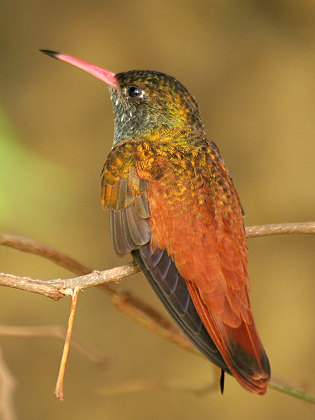
Cinnamon Hummingbird
Amazilia rutila
Order: Apodiformes / Family: Trochilidae

Wikimedia Commons
About the Cinnamon Hummingbird
The Cinnamon Hummingbird, or Amazilia rutila, is a striking member of the Trochilidae family, notable for its cinnamon-hued plumage that sets it apart from other hummingbirds. This species thrives primarily in the dry forests and scrublands of Central America, extending from western Mexico to Nicaragua. Its presence is an indicator of the health of these ecosystems, as it plays a crucial role in pollination. The Cinnamon Hummingbird exhibits a high degree of adaptability, allowing it to inhabit a range of environments including coastal regions, arid areas, and semi-urban locales. In terms of ecological significance, it contributes to the pollination of numerous native plant species, often those with tubular flowers which are specially adapted to the bird's feeding habits. Seasonal behaviors include slight altitudinal migrations, where these hummingbirds move to higher elevations during the wetter months to exploit blooming flowers. Their role in these ecosystems cannot be overstated, as they maintain the health and viability of numerous plant species by facilitating cross-pollination. This hummingbird's adaptability also means it can often be found in gardens and parks, providing opportunities for urban dwellers to observe their remarkable flight skills and vibrant coloration. During the breeding season, which occurs during the rainy months, males become more territorial, defending feeding territories that are crucial for attracting mates. This behavior enhances their visibility and allows birdwatchers to witness their dynamic aerial displays. Despite habitat fragmentation in parts of its range, the Cinnamon Hummingbird remains relatively stable in population numbers, a testament to its adaptability and ecological significance.
The Cinnamon Hummingbird belongs to the family Trochilidae, within the order Apodiformes. These birds typically live around 5-6 years, with some living up to 10 years..
How to Identify a Cinnamon Hummingbird
Adult Cinnamon Hummingbirds boast a predominantly cinnamon-brown body, with the back and wings exhibiting a greenish sheen that can catch the light in remarkable ways. The head and throat often display a subtle iridescence, shifting from a duller brown to a more vibrant hue depending on the angle of view. Males and females appear similar, though males may have slightly more pronounced iridescence. Juveniles resemble adults but often show a more muted coloration, lacking the full vibrancy of adults. In flight, the Cinnamon Hummingbird's silhouette is compact, with a characteristically rapid wingbeat that blurs the wings into near invisibility. When perched, it exhibits a slightly upright posture, often on exposed branches or wires, providing good vantage points and easy observation. Similar species, such as the Rufous-tailed Hummingbird, can cause confusion; however, the Cinnamon Hummingbird lacks the rufous tail and has a more uniform cinnamon coloration. This bird's distinct coloring is its most reliable field mark, making it easier to identify even for casual birdwatchers.
Having trouble telling birds apart? Upload a photo to our bird identification tool for an instant species match.
Cinnamon Hummingbird Habitat and Range
Preferred Habitat
The Cinnamon Hummingbird primarily inhabits dry forests, scrublands, and arid regions, where its cinnamon coloring offers excellent camouflage among dried leaves and branches. It thrives at elevations ranging from sea level to about 1,800 meters, frequently visiting gardens, parks, and plantations in search of nectar. Seasonal habitat shifts are minimal, but during wetter months, the bird might ascend to higher elevations to follow blooming patterns. Urban environments provide additional opportunities, and these birds adapt well to human-altered landscapes, often frequenting feeders and ornamental gardens.
Geographic Range
The Cinnamon Hummingbird's range extends from western Mexico down through Central America to Nicaragua. It is a resident species, generally non-migratory due to the stable climates within its range. In Mexico, it is often found in the states along the Pacific coast, including Jalisco, Guerrero, and Oaxaca. Populations are dense in regions where suitable habitats are abundant, particularly along coastal areas and in valleys. While some altitudinal movements occur, these are typically short-range and dictated by flowering patterns rather than temperature changes.
Want to know which birds visit your area? Browse our backyard birds by location guides for region-specific species lists.
What Does the Cinnamon Hummingbird Eat?
The Cinnamon Hummingbird primarily feeds on nectar, favoring flowers with tubular shapes that complement its bill. Secondary food sources include small insects and spiders, which provide essential proteins. Seasonal diet changes are subtle, as this bird exploits whatever floral resources are available. Foraging techniques involve hovering in front of flowers and darting quickly from one blossom to the next. Prey size is generally small, focusing on easily captured invertebrates found near flowers. The feeding schedule aligns with floral availability, often peaking in the early morning and late afternoon.
Want to attract Cinnamon Hummingbirds to your yard? See our recommended feeders and seed types for the best results.
Cinnamon Hummingbird Behavior and Social Structure
Cinnamon Hummingbirds exhibit a solitary social structure, primarily interacting during breeding or territorial disputes. Males establish and defend feeding territories with aggressive displays, including aerial chases and vocalizations. Courtship displays involve intricate flight patterns designed to attract females. Outside of the breeding season, these birds may be observed feeding in loose associations but seldom form flocks. They respond to predators with evasive maneuvers and rapid flights into dense vegetation. Daily activities are diurnal, with peaks in activity during cooler parts of the day when flower nectar is most abundant.
Cinnamon Hummingbird Nesting and Reproduction
Cinnamon Hummingbirds build small, cup-shaped nests using plant down, spider silk, and lichen, often placed on horizontal branches or sheltered locations like under eaves. Nests are typically located at heights ranging from 1 to 4 meters above the ground. The female lays two eggs per clutch, with an incubation period of about 15 to 19 days. The fledging timeline extends roughly 20 to 26 days post-hatching. Females solely undertake incubation and feeding duties, as males do not participate in rearing the young. Generally, one to two broods are produced per year, depending on environmental conditions.
Cinnamon Hummingbird Sounds and Vocalizations
The Cinnamon Hummingbird's song consists of a series of high-pitched, rapid chips and trills that can be likened to a mechanical whirring sound. These calls serve primarily for territory defense and mate attraction. Alarm calls are sharper and more insistent, used to warn other birds of potential threats. During the dawn chorus, their vocalizations are more subdued, merging into the background of the forest soundscape. Compared to other hummingbirds, their calls are less melodious but serve critical communication functions.
Interesting Facts About the Cinnamon Hummingbird
- 1The Cinnamon Hummingbird can beat its wings up to 80 times per second, allowing it to hover with ease.
- 2Unlike many birds, the Cinnamon Hummingbird can fly backward, a useful ability when maneuvering around flowers.
- 3Its metabolic rate is among the highest of any bird, requiring frequent feeding to maintain energy.
- 4Cinnamon Hummingbirds often visit the same flowers in a regular sequence, establishing feeding routes known as traplines.
- 5The species name 'rutila' refers to its reddish or fiery coloration, aptly describing its cinnamon-toned plumage.
- 6These hummingbirds can enter a state of torpor, significantly slowing their metabolism during cold nights.
- 7Despite their small size, Cinnamon Hummingbirds are highly territorial and can aggressively defend feeding areas.
Cinnamon Hummingbird Conservation Status
The Cinnamon Hummingbird is classified as Least Concern by the IUCN, with stable population trends across its range. Habitat loss due to deforestation and agricultural expansion poses the primary threat, though its adaptability to modified environments mitigates significant declines. Conservation efforts focus on protecting critical habitats, especially dry forests and coastal areas. Historical population data suggests fluctuations corresponding to habitat availability, but current resilience offers hope for long-term stability.
Attracting Cinnamon Hummingbirds to Your Feeder
The Cinnamon Hummingbird is a regular visitor to backyard bird feeders across its range. At the Eye On The Fly feeding station, we observe Cinnamon Hummingbirds regularly and capture footage with our feeder cameras.
Other Trochilidae Species


Birds Similar to the Cinnamon Hummingbird
These species are often confused with the Cinnamon Hummingbird due to similar appearance or overlapping range.