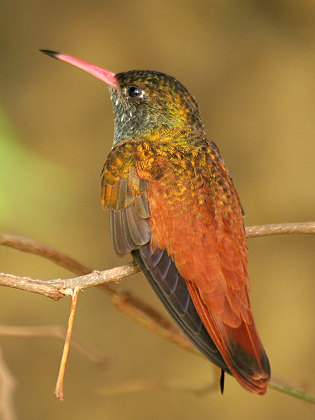
Rufous-tailed Hummingbird
Amazilia tzacatl
Order: Apodiformes / Family: Trochilidae

Wikimedia Commons
About the Rufous-tailed Hummingbird
The Rufous-tailed Hummingbird (Amazilia tzacatl) is a remarkable avian species found primarily in the neotropical regions of Central and South America. This hummingbird is a prominent member of the family Trochilidae and is one of the most widespread hummingbirds in its range. It thrives in a variety of habitats, from coastal lowlands to montane regions, often seen darting between flowers in search of nectar. The Rufous-tailed Hummingbird plays a significant ecological role as a pollinator, aiding in the reproduction of numerous plant species. Its presence in both natural and human-altered habitats underscores its adaptability and resilience. During the breeding season, usually occurring in the wetter months, these hummingbirds exhibit territorial behavior, vigorously defending their feeding and nesting sites. In regions such as Costa Rica and Panama, they are a familiar sight, often visiting gardens and parks. Beyond their ecological contributions, Rufous-tailed Hummingbirds are a delight for birdwatchers and photographers, their agility and vibrant plumage making them a favored subject. The species adapts to a wide range of elevations, from sea level to over 1,500 meters, and it exhibits a preference for areas with abundant flowering plants. Seasonal movements are generally local, driven by the availability of food rather than long migratory patterns. The Rufous-tailed Hummingbird's adaptability extends to human environments, where it often frequents feeders and gardens, bringing a splash of color and activity. In forests and edge habitats, they play a crucial role in the symbiotic relationships between plants and pollinators, facilitating genetic diversity and ecosystem health. Despite their small size, these hummingbirds are robust and hardy, able to maintain their territories against larger birds. Their adaptability to various climates and conditions, from humid tropical forests to urban settings, highlights their ecological importance and resilience in a changing world.
The Rufous-tailed Hummingbird belongs to the family Trochilidae, within the order Apodiformes. These birds typically live averages around 5 years, with some individuals living up to 10 years..
How to Identify a Rufous-tailed Hummingbird
The Rufous-tailed Hummingbird is easily recognized by its vibrant green plumage and distinctive rufous-colored tail. Adults showcase a bright emerald green body contrasted by a reddish-brown tail that sets them apart from other hummingbirds. Juveniles resemble adults but may appear duller with a less pronounced iridescence. Males and females are similar in appearance, although males may exhibit slightly more vivid coloration. Unlike other hummingbirds, the Rufous-tailed lacks any significant sexual dimorphism in plumage. In flight, this species displays a rapid, darting motion, often hovering near flowers. The Rufous-tailed Hummingbird can be confused with the similar Broad-billed Hummingbird, but the latter has a more pronounced blue throat and lacks the rufous tail. When perched, the Rufous-tailed Hummingbird sits upright, often on a low, exposed branch or wire, showcasing its tail as a defining characteristic. Their wings produce a characteristic humming sound, audible when the bird is in close proximity.
Having trouble telling birds apart? Upload a photo to our bird identification tool for an instant species match.
Rufous-tailed Hummingbird Habitat and Range
Preferred Habitat
Rufous-tailed Hummingbirds inhabit a wide range of environments, including tropical forests, secondary growth, and gardens. They are particularly common in edge habitats where forests meet open areas. Typical elevations range from sea level to 1,500 meters, although they are occasionally found at higher elevations. Within urban areas, they adapt well to parks and gardens, often visiting flowering plants and feeders. Seasonal habitat shifts occur in response to flowering cycles, ensuring a constant supply of nectar. Despite their adaptability, they prefer areas with abundant flowers, which provide both nectar and shelter.
Geographic Range
The Rufous-tailed Hummingbird's range extends from southern Mexico through Central America to western Colombia and Ecuador. This species breeds throughout its range, with no significant migratory movements. In countries like Costa Rica, Panama, and Nicaragua, they are abundant and widespread, frequenting gardens and forest edges. In South America, their presence in Colombia and Ecuador marks the southernmost portion of their range. Population densities are highest in areas with extensive flowering plants, often in suburban or rural settings where gardens are common.
Want to know which birds visit your area? Browse our backyard birds by location guides for region-specific species lists.
What Does the Rufous-tailed Hummingbird Eat?
The diet of the Rufous-tailed Hummingbird consists primarily of nectar from a wide variety of flowering plants. They exhibit a preference for tubular flowers, which accommodate their specialized feeding technique. In addition to nectar, they consume small insects and spiders, providing essential protein. Feeding occurs throughout the day, with peaks in activity during early morning and late afternoon. Rufous-tailed Hummingbirds employ a hovering technique to sip nectar, allowing them to access flowers with precision. Seasonal variations in diet are minor, as they exploit a wide range of plant species.
Want to attract Rufous-tailed Hummingbirds to your yard? See our recommended feeders and seed types for the best results.
Rufous-tailed Hummingbird Behavior and Social Structure
Rufous-tailed Hummingbirds are solitary and highly territorial, often engaging in aggressive interactions to defend feeding territories. During courtship, males perform aerial displays, involving rapid flights and vocalizations to attract females. They do not form flocks, although multiple individuals may congregate at rich feeding sites. When threatened, they exhibit swift evasive maneuvers and emit sharp alarm calls to deter predators. Their daily activity patterns include frequent feeding bouts interspersed with rest periods, during which they perch quietly, conserving energy.
Rufous-tailed Hummingbird Nesting and Reproduction
The Rufous-tailed Hummingbird constructs a small cup-shaped nest using plant fibers, spider silk, and other materials, often camouflaged with lichen. Nests are typically located on horizontal branches or in forks of trees, usually 1 to 3 meters above the ground. Clutch size is generally two eggs, which the female incubates for about 15 to 19 days. After hatching, the chicks fledge in approximately 20 to 26 days. The female alone cares for the young, providing all parental care and feeding. Typically, they raise two broods per year, depending on environmental conditions.
Rufous-tailed Hummingbird Sounds and Vocalizations
The Rufous-tailed Hummingbird's primary song is a rapid series of high-pitched chips and trills, often delivered from a concealed perch. These vocalizations are used in territory defense and courtship. Calls consist of sharp 'tsik' notes, functioning as both contact calls and alarms. During the dawn chorus, their melodic trills and chips contribute to the vibrant soundscape of tropical forests. Compared to other hummingbirds, their calls are more varied and complex, reflecting their active social interactions.
Interesting Facts About the Rufous-tailed Hummingbird
- 1Rufous-tailed Hummingbirds can beat their wings up to 70 times per second, allowing for their distinctive hovering flight.
- 2Their heart rate can exceed 1,200 beats per minute, enabling rapid energy bursts during territorial chases.
- 3Despite their small size, Rufous-tailed Hummingbirds can travel up to 40 km/h in flight.
- 4They have excellent memories and can recall flower locations and nectar availability, optimizing foraging efficiency.
- 5Rufous-tailed Hummingbirds have a specialized tongue that extends far beyond their bill, enabling efficient nectar extraction.
- 6These hummingbirds can consume up to twice their body weight in nectar each day, demonstrating their high metabolic demands.
- 7In addition to their vivid plumage, Rufous-tailed Hummingbirds possess iridescent throat feathers that can appear to change color depending on the light.
Rufous-tailed Hummingbird Conservation Status
The Rufous-tailed Hummingbird is currently assessed as Least Concern by the IUCN, with a stable population trend. While habitat loss poses a potential threat, their adaptability to altered habitats mitigates immediate risks. Conservation efforts focus on preserving tropical forests and promoting sustainable land use practices. Historically, populations have remained robust, benefiting from their ability to thrive in both natural and human-modified environments. Continuous monitoring and habitat protection are essential to ensure their ongoing survival.
Attracting Rufous-tailed Hummingbirds to Your Feeder
The Rufous-tailed Hummingbird is a regular visitor to backyard bird feeders across its range. At the Eye On The Fly feeding station, we observe Rufous-tailed Hummingbirds regularly and capture footage with our feeder cameras.
Other Trochilidae Species


Birds Similar to the Rufous-tailed Hummingbird
These species are often confused with the Rufous-tailed Hummingbird due to similar appearance or overlapping range.