
Citrine Canary-Flycatcher
Culicicapa helianthea
Order: Passeriformes / Family: Stenostiridae

Wikimedia Commons
About the Citrine Canary-Flycatcher
The Citrine Canary-Flycatcher (Culicicapa helianthea) is a small, strikingly colorful bird found primarily in Southeast Asia. Its vibrant yellow plumage makes it a standout in the lush green forests it calls home. This species belongs to the Stenostiridae family, a group of small passerine birds notable for their agile flight and insectivorous diet. The Citrine Canary-Flycatcher plays a crucial role in controlling insect populations, contributing significantly to the ecological balance of its habitat. Inhabiting regions such as Borneo, Sumatra, and parts of the Malay Peninsula, this bird is a common sight in tropical and subtropical moist broadleaf forests.
These birds are typically found at elevations ranging from lowland forests up to 2500 meters, although they prefer the mid-montane levels where the forest canopy is dense. The Citrine Canary-Flycatcher is not only significant for its beauty but also for its role as an indicator species, reflecting the health of its environment. The presence of these birds often suggests a rich, biodiverse habitat.
Seasonal behaviors of the Citrine Canary-Flycatcher include shifts in altitudinal range, particularly in response to monsoon changes. During the breeding season, which coincides with the wet season, these birds engage in more vocal displays and heightened territoriality. The Citrine Canary-Flycatcher's ecological role extends beyond insect control, as its activities help in seed dispersal, indirectly aiding in forest regeneration. Its adaptation to varied forest types, from primary to secondary growth, underscores its resilience and ecological importance.
The Citrine Canary-Flycatcher belongs to the family Stenostiridae, within the order Passeriformes. These birds typically live average 5-6 years with a maximum recorded of 8 years..
How to Identify a Citrine Canary-Flycatcher
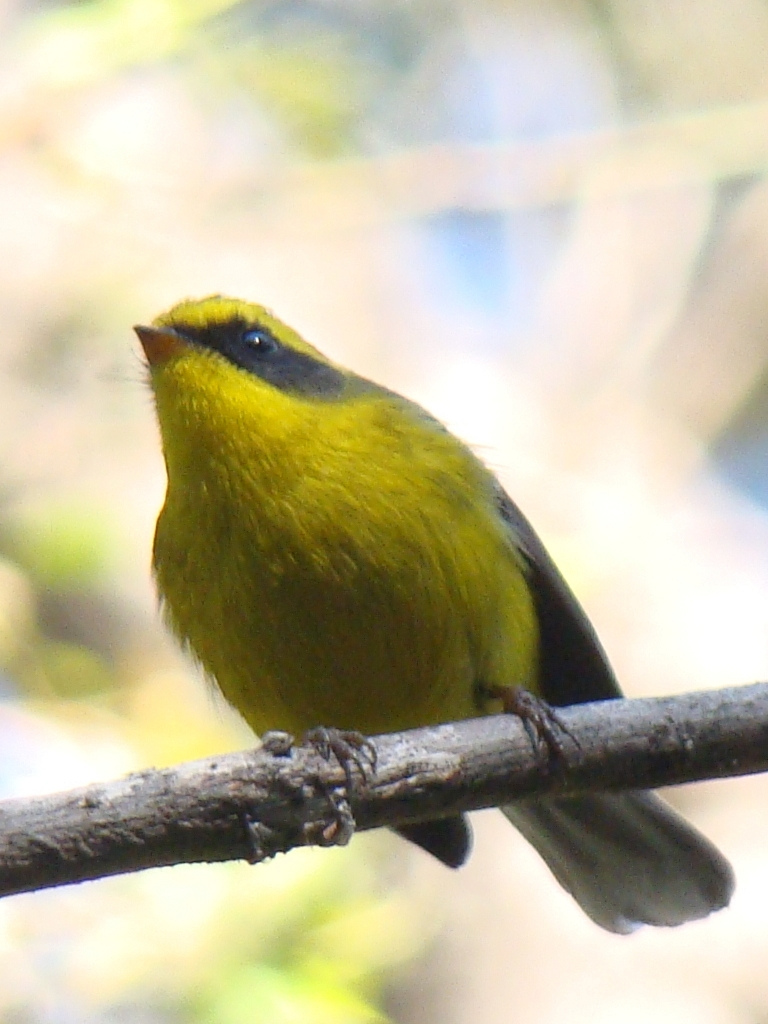
The Citrine Canary-Flycatcher is easily identified by its bright yellow underparts and olive-gray upperparts. Adults display a distinctive pale eye-ring that contrasts with their darker head, making them quite recognizable. Juvenile birds, however, are less vivid, showcasing a more muted yellow coloration with streaks of gray, which helps them blend into their environment for protection from predators.
Males and females of the species are similar in appearance, which can make sexing these birds in the field a challenge. However, males tend to have slightly more vibrant plumage during the breeding season, which can aid in identification. The Citrine Canary-Flycatcher is often confused with other small yellow birds in its range, such as the Yellow-bellied Fairy-Flycatcher. However, its distinctive head pattern and the absence of wing bars help distinguish it.
In flight, the Citrine Canary-Flycatcher exhibits rapid, fluttering wingbeats typical of flycatchers. When perched, they often adopt an upright posture, with a slight flicking of the tail. This behavior, combined with their vibrant coloring, makes them a joy to observe for birdwatchers and naturalists alike.
Having trouble telling birds apart? Upload a photo to our bird identification tool for an instant species match.
Citrine Canary-Flycatcher Habitat and Range
Preferred Habitat
The preferred habitat of the Citrine Canary-Flycatcher includes tropical and subtropical moist broadleaf forests. These birds thrive in the dense understory where they can actively hunt for insects. They are most commonly found in the lowland and montane forests of Southeast Asia, particularly in areas that offer both cover and abundant food sources.
They are typically seen at elevations ranging from sea level to about 2500 meters. During breeding seasons, these birds may ascend to higher altitudes to take advantage of the cooler climates and abundant food supply. Unlike some other forest birds, the Citrine Canary-Flycatcher shows adaptability to secondary forests, making them resilient to some habitat changes.
While primarily forest dwellers, they occasionally venture into forest edges and clearings. They are not commonly found in urban areas, as their habitat preferences lean heavily towards undisturbed environments. This makes them less visible in human-modified landscapes, though they can sometimes be spotted in suburban gardens that border forested areas.
Geographic Range
The breeding range of the Citrine Canary-Flycatcher is primarily located in Southeast Asia, including countries like Indonesia, Malaysia, and parts of the Philippines. These birds are year-round residents in many parts of their range, particularly in the extensive forests of Borneo and Sumatra.
During non-breeding seasons, some populations may undertake altitudinal migrations rather than long-distance migrations, moving to lower elevations as food resources shift or become scarce. Such movements are typical in response to climatic variations, particularly during the drier months.
Population density hotspots include the montane forests of the Malay Peninsula and the island of Java, where their preferred habitat is widespread. Although they are not considered migratory in the traditional sense, their movement patterns within their range are significant enough to note for those studying avian ecology in the region.
Want to know which birds visit your area? Browse our backyard birds by location guides for region-specific species lists.
What Does the Citrine Canary-Flycatcher Eat?
The diet of the Citrine Canary-Flycatcher primarily consists of insects, which they adeptly capture during agile flights through the forest understory. They are particularly fond of small flying insects such as midges and mosquitoes, which make up a significant portion of their diet.
During the wetter months, when insect populations boom, these birds can be observed engaging in more aggressive foraging behaviors. They often employ a technique known as sallying, where they perch quietly before launching into short flights to snatch insects mid-air. This method is both energy efficient and effective given their nimble flight capabilities.
There is some seasonal variation in their diet, with the inclusion of small berries and seeds when insect availability declines. However, such dietary shifts are minor as the Citrine Canary-Flycatcher remains predominantly insectivorous throughout the year. Their feeding schedule is largely diurnal, with peak activity during the cooler morning and late afternoon hours.
Citrine Canary-Flycatcher Behavior and Social Structure
The Citrine Canary-Flycatcher exhibits a variety of intriguing behaviors that provide insight into its social and ecological role. These birds are generally solitary or found in pairs, especially during the breeding season when they establish and defend territories.
Territorial behavior is marked by vocal displays and aerial chases, particularly among males. These displays serve both to attract mates and to ward off potential rivals. During courtship, males perform fluttering flights and display their vibrant plumage to entice females. Flocking behavior is rare outside of breeding periods, but small groups may form in areas with abundant food resources.
In response to predators, Citrine Canary-Flycatchers rely on their agility and speed. They often employ a tactic of rapid, erratic flight patterns to evade capture. These birds are most active during the early morning and late afternoon, timing their foraging with periods when insect prey is most accessible.
Although primarily diurnal, they may extend activity into dusk, especially in forested regions where twilight provides some cover from predators. Their interactions with other bird species can be competitive, particularly in areas with limited resources.
Citrine Canary-Flycatcher Nesting and Reproduction
The Citrine Canary-Flycatcher constructs cup-shaped nests made from fine plant materials, moss, and spider webs, which are skillfully woven together to create a secure structure. These nests are often situated in the fork of a tree branch or sometimes attached to the underside of large leaves, providing both concealment and protection from the elements.
Preferred nesting locations are within dense foliage at mid-level heights, typically between 3 to 10 meters above the ground. This strategic positioning helps minimize predation risks from both ground and aerial predators. The clutch size usually consists of 2 to 4 eggs, which are incubated primarily by the female for about 12 to 14 days.
Both parents share in feeding and caring for the fledglings, which leave the nest approximately two weeks after hatching. The Citrine Canary-Flycatcher typically raises one brood per year, although in optimal conditions, a second brood may be attempted. Their nesting success is influenced by environmental conditions and the availability of food resources.
Citrine Canary-Flycatcher Sounds and Vocalizations
The primary song of the Citrine Canary-Flycatcher is a series of high-pitched, melodious whistles that can be described as bright and cheerful. The rhythm is fast-paced, with a clear, ringing quality that carries well through the forest.
In addition to their song, these birds emit sharp, short call notes used for communication between mates and to signal alarm in the presence of potential threats. Their alarm calls are notably sharper and more abrupt, designed to alert not only conspecifics but also other species in the vicinity.
During the dawn chorus, the Citrine Canary-Flycatcher's song is often one of the first to be heard, serving as a wake-up call to the forest. These vocalizations are crucial for maintaining territory boundaries and reinforcing pair bonds throughout the breeding season.
Interesting Facts About the Citrine Canary-Flycatcher
- 1The Citrine Canary-Flycatcher can hover like a hummingbird when targeting insects, a rare skill among its family.
- 2Despite its small size, averaging 11 cm in length, the Citrine Canary-Flycatcher is a proficient predator of insects.
- 3This species is a fan of monsoon rains, as increased humidity leads to a boom in insect populations, their primary food source.
- 4The vivid yellow plumage of the Citrine Canary-Flycatcher acts as a visual signal in dense forests, aiding in mate attraction.
- 5They are sometimes called 'forest jewels' due to their striking appearance and agile flight patterns through the canopy.
- 6The Citrine Canary-Flycatcher's nests are crafted with spider silk to provide flexibility and strength.
- 7These birds rarely visit human-dominated landscapes, preferring the tranquility of their forested habitats.
Citrine Canary-Flycatcher Conservation Status
As of the latest assessments, the Citrine Canary-Flycatcher is listed as Least Concern by the IUCN, with stable population trends across most of its range. However, habitat destruction due to logging and agricultural expansion poses a significant threat, particularly in lowland forest areas. Conservation efforts focus on preserving critical habitats, particularly in regions where deforestation rates are high. Protected areas in parts of Indonesia and Malaysia play a crucial role in safeguarding the future of this species. Historical data show fluctuations in population densities, but no drastic long-term declines have been recorded. Continued monitoring and habitat preservation are essential to ensure that the Citrine Canary-Flycatcher remains a vibrant part of Southeast Asia's avian community. Collaborative conservation programs aim to address broader environmental challenges that impact these birds and their habitats.
Other Stenostiridae Species


Birds Similar to the Citrine Canary-Flycatcher
These species are often confused with the Citrine Canary-Flycatcher due to similar appearance or overlapping range.