Crossley's Vanga
Mystacornis crossleyi
Order: Passeriformes / Family: Vangidae

Wikimedia Commons
About the Crossley's Vanga
Crossley's Vanga, scientifically named Mystacornis crossleyi, is a captivating bird endemic to Madagascar, an island renowned for its rich biodiversity. This medium-sized bird belongs to the Vangidae family, which includes a variety of species adapted to different ecological niches on the island. Crossley's Vanga plays a significant role in the ecosystem as an insectivore, helping control insect populations and contributing to the health of the forest environment. Found primarily in the eastern rainforests, this bird's range extends from Marojejy National Park in the north to Ranomafana National Park in the south, highlighting its preference for humid, dense forest habitats. The species thrives in the lush canopy and understory layers, where it forages for its food, primarily insects, and small invertebrates. During the breeding season, Crossley's Vanga becomes more conspicuous, as males engage in vocal displays to attract mates. Their presence signifies a healthy, intact forest, as these birds are sensitive to habitat degradation and thus serve as indicators of ecological well-being. The bird remains non-migratory, maintaining year-round residency within its territorial range. However, some seasonal movements within the forest are observed, likely related to food resource availability. The Crossley's Vanga's conservation status is currently listed as Near Threatened by the International Union for Conservation of Nature (IUCN), primarily due to habitat loss from deforestation. Efforts in Madagascar to preserve rainforests are crucial to the survival of this intriguing species. Conservationists and researchers continue to study the Crossley's Vanga to better understand its ecological role and ensure its continued presence in Madagascar's unique avian biodiversity.
The Crossley's Vanga belongs to the family Vangidae, within the order Passeriformes. These birds typically live average 4-5 years, with a max recorded of 6 years..
How to Identify a Crossley's Vanga
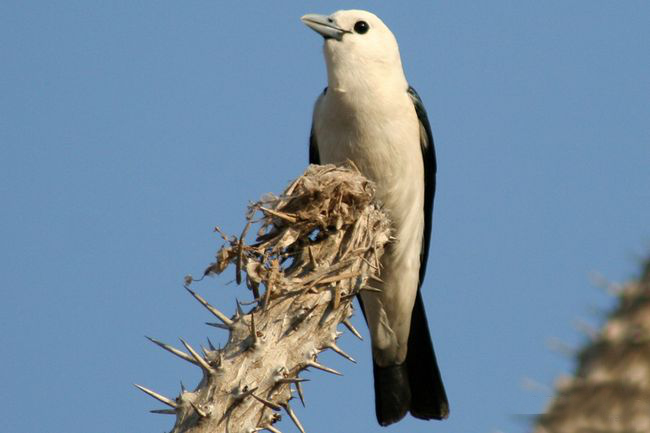
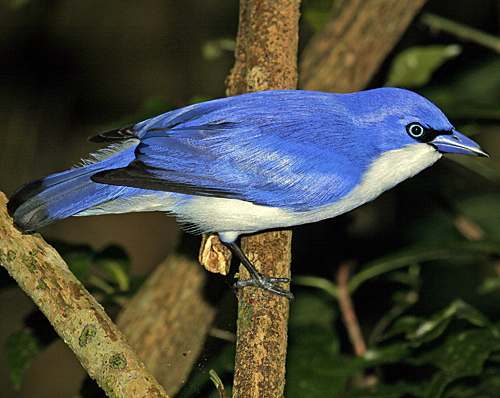
Crossley's Vanga is distinguished by its medium size, measuring approximately 24 cm in length. Its plumage is predominantly blue-gray, giving it a sleek and elegant appearance. One of the hallmark features of the Mystacornis crossleyi is its striking black facial mask, which extends across the eyes and contrasts sharply with its light body feathers. The underparts are a paler gray, while its wings and tail exhibit a slightly darker hue. The bird's bill is black, robust, and slightly curved, adapted for its insectivorous diet. Juveniles resemble the adults but have duller plumage with subdued markings, lacking the prominent black mask. Males and females are similar in appearance, making sexual dimorphism minimal. In flight, Crossley's Vanga displays a steady, fluttering flight pattern typical of forest-dwelling birds, with rounded wings and a moderately long tail aiding in maneuverability through dense foliage. While perched, it holds an upright posture on branches, often in the mid to upper canopy. Confusion with other vanga species is possible, but the unique facial mask and color pattern provide clear differentiation from others in its family.
Having trouble telling birds apart? Upload a photo to our bird identification tool for an instant species match.
Crossley's Vanga Habitat and Range
Preferred Habitat
Crossley's Vanga inhabits the lowland and montane rainforests of eastern Madagascar. Its preferred habitat ranges from sea level to elevations of approximately 1,500 meters. The bird thrives in humid environments with dense canopy and understory vegetation, often favoring primary forests, which provide ample food resources and nesting sites. Although predominantly associated with untouched forest areas, Crossley's Vanga can occasionally be found in secondary growth, indicating some adaptability to altered landscapes. However, it is rarely observed in urban settings, as it relies heavily on the forest for its ecological needs. Seasonal habitat shifts are subtle, with the bird moving within the forest to track food availability rather than undergoing long migrations.
Geographic Range
Crossley's Vanga is endemic to Madagascar, with its range confined to the eastern part of the island. This area includes various national parks and reserves such as Marojejy, Masoala, and Ranomafana, which are crucial for its survival. The bird's distribution is patchy, as it is highly reliant on intact forest ecosystems. The species does not undertake long-distance migrations, maintaining a year-round presence within its range. Population density is higher in protected areas where habitat conditions remain stable. Outside these refuges, deforestation poses a significant threat, leading to local population declines.
Want to know which birds visit your area? Browse our backyard birds by location guides for region-specific species lists.
What Does the Crossley's Vanga Eat?
The diet of Crossley's Vanga primarily consists of insects and other small invertebrates. This bird employs a variety of foraging techniques, including gleaning from leaves and branches, probing bark crevices, and occasionally catching prey in flight. Its robust bill is well-suited for capturing and processing a variety of arthropods, from beetles to caterpillars. Seasonal changes in diet correspond to the availability of prey, with some opportunistic feeding on small fruits and seeds during periods of insect scarcity. The bird's feeding schedule is mostly diurnal, with peak activity during the early morning and late afternoon when insect activity is highest.
Crossley's Vanga Behavior and Social Structure
Crossley's Vanga exhibits a primarily solitary or pair-based social structure, with individuals or pairs maintaining defined territories within the forest. Territorial behavior includes vocal displays and occasional physical confrontations to ward off intruders. During the breeding season, males engage in elaborate courtship displays, using song and physical posturing to attract females. The bird's response to predators, such as snakes and birds of prey, includes mobbing and alarm calls to alert conspecifics. Daily activity patterns involve active foraging interspersed with periods of rest, often in well-concealed locations within the canopy.
Crossley's Vanga Nesting and Reproduction
Crossley's Vanga constructs cup-shaped nests using a variety of materials, including twigs, leaves, and moss, often placed in the fork of a tree branch. Nests are typically located several meters above the ground, providing protection from ground-dwelling predators. The clutch size ranges from 2 to 4 eggs, with both parents sharing incubation duties over a period of approximately 15 to 18 days. Once hatched, the chicks remain in the nest for about 20 to 25 days before fledging. Parental care continues post-fledging, with adults feeding and teaching young birds essential survival skills. Typically, this species raises one brood per year, although favorable conditions may allow for a second.
Crossley's Vanga Sounds and Vocalizations
The primary song of Crossley's Vanga is a series of melodious whistles, varying in pitch and rhythm. These vocalizations serve both territorial and mating purposes, often heard during the early morning hours. Call notes include sharper, more abrupt tones used for communication between pairs or to express alarm. During the dawn chorus, Crossley's Vanga contributes its distinct calls to the symphony of the forest, providing an auditory marker of its presence. Compared to other vangas, its song is less harsh, with a more musical quality that blends seamlessly with the ambient sounds of its habitat.
Interesting Facts About the Crossley's Vanga
- 1Crossley's Vanga was first described in 1870 and is named after Alfred Crossley, a British naturalist.
- 2Unlike many birds, Crossley's Vanga shows little sexual dimorphism, making male and female identification challenging.
- 3The blue-gray plumage of Crossley's Vanga provides effective camouflage among the rainforest's shadows and light.
- 4This species' reliance on intact forests makes it an excellent indicator of forest health in Madagascar.
- 5Crossley's Vanga has a specialized tongue adapted for probing, an evolutionary trait for insectivory.
- 6The bird's call, described as musical, contrasts with the typically harsh calls of other vangas.
- 7Despite being non-migratory, Crossley's Vanga may shift territories within the forest to follow food sources.
Crossley's Vanga Conservation Status
Crossley's Vanga is classified as Near Threatened by the IUCN, with population trends showing a worrying decline. The primary threat to its survival is habitat loss due to deforestation for agriculture and logging. Conservation efforts focus on habitat preservation and restoration within Madagascar's national parks and reserves. Historical population changes suggest a gradual decrease in numbers, correlating with expanding human activities. Active involvement from local communities and international conservation organizations is vital in ensuring the continued existence of this emblematic species.