
Fire-tailed Myzornis
Myzornis pyrrhoura
Order: Passeriformes / Family: Sylviidae

Wikimedia Commons
About the Fire-tailed Myzornis
The Fire-tailed Myzornis (Myzornis pyrrhoura) is a small passerine bird, revered for its iridescent green plumage and distinctive fiery red tail. This species belongs to the family Sylviidae and is found predominantly in the temperate forests of the Himalayas, including regions like Bhutan, Nepal, the Indian states of Sikkim and Arunachal Pradesh, and parts of Tibet. These birds prefer the dense rhododendron and oak forests that dominate these regions, thriving at elevations ranging from 2,400 to 4,000 meters. Their presence is a marker of the rich biodiversity that characterizes the Himalayan ecosystem. The Fire-tailed Myzornis plays a crucial ecological role as both a pollinator and a consumer of insects, thus maintaining the balance in its native habitat. During the breeding season, which spans from April to June, these birds become particularly active, engaging in elaborate courtship rituals that highlight their vibrant plumage. Outside the breeding season, they remain largely sedentary, although some altitudinal migration may occur as they move to slightly lower elevations during harsh winter months in search of food. This movement ensures they evade the snow-laden upper forests, offering them continued access to food resources. The bird's ecological significance extends beyond its immediate environment; by contributing to the pollination of various high-altitude plant species, the Fire-tailed Myzornis helps sustain the floral diversity that supports numerous other animal species. Its presence in the fragile montane ecosystems of the Himalayas underscores the importance of conservation efforts aimed at preserving these unique habitats. Despite its relatively small range, the Fire-tailed Myzornis enjoys a stable population, though it remains sensitive to habitat destruction and climate change.
The Fire-tailed Myzornis belongs to the family Sylviidae, within the order Passeriformes. These birds typically live average 3 years, max recorded 5 years.
How to Identify a Fire-tailed Myzornis
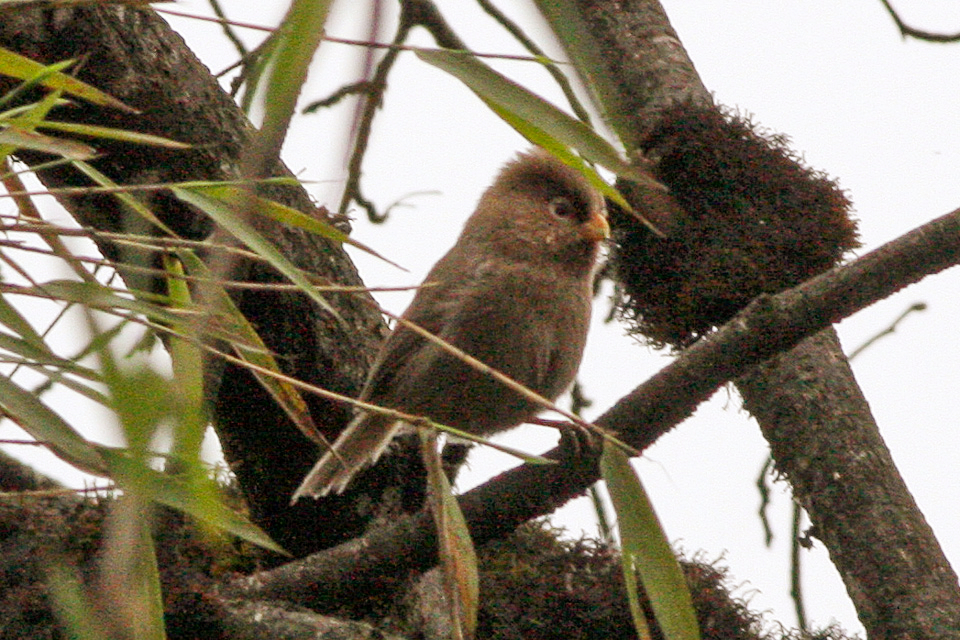
The Fire-tailed Myzornis is unmistakable with its bright green plumage that shimmers under the sunlight, giving it an almost jewel-like appearance. Adult birds exhibit a vibrant red tail, which contrasts sharply against their green body, providing a key field mark for identification. The feathering around the face is marked with black and white streaks, adding to its striking appearance. Juveniles resemble adults but tend to have a slightly duller hue, with less pronounced red on the tail. Males and females look similar, making sex differentiation difficult in the field. In flight, the Fire-tailed Myzornis displays a unique silhouette with its short, rounded wings and long tail that flares out like a fan, enhancing the fiery effect. When perched, it often sits upright on branches, showcasing its compact body and long tail. Despite its distinctive features, it can be confused with other green birds like the Green Shrike-Babbler, but the Myzornis's red tail and more vibrant green plumage are distinguishing features. Observing their behavior and specific habitat preferences can also aid in correct identification.
Having trouble telling birds apart? Upload a photo to our bird identification tool for an instant species match.
Fire-tailed Myzornis Habitat and Range
Preferred Habitat
The Fire-tailed Myzornis occupies montane forests, particularly favoring areas rich in rhododendron and oak. These habitats, found at elevations between 2,400 and 4,000 meters, provide ample cover and food resources. During the breeding season, they prefer dense thickets that offer protection for nest sites. In winter, they may descend to slightly lower altitudes, seeking refuge in mixed broadleaf forests, where temperatures are milder. While they are not typically found in urban areas, their habitats often border human settlements, particularly in rural regions where forest edges provide an interface between human activity and natural spaces. Seasonal shifts in habitat preference are minor, as these birds are largely non-migratory and remain within their montane environment year-round.
Geographic Range
The Fire-tailed Myzornis is primarily found in the eastern Himalayas, with its range extending across Bhutan, Nepal, northeastern India, and southern Tibet. Within India, it is most commonly seen in the states of Sikkim and Arunachal Pradesh, where suitable forest habitats are abundant. The bird's distribution is patchy, limited to areas where dense montane forests provide the necessary ecological conditions. While they do not undertake long-distance migrations, some altitudinal movements occur, with individuals descending to lower elevations in response to colder weather. This species is considered locally common within its range, although precise population densities can vary based on habitat quality and availability.
Want to know which birds visit your area? Browse our backyard birds by location guides for region-specific species lists.
What Does the Fire-tailed Myzornis Eat?
The diet of the Fire-tailed Myzornis primarily consists of insects, which it gleans from foliage using its slender, slightly curved bill. This foraging behavior is crucial during the breeding season when protein-rich insects support demanding nutritional needs. They also consume nectar, which not only supplements their diet but also facilitates pollination. Insects such as caterpillars, beetles, and spiders form a significant part of their diet, while their nectar consumption sees them frequenting rhododendron flowers in particular. Feeding occurs throughout the day, with peak activity in the early morning and late afternoon when insects are most active. Their feeding technique involves agile movements through the foliage, often seen hanging upside down to access harder-to-reach prey.
Fire-tailed Myzornis Behavior and Social Structure
Fire-tailed Myzornis are social birds, often found in small groups or mixed-species flocks, which provide safety in numbers and increase foraging efficiency. They exhibit a high degree of territoriality during the breeding season, with pairs defending their chosen nesting area from intruders. Courtship displays are a visual spectacle, as males flaunt their vibrant plumage to attract females. These birds are diurnal, with activity levels peaking during the cooler parts of the day, particularly at dawn and dusk. In response to predators, they rely on their agile flight and cryptic plumage to evade capture, often retreating into dense vegetation. Their social structure outside of breeding season is less rigid, allowing them to integrate into larger flocks comprising various other insectivorous species.
Fire-tailed Myzornis Nesting and Reproduction
The Fire-tailed Myzornis constructs cup-shaped nests, meticulously woven from moss, lichen, and fibers, camouflaged within the dense foliage of rhododendron or oak trees. These nests are typically located at heights of 2 to 3 meters above ground, providing protection from ground-dwelling predators. A typical clutch consists of two to four eggs, which are incubated primarily by the female over a period of approximately 14 days. Both parents participate in feeding the chicks, which fledge about 15 to 18 days after hatching. The pair may raise one to two broods per breeding season, depending on environmental conditions and food availability. Parental care continues for a short period after fledging to ensure the young birds adapt successfully to independence.
Fire-tailed Myzornis Sounds and Vocalizations
The vocalizations of the Fire-tailed Myzornis are characterized by a series of high-pitched, melodic notes that form a distinctive song. This song, often delivered from a concealed perch within the canopy, serves both to establish territory and attract mates. Their call notes, more subdued than their song, consist of soft chips and trills, used primarily for communication within flocks. During the early morning hours, they contribute to the dawn chorus, their clear notes standing out amidst the cacophony of the forest. Alarm calls are sharp and abrupt, alerting other birds to potential threats in the vicinity.
Interesting Facts About the Fire-tailed Myzornis
- 1The Fire-tailed Myzornis can hover like a hummingbird when feeding on nectar, a rare behavior for birds in its family.
- 2Despite its vibrant colors, the Fire-tailed Myzornis can be surprisingly elusive, often blending seamlessly into the dense foliage.
- 3The species name 'pyrrhoura' is derived from Greek, meaning 'fire-tailed', a nod to its striking tail coloration.
- 4During courtship, males perform fluttering displays that showcase their vivid plumage in the dappled forest light.
- 5Fire-tailed Myzornis are known to join mixed-species flocks, which can include other small birds like tits and warblers.
- 6Their nests, often lined with spider silk, are adeptly camouflaged, making them hard to spot even by experienced birders.
- 7These birds play a role in pollinating the rhododendrons of the Himalayas, crucial plants in their ecosystem.
Fire-tailed Myzornis Conservation Status
The Fire-tailed Myzornis is currently listed as Least Concern by the IUCN, with a stable population trend. However, its limited range and specific habitat requirements make it vulnerable to habitat degradation, particularly due to deforestation and climate change. Conservation efforts focus on preserving high-altitude forest habitats and mitigating the impacts of human encroachment. Historical records suggest that the population has remained relatively stable over the decades, though continued monitoring is necessary to ensure this trend persists. Protecting the montane forests of the Himalayas is crucial for the ongoing survival of this and numerous other endemic species.
Other Sylviidae Species



Birds Similar to the Fire-tailed Myzornis
These species are often confused with the Fire-tailed Myzornis due to similar appearance or overlapping range.
