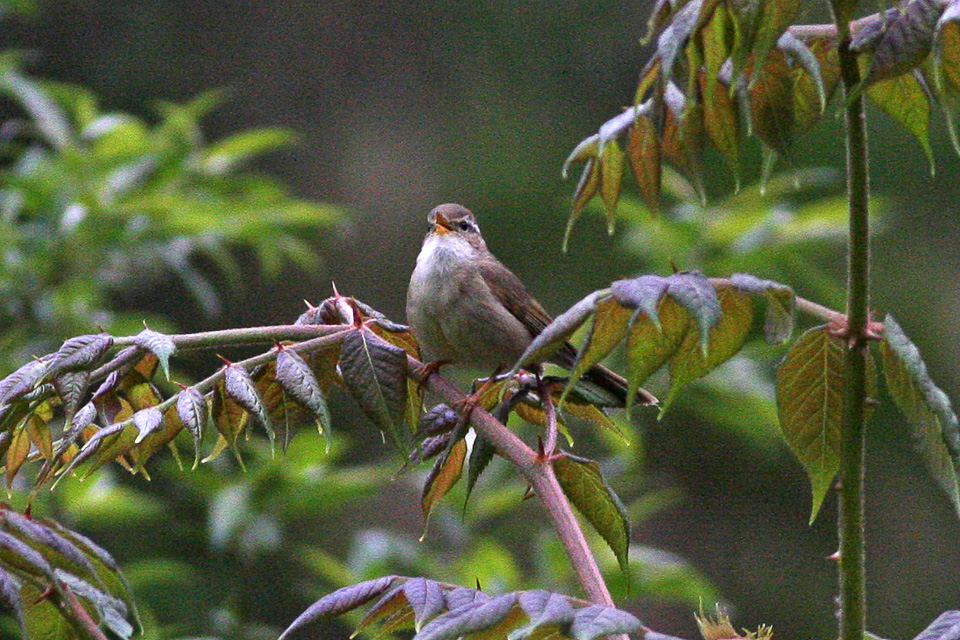
Golden-spectacled Warbler
Seicercus burkii
Order: Passeriformes / Family: Phylloscopidae

Wikimedia Commons
About the Golden-spectacled Warbler
The Golden-spectacled Warbler, Seicercus burkii, is a small passerine bird that inhabits the forests of the Himalayas and southeast Asia. With its bright yellow eye-ring, this warbler stands out amid dense foliage. It plays a critical role in the ecosystem as an insectivore, helping control insect populations within its habitat. The species thrives in a variety of forested environments, ranging from subtropical and temperate forests to montane regions. During the breeding season, which typically spans from March to August, the Golden-spectacled Warbler occupies the higher altitudes of the Himalayas, with altitudinal shifts occurring as the seasons change. As autumn approaches, these warblers descend to lower elevations, moving into the foothills and more temperate zones. This seasonal migration helps them avoid the harsh conditions of the high-altitude winters. The Golden-spectacled Warbler is significant not only as a predator of insects but also as a prey species for larger avian predators. Its presence indicates a healthy forest ecosystem, as it requires a robust understory for foraging and nesting. Their migratory patterns also contribute to seed dispersal and pollination, thereby supporting plant diversity. This warbler's adaptability to different forest types underscores its resilience, yet it remains sensitive to habitat destruction and fragmentation. Conservation efforts for this species focus on preserving its natural habitat, which faces threats from deforestation and land conversion for agriculture. The Golden-spectacled Warbler serves as a vital component of its ecosystem, reflecting the health of the habitats it occupies.
The Golden-spectacled Warbler belongs to the family Phylloscopidae, within the order Passeriformes. These birds typically live generally 2-5 years, with the longest recorded lifespan of 8 years.
How to Identify a Golden-spectacled Warbler
The Golden-spectacled Warbler can be identified by its striking yellow eye-ring and olive-green upperparts. Its underparts are generally a duller grayish-white, providing a subtle contrast. Adult plumage is consistent between sexes, offering little sexual dimorphism, which can complicate field identification based on plumage alone. Juveniles, however, tend to have a paler and less vivid coloration, lacking the pronounced yellow of the adults. One might confuse this warbler with similar species like the White-spectacled Warbler, but the latter has a distinctly different facial pattern. In flight, the Golden-spectacled Warbler exhibits a rapid, flitting motion, characteristic of the Phylloscopidae family. When perched, it maintains an upright posture, often flicking its tail and wings, which is a behavior typical of active insectivores. Observing these field marks and behaviors can aid birders in distinguishing this species from other warblers in its range.
Having trouble telling birds apart? Upload a photo to our bird identification tool for an instant species match.
Golden-spectacled Warbler Habitat and Range
Preferred Habitat
The Golden-spectacled Warbler inhabits a diverse range of forest types, including subtropical and temperate forests, montane forests, and sometimes mixed woodlands. It typically resides at elevations between 1,500 to 3,500 meters during the breeding season, preferring areas with dense undergrowth where it can forage for insects. As the seasons change, it may descend to as low as 500 meters in elevation, especially during the winter months when it seeks milder climates. While primarily a forest dweller, it can occasionally be found in secondary growth and edge habitats, adapting well to areas with sufficient vegetation cover. However, it generally avoids urban environments and heavily disturbed areas, relying on natural or semi-natural landscapes for its survival.
Geographic Range
The breeding range of the Golden-spectacled Warbler extends across the Himalayas, spanning countries such as Nepal, Bhutan, and northern India. During the non-breeding season, its range expands further into southeast Asia, reaching countries like Myanmar, Thailand, and Vietnam. The warbler's migration corridors run along the Himalayan foothills, where it moves altitudinally to escape the cold. Population densities are highest in regions with abundant forest cover and minimal human disturbance, such as protected areas within its range. While not globally threatened, local populations may vary based on habitat availability and environmental pressures.
Want to know which birds visit your area? Browse our backyard birds by location guides for region-specific species lists.
What Does the Golden-spectacled Warbler Eat?
The diet of the Golden-spectacled Warbler primarily consists of insects and other small arthropods. During the breeding season, it focuses on protein-rich prey such as caterpillars, aphids, and beetles, which are abundant in the lush forest canopies. In the winter months, when insect availability declines, the warbler may supplement its diet with small fruits and seeds. Foraging typically occurs in the mid to upper levels of the forest, where it actively gleans insects from leaves and branches. The Golden-spectacled Warbler employs a methodical foraging technique, often hanging upside down to reach hidden prey. Its feeding schedule is largely diurnal, with peak activity occurring during the early morning and late afternoon when insects are most active.
Golden-spectacled Warbler Behavior and Social Structure
The Golden-spectacled Warbler exhibits solitary or small group behavior outside of the breeding season, though it can become more social in mixed-species foraging flocks. During the breeding season, males establish and defend territories using both song and physical displays to ward off intruders. Courtship involves a series of aerial displays and vocalizations, with males showcasing their agility. The warbler is generally non-aggressive, relying on its blend of foliage and keen senses to avoid predators. Its daily activity pattern includes periods of intense foraging interspersed with rest and preening. Although typically quiet, it can become vocally active if threatened or during territorial disputes.
Golden-spectacled Warbler Nesting and Reproduction
The nesting habits of the Golden-spectacled Warbler are characterized by the construction of a cup-shaped nest, typically placed well hidden in dense shrubs or low trees. The nest is crafted from fine grasses, moss, and spider silk, providing camouflage and stability. Clutch size usually ranges from three to five eggs, with an incubation period of about 12 to 14 days. Both parents share incubation duties, though the female often takes the lead role. Once hatched, the chicks fledge after approximately 12 to 15 days. The Golden-spectacled Warbler may raise one to two broods per year, depending on food availability and environmental conditions. Parental care continues post-fledging, with both adults feeding and protecting the young until they are fully independent.
Golden-spectacled Warbler Sounds and Vocalizations
The primary song of the Golden-spectacled Warbler is a series of high-pitched, melodic notes delivered in a rapid sequence, somewhat reminiscent of a trill. This song is often repeated throughout the day, particularly during the breeding season, serving both to attract mates and to assert territorial boundaries. Call notes are typically short and sharp, used in communication between individuals or as alarm calls. During the dawn chorus, the warbler's song merges with those of other forest birds, creating a vibrant symphony. The alarm call is a distinct high-pitched 'tsee' that alerts others to potential danger.
Interesting Facts About the Golden-spectacled Warbler
- 1The Golden-spectacled Warbler's eye-ring is not only a key identification feature but also serves to enhance its foraging efficiency by reducing glare.
- 2Despite its small size, this warbler can cover over 1,000 kilometers during its seasonal migrations.
- 3The species' adaptability to various forest types has allowed it to thrive in regions with diverse ecological conditions.
- 4Golden-spectacled Warblers are known for their agility, often hanging upside down to capture insects hidden beneath leaves.
- 5Their nests, although small, are intricately woven with natural materials, showcasing the birds' meticulous construction skills.
- 6Some populations of the Golden-spectacled Warbler exhibit partial migratory behavior, staying in montane regions year-round.
- 7The warbler's song contributes to the vibrant soundscape of Asian montane forests, particularly during the breeding season.
Golden-spectacled Warbler Conservation Status
The IUCN classifies the Golden-spectacled Warbler as a species of Least Concern, with stable population trends across its range. However, localized threats such as deforestation and habitat fragmentation pose significant risks to specific populations. Conservation efforts focus on habitat preservation and restoration, particularly in regions experiencing rapid land-use change. Historical data suggest that while the species has maintained a broad range, habitat loss could lead to declines in certain areas if not managed effectively. Collaboration with local communities and conservation organizations is crucial to ensuring the long-term survival of this species.