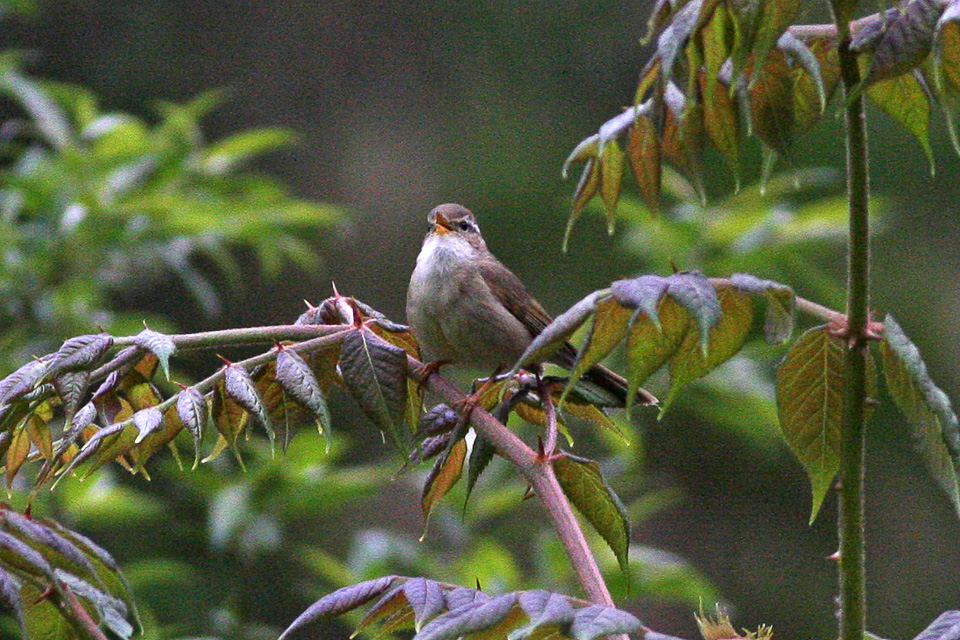
Gray-cheeked Warbler
Seicercus poliogenys
Order: Passeriformes / Family: Phylloscopidae

Wikimedia Commons
About the Gray-cheeked Warbler
The Gray-cheeked Warbler, Seicercus poliogenys, is a small passerine bird that thrives in the lush forests of Southeast Asia. This warbler exhibits a subtle yet distinctive plumage with olive-green upperparts contrasting with its gray cheeks, which lend the bird its common name. Found predominantly in regions like Bhutan, northern India, and Myanmar, the Gray-cheeked Warbler plays a significant role in its ecosystem as an insectivore, helping control insect populations. The bird's ecological importance extends to being a vital participant in the food web, serving as prey for larger avian predators.
This species is particularly fascinating due to its seasonal behaviors. During the breeding season, the Gray-cheeked Warbler migrates to higher altitudes, seeking the dense undergrowth of montane forests. Here, it engages in courtship displays and vocalizes frequently to establish territory and attract mates. The warbler's presence in diverse habitats, from subtropical forests to temperate woodlands, showcases its adaptability. Outside the breeding season, it descends to lower elevations, where it continues to forage actively.
The Gray-cheeked Warbler's significance extends beyond its immediate ecological roles. As a bioindicator, its presence or absence can reflect the health of its habitat. Changes in its population can signal shifts in forest health or the impact of human activities, such as deforestation and climate change. Conservation efforts for this species often focus on preserving its natural habitat, ensuring that the intricate balance of the ecosystems it inhabits remains undisturbed. The bird also attracts birdwatchers and ornithologists, who contribute to local economies and promote awareness of conservation issues.
The Gray-cheeked Warbler belongs to the family Phylloscopidae, within the order Passeriformes. These birds typically live average 3-5 years with a maximum recorded of 7 years..
How to Identify a Gray-cheeked Warbler
The Gray-cheeked Warbler can be identified by its olive-green upperparts and distinctive gray cheeks, which are unique to this species. Adult birds display these features prominently, while juveniles may have slightly duller coloration, making them harder to spot in dense foliage. Both males and females share similar plumage, which can make sexing the birds challenging outside of the breeding season when behavior might provide additional clues.
When observing this species in the field, note its small size and active behavior, as it flits through the lower and mid-canopy levels. The Gray-cheeked Warbler's flight silhouette is typical of warblers, with rapid wingbeats and short glides. It often perches with a slightly upright posture, frequently flicking its wings and tail. These subtle movements can help distinguish it from similar species, such as the Blyth's Leaf Warbler, which lacks the characteristic gray cheeks.
Another potential source of confusion is the Buff-barred Warbler, which shares the same general habitat but can be differentiated by the latter's buff wing bars and absence of gray cheeks. Identifying the Gray-cheeked Warbler requires careful observation and often a keen ear, as its vocalizations are distinct and can aid in confirming its presence.
Having trouble telling birds apart? Upload a photo to our bird identification tool for an instant species match.
Gray-cheeked Warbler Habitat and Range
Preferred Habitat
The Gray-cheeked Warbler inhabits a variety of forested environments in Southeast Asia. It is most commonly found in subtropical and temperate montane forests, where it favors dense undergrowth and thickets. These areas provide both cover and an abundance of insect prey. The species is adaptable to different elevations, typically ranging from 1,000 to 3,000 meters, though it may venture lower in the non-breeding season.
During the breeding season, the warbler prefers higher elevations with cooler climates and abundant ground cover. In contrast, outside of this period, it often descends to lower altitudes where it utilizes subtropical forests and even occasionally ventures into more disturbed habitats, such as secondary growth and forest edges. While primarily a forest dweller, the Gray-cheeked Warbler's adaptability allows it to persist in areas experiencing moderate human activity, although it generally avoids urban environments.
Its reliance on forest habitats means that the warbler is sensitive to habitat destruction and fragmentation. Conservation of these forested regions is crucial for maintaining healthy populations of the Gray-cheeked Warbler and other forest-dependent species.
Geographic Range
The Gray-cheeked Warbler breeds across several regions in Southeast Asia, with its range spanning parts of Bhutan, northern India, and Myanmar. It is known to nest in the montane forests of the eastern Himalayas, where suitable habitat and climate conditions support its breeding activities. During the breeding season, this species is typically found at higher elevations, where cooler temperatures and dense vegetation provide ideal conditions.
As the seasons change, the Gray-cheeked Warbler descends to lower elevations, exhibiting altitudinal migration rather than long-distance movements. This seasonal movement allows the bird to exploit different ecological niches throughout the year, maximizing its foraging opportunities and minimizing competition with other species. While not a long-distance migrant, the warbler's range does cover significant altitudinal gradients, demonstrating its adaptability to various environmental conditions.
Population density hotspots for the Gray-cheeked Warbler include undisturbed montane forests, particularly in Bhutan and northern India, where conservation efforts have focused on preserving these critical habitats. While its range is relatively limited geographically, the warbler's presence across multiple countries highlights the need for international cooperation in its conservation.
Want to know which birds visit your area? Browse our backyard birds by location guides for region-specific species lists.
What Does the Gray-cheeked Warbler Eat?
The Gray-cheeked Warbler's diet primarily consists of insects and other small arthropods, which it actively forages for in the dense undergrowth of its forest habitat. The bird employs a technique known as 'gleaning', where it picks off prey items from leaves and branches with precision. Its diet includes caterpillars, beetles, spiders, and a variety of other invertebrates, which provide the necessary nutrients for its active lifestyle.
Seasonal changes can influence the availability of prey, and the Gray-cheeked Warbler adjusts its foraging behavior accordingly. During the breeding season, when energy demands are higher, the warbler may increase its foraging rate to ensure sufficient food for both itself and its offspring. In the non-breeding season, the bird continues to feed primarily on insects but may also consume small quantities of plant material, such as berries or seeds, when insect prey is scarce.
The warbler's feeding schedule is largely diurnal, with peak activity occurring during the early morning and late afternoon. This pattern aligns with the activity of many insect species, optimizing the warbler's foraging efficiency. The bird's agile foraging tactics and ability to exploit various food sources underscore its adaptability and survival skills in the diverse forest ecosystems it inhabits.
Gray-cheeked Warbler Behavior and Social Structure
The Gray-cheeked Warbler exhibits a range of behaviors that reflect its adaptability and ecological niche. It is generally solitary or found in pairs, particularly during the breeding season when it establishes territories in dense forest undergrowth. Territorial behavior is prominent, with males engaging in vocal displays to ward off rivals and attract mates.
Courtship displays involve both vocalizations and physical displays, where the male may perform fluttering flights or wing-flicking to catch the female's attention. These behaviors are crucial during the breeding season, as they ensure the continuation of the species by facilitating pair bonding and mate selection.
Outside the breeding season, the Gray-cheeked Warbler may join mixed-species foraging flocks, a behavior that enhances foraging efficiency and provides protection against predators. This social structure allows the warbler to benefit from the vigilance of other birds while minimizing the risk of predation. When faced with threats, the warbler employs a variety of anti-predator tactics, including alarm calls and evasive flight maneuvers.
Daily activity patterns of the Gray-cheeked Warbler are primarily diurnal, with peak activity occurring during the cooler hours of the day. This timing aligns with the activity patterns of its insect prey, ensuring optimal foraging success. The warbler's behavior reflects a finely tuned adaptation to its environment, balancing the demands of foraging, reproduction, and predator avoidance.
Gray-cheeked Warbler Nesting and Reproduction
The Gray-cheeked Warbler constructs its nest with meticulous attention to detail, utilizing a range of materials suited to its forest habitat. Typically, the nest is built close to the ground, often concealed in dense underbrush or among the roots of trees. This location provides protection from predators and environmental elements.
Nest materials include moss, grass, leaves, and small twigs, which are woven together to form a cup-shaped structure. The interior is lined with softer materials, such as feathers or fine plant fibers, creating a comfortable environment for the eggs and nestlings. Clutch size for the Gray-cheeked Warbler generally ranges from three to five eggs, which are incubated primarily by the female.
The incubation period lasts approximately 12 to 14 days, during which the male plays a supportive role by feeding the female and assisting in territory defense. Once hatched, the young are altricial, requiring constant care and feeding from both parents. The fledging period is relatively short, lasting around 10 to 12 days before the young are ready to leave the nest.
Gray-cheeked Warblers typically produce one brood per year, although in optimal conditions, a second brood may be attempted. Parental investment is significant, with both adults involved in feeding and protecting the young until they are sufficiently independent. This commitment ensures high survival rates for the fledglings, contributing to the species' overall reproductive success.
Gray-cheeked Warbler Sounds and Vocalizations
The Gray-cheeked Warbler is known for its distinctive song, a series of rapid, high-pitched trills and whistles that vary in complexity. The primary song serves multiple functions, including territory establishment and mate attraction. The rhythm of the song is fast-paced, with a bright and clear quality that carries well through the dense forest habitat.
Call notes are shorter and simpler, often used for communication between mates or signaling alarm. These calls can be described as sharp 'chip' or 'tik' sounds, which are easily recognizable to experienced birders. Alarm calls are more urgent and harsh, intended to alert other birds to potential threats.
During the dawn chorus, the Gray-cheeked Warbler is an active participant, its song contributing to the vibrant acoustic landscape of the forest. The sound is reminiscent of other Phylloscopidae species but can be distinguished by the unique combination of trills and whistles.
The bird's vocalizations are a vital component of its behavior, facilitating social interactions and playing a critical role in its survival. Listening for these specific sounds can aid in locating and identifying the Gray-cheeked Warbler within its dense forest environment.
Interesting Facts About the Gray-cheeked Warbler
- 1The Gray-cheeked Warbler can cover elevations from 1,000 to 3,000 meters, showcasing remarkable adaptability.
- 2This warbler is part of the Phylloscopidae family, known for their leaf-gleaning foraging behavior.
- 3Despite being primarily insectivorous, it occasionally consumes berries when insect prey is scarce.
- 4The Gray-cheeked Warbler participates in mixed-species flocks outside breeding season, enhancing foraging success.
- 5Its song consists of rapid trills and whistles, making it a standout participant in the dawn chorus.
- 6The warbler's presence in forests acts as a bioindicator, reflecting the health of its environment.
- 7Successful conservation efforts have focused on habitat protection in Bhutan and northern India.
Gray-cheeked Warbler Conservation Status
The Gray-cheeked Warbler is currently classified as Least Concern by the IUCN, with populations considered stable across its range. However, ongoing habitat destruction and fragmentation pose significant threats to its long-term survival. Deforestation for agriculture and urban development reduces available habitat, impacting not only the Gray-cheeked Warbler but numerous other forest-dependent species. Conservation efforts focus on preserving and restoring forest habitats, particularly in regions where the warbler is most abundant. Protected areas and national parks in Bhutan and northern India play a crucial role in safeguarding critical breeding habitats. Additionally, international cooperation is essential for addressing habitat loss across the warbler's range. Historical data indicate that while the species has faced challenges due to habitat changes, effective conservation measures have mitigated more severe population declines. Continued monitoring and research are necessary to track population trends and address emerging threats. Public awareness and engagement are also vital components of conservation strategies, encouraging sustainable land-use practices and fostering appreciation for the biodiversity within the Gray-cheeked Warbler's habitat.