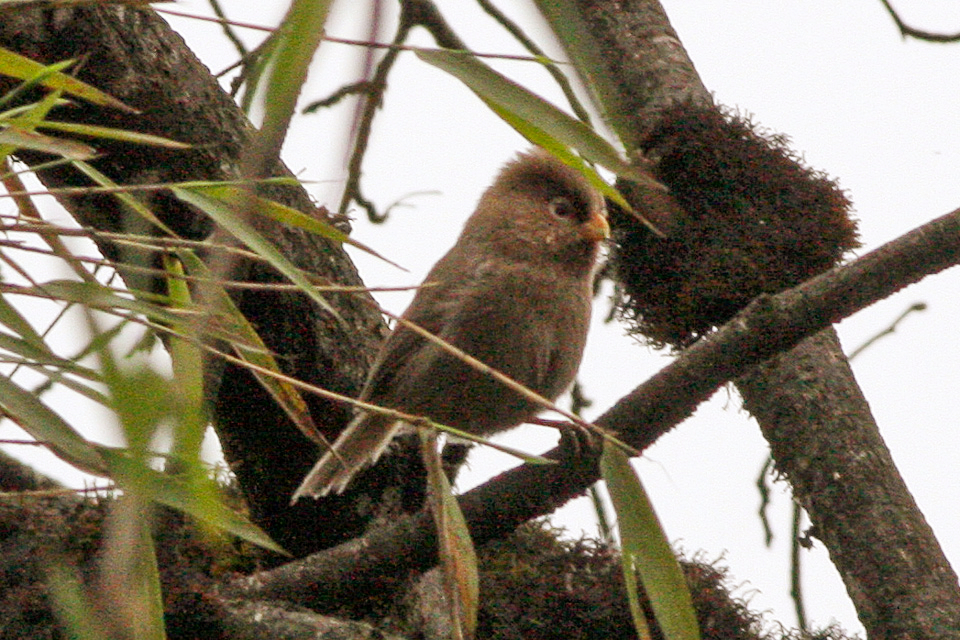
Gray-hooded Fulvetta
Fulvetta cinereiceps
Order: Passeriformes / Family: Sylviidae

Wikimedia Commons
About the Gray-hooded Fulvetta
The Gray-hooded Fulvetta (Fulvetta cinereiceps) is a small passerine bird renowned for its vibrant social behavior and distinctive gray head. Occupying the sylviid family, this bird is a common resident of the montane forests across parts of Asia, particularly in regions of central and southern China, Taiwan, and northern Vietnam. Typically found at elevations ranging from 1,000 to 3,500 meters, the Gray-hooded Fulvetta thrives in subtropical or tropical moist montane forests. It plays a significant role in the ecosystem as both a seed disperser and an insect controller. The species exhibits seasonal movements, often descending to lower altitudes during the colder months in search of food resources. Despite its small size, the Gray-hooded Fulvetta makes a substantial impact on the forest ecosystems it inhabits. Its presence indicates a healthy, biodiverse environment, as it is sensitive to habitat changes and requires intact forest areas with dense undergrowth for feeding and breeding. The bird’s ecological role extends to mutualistic relationships with other species, as it often participates in mixed-species foraging flocks, contributing to the dynamic balance of its habitat. The Gray-hooded Fulvetta's adaptability to varying altitudinal zones allows it to adjust its foraging strategies and dietary needs according to seasonal availability, thus demonstrating its resilience in the face of environmental changes. This adaptability, however, does not make it immune to threats such as deforestation and habitat fragmentation, which remain significant concerns for the continued viability of its populations across its range. Observations indicate that the Gray-hooded Fulvetta is an active and vocal participant in the dawn chorus, using its melodious song to establish territory and attract mates. Its ability to adapt its behavior seasonally is crucial for survival, as it must navigate the challenges posed by fluctuating food supplies and climatic conditions in its mountainous habitats.
The Gray-hooded Fulvetta belongs to the family Sylviidae, within the order Passeriformes. These birds typically live average 4-6 years with a maximum recorded of 10 years..
How to Identify a Gray-hooded Fulvetta
The Gray-hooded Fulvetta presents a distinctive appearance that aids birders in its identification. Adults have a notable gray head, which contrasts sharply with their olive-brown back and wings. The face is marked by a white eyering, adding to its striking facial features. The underparts are lighter, typically a soft buff color, which blends smoothly with the overall gray and brown tones of the plumage. Juveniles resemble adults but have slightly duller plumage, lacking the sharp contrast seen in mature birds. There is little sexual dimorphism in this species, with males and females exhibiting similar coloration and size, making gender identification in the field challenging. When observing the Gray-hooded Fulvetta in flight, its short, rounded wings and a slightly notched tail become apparent. The bird's flight is often described as undulating, characterized by a flutter, glide, and flutter pattern. In a seated posture, the bird often appears upright, maintaining a vigilant stance while foraging. While there is some potential for confusion with related species, such as the Rufous-winged Fulvetta, the Gray-hooded Fulvetta's gray head and lack of rufous coloring on the wings are key distinguishing features.
Having trouble telling birds apart? Upload a photo to our bird identification tool for an instant species match.
Gray-hooded Fulvetta Habitat and Range
Preferred Habitat
The Gray-hooded Fulvetta is predominantly found in subtropical or tropical moist montane forests. These forests provide the dense undergrowth and rich biodiversity necessary for its survival. It inhabits regions of central and southern China, Taiwan, and northern Vietnam, thriving at elevations from 1,000 to 3,500 meters. In these highland areas, the bird finds abundant food resources and nesting sites. Seasonal habitat shifts occur, with populations descending to lower elevations during colder months to exploit different food resources. While primarily a forest dweller, the Gray-hooded Fulvetta can occasionally be spotted at forest edges or in secondary growth areas, but it avoids urban environments, preferring the tranquility and cover of its natural habitat.
Geographic Range
The Gray-hooded Fulvetta's range extends across several Asian countries, including central and southern China, Taiwan, and northern Vietnam. It occupies a relatively narrow elevational band from 1,000 to 3,500 meters, where it finds suitable montane forest habitat. While it is not considered migratory in the traditional sense, the bird exhibits altitudinal migration, moving to lower elevations during winter months to adapt to changing environmental conditions. Population density is typically higher in regions with minimal human disturbance and intact forest cover. In China, the species is more frequent in provinces like Sichuan, Yunnan, and Guizhou, where extensive montane forests remain.
Want to know which birds visit your area? Browse our backyard birds by location guides for region-specific species lists.
What Does the Gray-hooded Fulvetta Eat?
The diet of the Gray-hooded Fulvetta primarily consists of insects and other small invertebrates, supplemented by seeds and berries. Insect foraging occurs primarily in the dense undergrowth of its forest habitat, where it skillfully picks insects from foliage and branches. Seasonal variations in diet are evident, with a higher reliance on seeds and berries during colder months when insect availability declines. The bird employs a methodical foraging strategy, often seen in mixed-species flocks, where it benefits from the collective vigilance and foraging efficiency of the group. Prey size is typically small, including ants, beetles, and caterpillars, which are abundant in its montane forest environment.
Gray-hooded Fulvetta Behavior and Social Structure
The Gray-hooded Fulvetta exhibits a highly social and interactive behavior, often seen in small flocks that engage in cooperative foraging. This social structure not only aids in finding food but also provides protection against predators through collective vigilance. The bird displays territorial behavior, especially during the breeding season when pairs establish and defend nesting territories. Courtship displays are characterized by mutual preening and the exchange of soft calls. Flocking is a year-round behavior, with the size of the flocks increasing during non-breeding seasons, as individuals gather in larger groups to forage and roost. The Gray-hooded Fulvetta is diurnal, with peak activity occurring during the morning and late afternoon. In response to predators, the bird relies on alarm calls and collective evasive maneuvers within the flock.
Gray-hooded Fulvetta Nesting and Reproduction
The Gray-hooded Fulvetta constructs its nest in dense shrubs or low tree branches, preferring locations that provide ample cover from predators. The nest is cup-shaped, made from grass, leaves, and strips of bark, often lined with finer materials for insulation. The typical clutch size ranges from three to five eggs, which are incubated by both parents for about 12 to 14 days. After hatching, both parents participate in feeding the chicks, which fledge approximately two weeks post-hatching. The species is known to raise two broods per year, depending on environmental conditions and food availability. Parental investment is high, with both parents actively involved in the protection and feeding of the young.
Gray-hooded Fulvetta Sounds and Vocalizations
The Gray-hooded Fulvetta's song is a series of melodious notes, often described as a mix of whistles and trills. Its primary song comprises rhythmic sequences that vary in pitch and are delivered with a sweet, clear quality. Calls include soft contact notes used to maintain flock cohesion and harsher alarm calls that signal the presence of predators. During the dawn chorus, the bird's song contributes to the vibrant soundscape of the montane forests it inhabits. The song can be compared to the gentle trills of other sylviid species, yet it retains a unique pattern that aids in its identification during field observations.
Interesting Facts About the Gray-hooded Fulvetta
- 1The Gray-hooded Fulvetta can be found at elevations up to 3,500 meters, making it a true highland resident.
- 2Despite its small size, it plays a significant role in seed dispersal, aiding forest regeneration.
- 3This fulvetta frequently joins mixed-species flocks, enhancing foraging success through cooperative behavior.
- 4The bird's song is often one of the first heard at dawn in its montane forest habitat, contributing to the dawn chorus.
- 5Gray-hooded Fulvettas are known for their adaptability, shifting altitudinally with changing seasons.
- 6Its sociable nature makes it one of the more easily observed sylviid species in its range.
- 7The Gray-hooded Fulvetta's nesting sites are often cleverly concealed within dense undergrowth, protecting it from predators.
Gray-hooded Fulvetta Conservation Status
The Gray-hooded Fulvetta is currently listed as a species of Least Concern on the IUCN Red List, with populations considered stable across much of its range. However, habitat destruction due to deforestation and land conversion poses ongoing threats. Conservation efforts focus on protecting forest habitats and maintaining ecological corridors that ensure the species can move freely across its range. Historical population changes are not well-documented, but ongoing habitat monitoring is crucial to detect potential declines. Local conservation programs emphasize the importance of preserving montane forests and addressing broader environmental challenges that could impact this and other species.