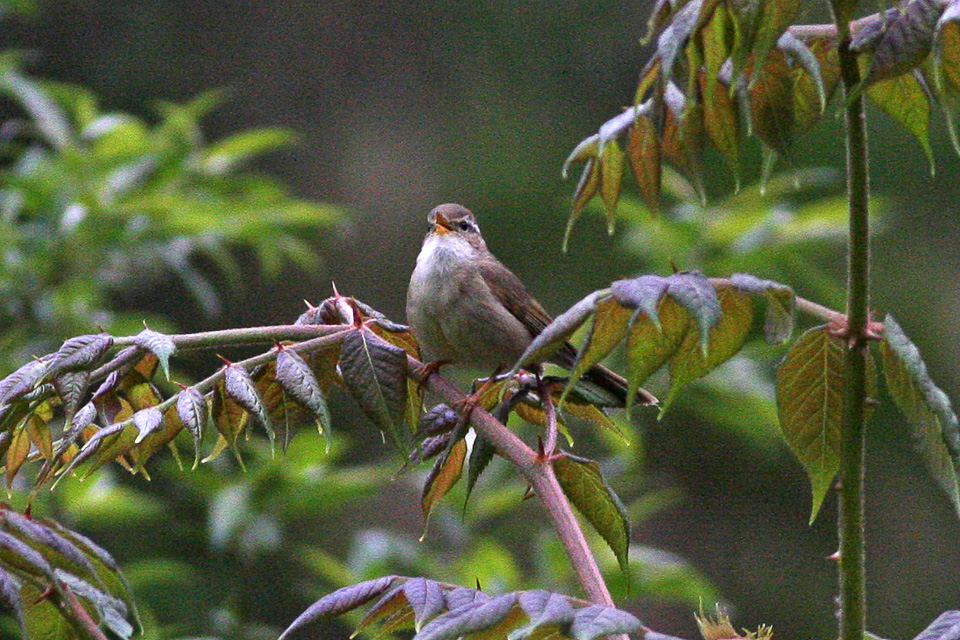
Hartert's Leaf Warbler
Phylloscopus goodsoni
Order: Passeriformes / Family: Phylloscopidae

Wikimedia Commons
About the Hartert's Leaf Warbler
Hartert's Leaf Warbler, Phylloscopus goodsoni, is a small songbird belonging to the family Phylloscopidae. This species is primarily found in the subtropical and tropical moist lowland forests of Southeast Asia, especially in regions like southern China and northern Vietnam. The warbler plays a significant ecological role as both a predator of insects and as prey for larger birds. Its presence indicates a healthy forest ecosystem due to its reliance on abundant insect populations and intact forest canopies. As an insectivorous bird, it helps control insect populations, contributing to the ecological balance within its habitat.
The warbler's vibrant plumage and distinct vocalizations make it a favorite among birdwatchers. During the breeding season, which occurs from March to July, Hartert's Leaf Warbler becomes more vocal, using its song to establish territories and attract mates. Outside of the breeding season, the bird may form mixed-species flocks, particularly during migration periods, which helps reduce predation risks and improve foraging efficiency.
Hartert's Leaf Warbler's adaptability to various forest types, from dense primary forests to secondary growth, makes it a relatively resilient species. However, ongoing habitat loss due to deforestation poses a significant threat. Efforts to preserve and restore its natural habitats are crucial for the conservation of this species. Its ability to thrive in diverse forest environments, including montane and lowland areas, underscores its ecological importance and adaptability.
The Hartert's Leaf Warbler belongs to the family Phylloscopidae, within the order Passeriformes. These birds typically live average 4 years with a max recorded of 6 years..
How to Identify a Hartert's Leaf Warbler
Hartert's Leaf Warbler is best identified by its small size, measuring about 10 cm in length, with a wingspan ranging from 15 to 20 cm. The adult plumage is predominantly green, with a striking yellowish tinge on the underparts. The warbler's upperparts display a more olive-green coloration, providing excellent camouflage among the forest foliage.
Juvenile Hartert's Leaf Warblers resemble adults but exhibit slightly duller plumage. Unlike many bird species, male and female Hartert's Leaf Warblers are similar in appearance, making sex determination in the field challenging. However, during the breeding season, males may be more vocal and exhibit slightly brighter plumage.
This warbler can sometimes be confused with other Phylloscopus species, such as the Yellow-browed Warbler, but Hartert's Leaf Warbler lacks the conspicuous yellow eyebrow stripe present in the latter. In flight, the warbler displays a rapid, fluttery wingbeat. When perched, it often flicks its wings and tail, a behavior typical of many Phylloscopus warblers.
Having trouble telling birds apart? Upload a photo to our bird identification tool for an instant species match.
Hartert's Leaf Warbler Habitat and Range
Preferred Habitat
Hartert's Leaf Warbler inhabits subtropical and tropical moist lowland forests, favoring dense canopy cover. It thrives in primary forests but also adapts to secondary forests and forest edges. The species is often found at elevations ranging from sea level up to 2,000 meters, with a preference for areas rich in insect life.
During the breeding season, the warbler seeks out forests with ample cover to conceal its nest. In non-breeding months, Hartert's Leaf Warbler may move to slightly different habitats, such as scrublands and open woodlands, as it forms mixed-species flocks to forage.
Although primarily a forest bird, it can sometimes be found in more urbanized areas with suitable tree cover. However, its presence in rural areas is more common, where forest patches are more prevalent.
Geographic Range
Hartert's Leaf Warbler primarily breeds in the forested regions of southern China, including provinces such as Yunnan and Guangxi. Its breeding range extends into northern Vietnam, particularly in areas with high forest density and rich biodiversity.
During the non-breeding season, the warbler may undertake short-distance migrations, moving slightly southward. It remains largely within Southeast Asia, with some populations possibly reaching northern Thailand.
Population density hotspots include the karst landscapes of Guangxi and the mountainous areas of Yunnan, where the warbler's preferred habitat is abundant. Although not considered a long-distance migrator, its movements are influenced by seasonal changes in food availability and climate conditions.
Want to know which birds visit your area? Browse our backyard birds by location guides for region-specific species lists.
What Does the Hartert's Leaf Warbler Eat?
Hartert's Leaf Warbler is primarily insectivorous, feeding on a variety of small insects and spiders. Its diet includes caterpillars, beetles, and flies, with occasional consumption of small arthropods.
During the breeding season, the warbler increases its food intake to support the energy demands of nesting and feeding young. It forages actively among leaves and branches, employing a gleaning technique to pick insects from foliage.
In the non-breeding season, its diet remains largely the same, but it may expand to include more diverse prey types due to changes in insect availability. The warbler often forages in mixed flocks, which enhances its foraging success by reducing competition and increasing access to varied food sources.
Hartert's Leaf Warbler Behavior and Social Structure
Hartert's Leaf Warbler displays a complex social structure, particularly during the breeding season when it becomes highly territorial. Males sing vigorously to establish and defend territories, using their rapid and melodic song as a primary tool.
Outside the breeding season, the warbler often joins mixed-species flocks, a behavior that provides safety in numbers and increases foraging efficiency. These flocks usually consist of other small insectivorous birds, allowing the warbler to benefit from different foraging techniques and vigilance against predators.
The warbler exhibits notable courtship displays, with males showcasing their plumage and vocal abilities to attract females. When faced with predators, Hartert's Leaf Warbler employs a blend of alarm calls and evasive maneuvers, often retreating to denser vegetation for cover.
Daily activity patterns show that the warbler is most active during the early morning and late afternoon, aligning its foraging and social behaviors with peak insect activity.
Hartert's Leaf Warbler Nesting and Reproduction
Hartert's Leaf Warbler constructs a cup-shaped nest, typically located in dense foliage or shrubbery to protect it from predators. The nest is composed of grasses, leaves, and moss, expertly woven together to create a secure environment for the eggs.
Preferred nesting sites are usually at low to mid-level in the forest understory, providing both concealment and easy access for the nesting adults. The typical clutch size is four to six eggs, which both parents incubate over a period of approximately 12 to 14 days.
After hatching, the chicks remain in the nest for about 10 to 12 days before fledging. During this time, both parents actively participate in feeding and caring for the young. Hartert's Leaf Warbler generally raises one brood per year, although favorable conditions may occasionally lead to a second brood.
Hartert's Leaf Warbler Sounds and Vocalizations
The primary song of Hartert's Leaf Warbler consists of a rapid series of high-pitched notes, often described as a trilling sequence that rises and falls in pitch. This song serves as both a territorial and courtship display, with males singing more frequently during the breeding season.
In addition to its song, the warbler uses various call notes, including sharp 'chip' sounds when alarmed. These calls help maintain contact with mates and alert other birds to potential threats.
During the dawn chorus, Hartert's Leaf Warbler's song blends with those of other forest birds, creating a rich tapestry of sound. Its rhythmic and melodious song is distinctive yet harmonizes well with the diverse vocalizations of its habitat.
Interesting Facts About the Hartert's Leaf Warbler
- 1Hartert's Leaf Warbler is named after Ernst Hartert, a notable German ornithologist who contributed significantly to avian taxonomy.
- 2Despite its small size, Hartert's Leaf Warbler can produce a remarkably loud and complex song, often heard echoing through its forest habitat.
- 3The warbler's ability to adapt to both primary and secondary forests makes it a resilient species in the face of environmental changes.
- 4Hartert's Leaf Warbler exhibits unique wing-flicking behavior when foraging, a trait shared with other Phylloscopus warblers.
- 5Its mixed-species flocking behavior during non-breeding seasons enhances foraging success and reduces predation risks.
Hartert's Leaf Warbler Conservation Status
Hartert's Leaf Warbler currently holds a status of Least Concern according to the IUCN, with its population considered stable. However, habitat destruction through deforestation poses a significant threat to its long-term survival. Conservation efforts focus on habitat preservation and restoration, particularly in regions experiencing rapid development. Historical population assessments indicate that while the species has remained relatively stable, localized declines have occurred in areas with significant habitat loss. Ongoing research and conservation programs aim to mitigate these threats by promoting sustainable forestry practices and protecting key habitats within its range.