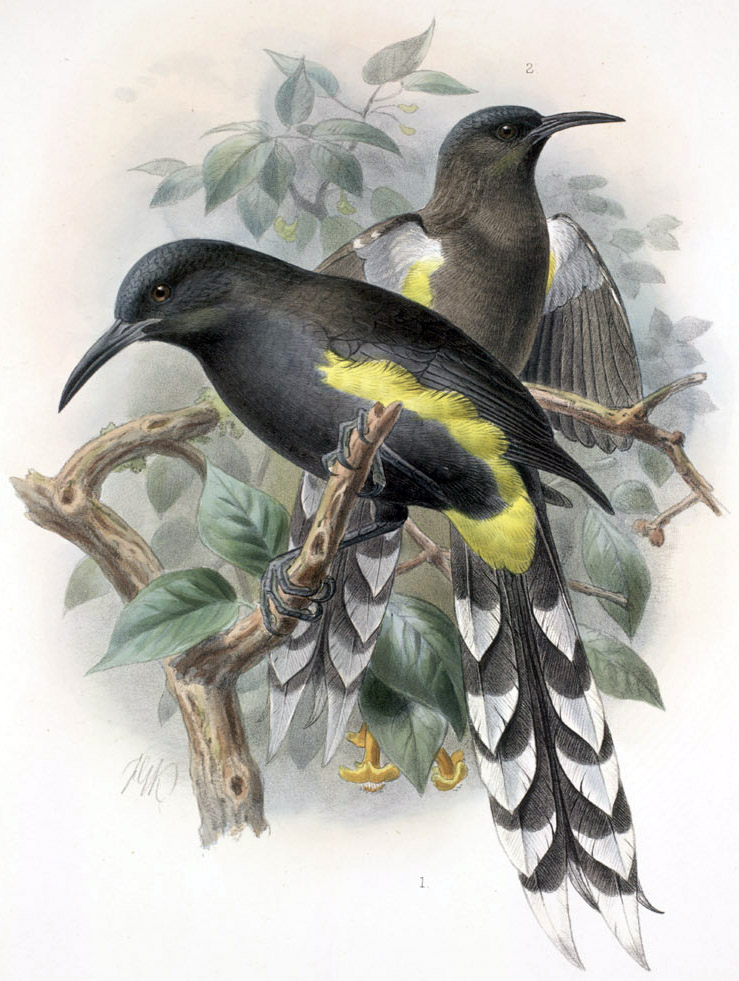
Hawaii Oo
Moho nobilis
Order: Passeriformes / Family: Mohoidae

Wikimedia Commons
About the Hawaii Oo
The Hawaii Oo, scientifically known as Moho nobilis, was a bird endemic to the Hawaiian Islands, particularly noted for its striking appearance and melodious song. Historically, it occupied the forests of the islands, playing a crucial ecological role by pollinating native plants. The Hawaii Oo was a significant part of the island's culture and biodiversity, often associated with Hawaiian mythology and considered a symbol of the islands' vibrant natural history. Unfortunately, due to habitat destruction, the introduction of invasive species, and diseases such as avian malaria, the Hawaii Oo faced extinction. Its decline started in the late 19th century, and despite conservation efforts, the last confirmed sighting was in the late 1930s. This bird was primarily found in the native Hawaiian forests, ranging from lowland areas to higher elevations, where it thrived among the endemic flora. The Hawaii Oo contributed to the pollination of plants like the lobelia and the ohia lehua, playing a part in maintaining the island's unique ecosystem. Seasonally, the Hawaii Oo was most vocal during the breeding season, using its song to establish territory and attract mates. The extinction of the Hawaii Oo signifies a loss not only of a species but of an integral component of Hawaii's natural heritage. It serves as a poignant reminder of the fragility of island ecosystems and the impacts of human activity and introduced species on endemic wildlife.
The Hawaii Oo belongs to the family Mohoidae, within the order Passeriformes. These birds typically live unknown due to extinction, but similar species lived 5-10 years..
How to Identify a Hawaii Oo
The Hawaii Oo was characterized by its glossy black plumage, which shimmered in the sunlight, giving the bird a striking appearance. Its most distinguishing feature was the bright yellow tufts on its legs, which stood out vividly against the darker feathers. These tufts were not only visually distinctive but also played a role in mating displays. The adult Hawaii Oo had a slight iridescence to its feathers, with subtle hints of green and purple when viewed at certain angles. Juveniles were similar in appearance but tended to have slightly duller plumage with less pronounced leg tufts. Both males and females exhibited similar coloration, making it challenging to distinguish between the sexes in the field. In flight, the Hawaii Oo resembled other members of the Mohoidae family, with a strong, swift flying pattern. Its perching posture was upright, often observed in the canopy as it moved between flowering plants. The Hawaii Oo could be confused with other native Hawaiian birds, such as the iiwi or amakihi, but its unique leg tufts and overall larger size set it apart.
Having trouble telling birds apart? Upload a photo to our bird identification tool for an instant species match.
Hawaii Oo Habitat and Range
Preferred Habitat
The Hawaii Oo primarily inhabited the lush, dense forests of the Hawaiian Islands, thriving in regions with abundant flowering plants. It preferred elevations ranging from sea level up to 2,000 meters, although it was more commonly found in mid-elevation forests. This bird's habitat consisted of areas rich in native flora, including ohia lehua and koa trees, which provided both food sources and nesting sites. Seasonal shifts in habitat use were observed, with the Hawaii Oo potentially moving to different elevations based on the availability of flowering plants. Unlike some avian species, the Hawaii Oo was not typically found in urban areas, as it relied heavily on the native forest ecosystem for its survival. The decline of these habitats due to logging, agriculture, and urban development significantly contributed to the species' extinction.
Geographic Range
The Hawaii Oo was endemic to the Hawaiian Islands, with its range historically covering the islands of Oahu, Maui, and Hawaii. While its presence was once widespread across these islands, its range contracted significantly as populations declined. Breeding and nesting occurred within the native forests, where the bird was most commonly observed. The Hawaii Oo did not migrate, as it was a year-round resident of the islands. Population density was highest in areas where native vegetation thrived, providing ample food and nesting opportunities. As habitats diminished, so did the range, leading to localized populations that eventually disappeared. Today, the Hawaii Oo serves as a reminder of the rich biodiversity that once existed across the Hawaiian Islands.
Want to know which birds visit your area? Browse our backyard birds by location guides for region-specific species lists.
What Does the Hawaii Oo Eat?
The Hawaii Oo primarily fed on nectar from native Hawaiian plants, making it an important pollinator within its ecosystem. Its curved bill was adapted for accessing the nectar of flowers such as those of the ohia lehua and lobelia. In addition to nectar, the Hawaii Oo consumed insects, which provided essential proteins, especially during the breeding season. This diet shift was crucial for raising young, as insects offered the necessary nutrients for chick development. The bird employed a foraging technique that involved moving swiftly through the canopy, probing flowers for nectar and occasionally catching insects in flight. Its feeding schedule was diurnal, with peak activity occurring during the early morning and late afternoon. The Hawaii Oo's reliance on specific native plants made it vulnerable to habitat changes and the introduction of invasive plant species.
Hawaii Oo Behavior and Social Structure
The Hawaii Oo exhibited a range of behaviors typical of nectar-feeding birds, including a high degree of mobility as it moved through the forest canopy. It was primarily a solitary bird outside the breeding season, although pairs formed strong bonds during nesting. Territorial behavior was pronounced, with males singing to establish and defend their territory. The song of the Hawaii Oo was a series of melodious notes, used both to attract mates and to ward off competitors. Courtship involved elaborate displays, with the male showcasing its bright leg tufts and performing aerial maneuvers to impress the female. The Hawaii Oo responded to predators with alarm calls and evasive flight patterns, often seeking refuge in dense foliage. Its daily activity pattern revolved around foraging during the cooler parts of the day, while resting or preening during midday when temperatures were higher.
Hawaii Oo Nesting and Reproduction
The Hawaii Oo constructed cup-shaped nests using materials gathered from its surroundings, such as twigs, leaves, and moss. Nests were typically located in the forks of trees, often at considerable height to avoid ground-based predators. Clutch size generally consisted of two to three eggs, with both parents involved in incubation. The incubation period lasted approximately two weeks, during which the female primarily incubated the eggs while the male provided food. Once hatched, the chicks remained in the nest for another two to three weeks, receiving care and feeding from both parents. The fledging timeline was relatively short, a necessary adaptation for survival in an environment with many potential threats. The Hawaii Oo likely raised one brood per year, although this may have varied depending on food availability and environmental conditions.
Hawaii Oo Sounds and Vocalizations
The primary song of the Hawaii Oo was a melodious sequence of flute-like notes, often described as hauntingly beautiful. The rhythm was varied, with a mix of long and short notes that echoed through the forest canopy. Call notes were simpler, used for communication between mates or signaling alarm. The alarm call was a sharp, repetitive note, distinct from the bird's more musical song. During the dawn chorus, the Hawaii Oo's song stood out, contributing to the symphony of sounds that marked the beginning of a new day in the Hawaiian forest. Compared to more common birds, the song of the Hawaii Oo was rich and complex, a testament to its role as a key species within its habitat.
Interesting Facts About the Hawaii Oo
- 1The Hawaii Oo's bright yellow leg tufts were not just for show; they played a crucial role in mating displays, helping males attract females.
- 2Despite being extinct, the Hawaii Oo's song was so distinctive that it remains a point of study for ornithologists interested in the acoustic ecology of Hawaiian birds.
- 3The Hawaii Oo was one of the last members of the Mohoidae family, a group of birds that were once widespread across the Hawaiian Islands.
- 4In Hawaiian mythology, the Hawaii Oo was often associated with the gods and considered a sacred bird, symbolizing the connection between nature and the divine.
- 5The decline of the Hawaii Oo began with the arrival of Europeans in Hawaii, who introduced new species and altered the natural landscape.
Hawaii Oo Conservation Status
The IUCN classifies the Hawaii Oo as extinct, with the last confirmed sighting in the late 1930s. The primary threats leading to its extinction included habitat destruction, invasive species, and diseases such as avian malaria. Conservation efforts in the late 20th century focused on habitat restoration and the control of introduced species, but these measures came too late for the Hawaii Oo. Historically, the population declined rapidly as human activities altered the landscape. The extinction of the Hawaii Oo highlights the urgent need for proactive conservation strategies to protect remaining endemic species in Hawaii and similar island ecosystems worldwide.