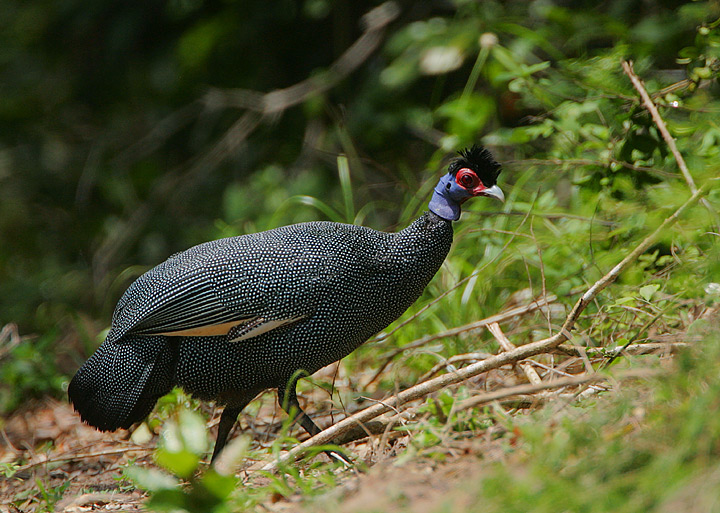
Helmeted Guineafowl
Numida meleagris
Order: Galliformes / Family: Numididae

Wikimedia Commons
About the Helmeted Guineafowl
The Helmeted Guineafowl (Numida meleagris) stands out as a distinctive member of the family Numididae, primarily found in sub-Saharan Africa. Known for its unique appearance and vocal nature, this bird plays a significant ecological role in its native habitats. Helmeted Guineafowl thrive in a variety of environments, including savannas, grasslands, and open woodlands. They are particularly abundant in countries like South Africa, Botswana, and Namibia, where they are often seen foraging in flocks. This bird is easily recognized by its helmet-like casque, a feature that not only aids in identification but also serves practical purposes, such as protection when moving through dense vegetation. Helmeted Guineafowl are social birds, often forming large flocks that can number in the dozens. These birds contribute to their ecosystems by controlling insect populations, as they feed on a variety of invertebrates, playing a vital role in pest management. Their foraging behavior also aids in seed dispersal, promoting plant diversity. Seasonally, Helmeted Guineafowl may adjust their movements slightly within their range in response to food availability and environmental conditions. During the breeding season, which typically occurs during the rainy months, their activities are more localized, focusing on nesting and raising their young. The Helmeted Guineafowl's adaptability to various habitats and its ability to thrive in both wild and semi-domesticated environments underline its ecological importance. These birds are often introduced outside their native range for agricultural purposes due to their role in controlling pests. Despite this, Helmeted Guineafowl maintain a stable population, aided by their adaptability and widespread distribution. However, they still face threats from habitat destruction and hunting in some areas. Overall, the Helmeted Guineafowl exemplifies a successful species that has carved out a niche across diverse habitats.
The Helmeted Guineafowl belongs to the family Numididae, within the order Galliformes. These birds typically live average 10-15 years with a maximum recorded of 20 years..
How to Identify a Helmeted Guineafowl
The Helmeted Guineafowl displays a striking appearance, characterized by its gray body speckled with small white spots. The most notable feature is its helmet-like casque on the head, which, combined with a bare face and bright blue skin, gives this bird its distinctive look. Adults typically have a uniform plumage pattern, but juvenile birds show less defined spots and a more muted color palette. Males and females appear similar, making gender differentiation challenging without close observation. However, males are slightly larger and may display more vibrant head coloration. In flight, the Helmeted Guineafowl shows a silhouette of broad wings and a short tail, giving it a somewhat ungainly appearance. Unlike many birds, they prefer running to flying, often seen sprinting with heads held low. When perching, they stand upright, displaying their full profile. Confusion with other guineafowl species can occur, but the Helmeted Guineafowl's casque and distinct spotted pattern are reliable identifiers.
Having trouble telling birds apart? Upload a photo to our bird identification tool for an instant species match.
Helmeted Guineafowl Habitat and Range
Preferred Habitat
Helmeted Guineafowl favor open habitats such as savannas, grasslands, and lightly wooded areas. They thrive in regions with a mix of open spaces and cover, which provides protection from predators. In Africa, they are commonly found from sea level to elevations of around 3000 meters, adapting to various climate conditions. Seasonal changes may lead them to seek areas with abundant food sources, often closer to water during dry months. While primarily rural, they can adapt to urban fringes, often visiting farmlands and gardens where food is readily available.
Geographic Range
The range of the Helmeted Guineafowl covers much of sub-Saharan Africa, from Senegal and Guinea in the west to Ethiopia and Kenya in the east, and extending southwards to South Africa. They are sedentary birds in much of their range, with localized movements rather than long migrations. In areas like the Sahel, they may move seasonally, tracking resources. Populations introduced in Europe and the Americas have established in some areas, though they remain more common in their native African range.
Want to know which birds visit your area? Browse our backyard birds by location guides for region-specific species lists.
What Does the Helmeted Guineafowl Eat?
Helmeted Guineafowl have an omnivorous diet, primarily consisting of insects like grasshoppers, beetles, and ants, which they forage for by scratching the ground. They also consume seeds, tubers, and small reptiles. During the wet season, their diet shifts towards more insects due to increased availability, while in the dry season, seeds and plant material become more prominent. Guineafowl feed mainly during the early morning and late afternoon, employing a methodical foraging pattern that covers the ground efficiently.
Helmeted Guineafowl Behavior and Social Structure
Helmeted Guineafowl are social creatures, forming flocks that can range from a few individuals to over 20 birds. These flocks often engage in cooperative behaviors such as communal roosting in trees during the night to avoid predators. They exhibit strong territorial instincts, especially during the breeding season, with males frequently displaying aggressive behaviors to defend their space. Courtship involves elaborate displays, where males puff up their feathers and produce grating calls. The birds also employ a variety of vocalizations to maintain group cohesion and alert others to danger.
Helmeted Guineafowl Nesting and Reproduction
Helmeted Guineafowl nest on the ground in shallow scrapes lined with vegetation. Preferred nesting locations are well-concealed spots with dense cover. The typical clutch size ranges from 6 to 12 eggs, with an incubation period of about 26 to 28 days. Both parents participate in incubation and rearing, though the female primarily incubates the eggs. Chicks are precocial, leaving the nest shortly after hatching and are cared for by both parents. The species typically raises one brood per year, although favorable conditions can lead to more.
Helmeted Guineafowl Sounds and Vocalizations
The Helmeted Guineafowl has a distinctive call, often described as a harsh, repetitive cackling or clucking. These calls vary in pitch and urgency, serving different purposes such as alarms or communication between flock members. Their vocal repertoire includes a series of grating, metallic notes, especially during territorial disputes or courtship. Their calls are most frequent at dawn and dusk, coinciding with their peak activity periods, creating a characteristic soundscape in their habitats.
Interesting Facts About the Helmeted Guineafowl
- 1Helmeted Guineafowl can run at speeds up to 35 kilometers per hour, preferring to flee on foot rather than fly.
- 2Their distinctive helmet-like casque serves as protection when moving through dense underbrush.
- 3Flocks of Helmeted Guineafowl can number from 10 to over 200 individuals in ideal conditions.
- 4Despite their awkward flight, Helmeted Guineafowl can cover short distances quickly if threatened.
- 5Helmeted Guineafowl are known to form symbiotic relationships with mammals like zebras, feeding on insects disturbed by grazing.
- 6They have been domesticated in some regions, valued for their meat and pest control abilities.
- 7Helmeted Guineafowl chicks, known as keets, are precocial and leave the nest shortly after hatching.
Helmeted Guineafowl Conservation Status
The IUCN lists the Helmeted Guineafowl as a species of least concern, with stable population trends. However, threats such as habitat loss and hunting in certain regions could impact populations. Conservation measures include habitat preservation and ensuring sustainable hunting practices. Historically, their widespread distribution has allowed them to maintain robust numbers, and continued efforts to protect their habitats will be crucial for their future conservation.
Other Numididae Species


Birds Similar to the Helmeted Guineafowl
These species are often confused with the Helmeted Guineafowl due to similar appearance or overlapping range.