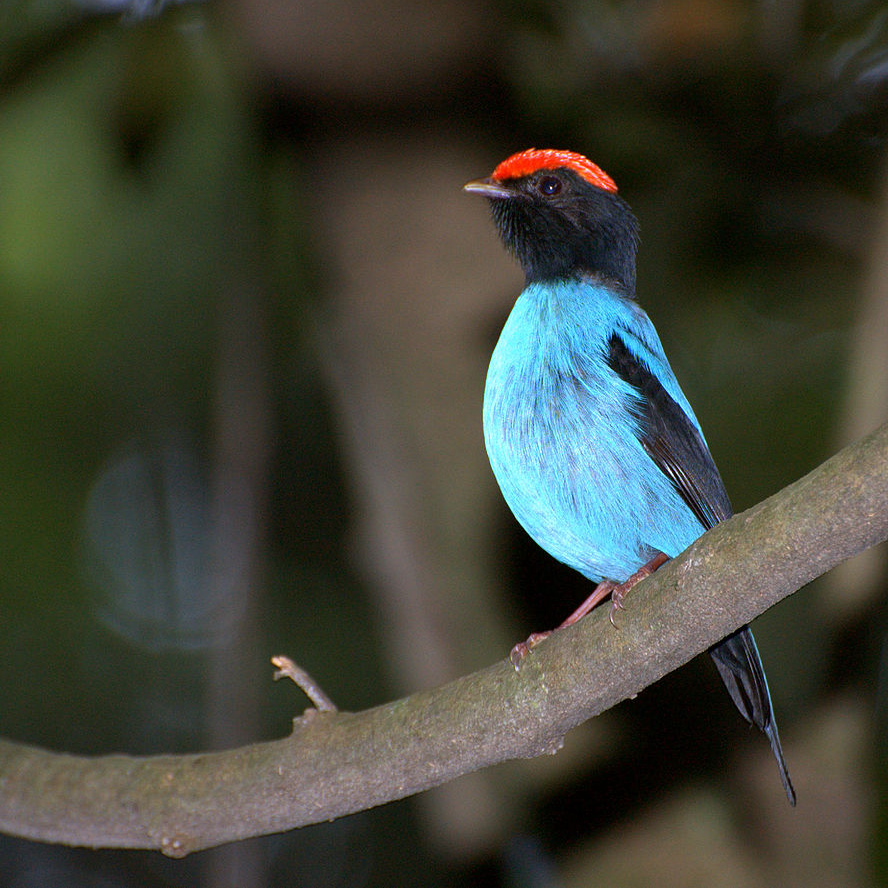
Lance-tailed Manakin
Chiroxiphia lanceolata
Order: Passeriformes / Family: Pipridae

Wikimedia Commons
About the Lance-tailed Manakin
The Lance-tailed Manakin (Chiroxiphia lanceolata) is a striking member of the Pipridae family, known for its vibrant coloration and fascinating behaviors. This species inhabits tropical and subtropical regions, primarily in Central America, where it plays a significant role in local ecosystems. The Lance-tailed Manakin can be found from southeastern Mexico through Panama, residing in lowland forests, forest edges, and secondary growth areas. Its presence in these habitats contributes to seed dispersal, a critical ecological role that helps maintain forest diversity and health. During the breeding season, the Lance-tailed Manakin becomes particularly significant due to its unique lekking behavior. Males gather in small groups to perform elaborate courtship displays, which are crucial for attracting females. These displays involve coordinated dances and vocalizations, showcasing the males' agility and vibrant plumage. Such behaviors not only highlight the species' intricate social dynamics but also underscore the evolutionary importance of sexual selection. The Lance-tailed Manakin's ecological significance extends beyond its reproductive strategies. As an insectivore and frugivore, it helps control insect populations and facilitates plant reproduction through seed dispersal. Its diet consists of a variety of fruits and insects, which it forages for in the mid to upper canopy. The presence of the Lance-tailed Manakin in its habitat indicates a healthy ecosystem, as it requires a diverse array of flora and fauna to thrive. Seasonal behaviors of the Lance-tailed Manakin include its breeding and molting cycles. During the rainy season, typically from May to August, breeding activities peak, and males engage in their most active displays. This period coincides with an abundance of food resources, supporting the energetic demands of reproduction. Outside the breeding season, the Lance-tailed Manakin may display more solitary behaviors, although it remains an active participant in its ecosystem year-round.
The Lance-tailed Manakin belongs to the family Pipridae, within the order Passeriformes. These birds typically live average 7 years, with a maximum recorded of 10 years..
How to Identify a Lance-tailed Manakin
The Lance-tailed Manakin is easily identifiable by its striking blue and black plumage, which is particularly vivid in adult males. The males possess a sleek, glossy black body contrasted by brilliant blue on their wings and back. A distinguishing feature is the bright red crown, a trait that sets it apart from similar species. Females and juveniles, however, exhibit a more muted olive-green coloration, aiding in camouflage within their lush forest habitats. This sexual dimorphism plays a critical role in their mating displays, where the males' bright colors are essential for attracting mates. In terms of size, the Lance-tailed Manakin measures approximately 13-15 centimeters in length, making it a small, compact bird. Its short tail and rounded wings contribute to a distinctive silhouette both at rest and in flight. When perched, the Lance-tailed Manakin often adopts an upright posture, which, combined with its vivid coloration, makes it a standout in the forest understory. Confusion with similar species can occur, particularly with other manakins in the same range, such as the Blue-backed Manakin. However, the Lance-tailed Manakin's unique combination of red crown and blue body helps distinguish it from these counterparts.
Having trouble telling birds apart? Upload a photo to our bird identification tool for an instant species match.
Lance-tailed Manakin Habitat and Range
Preferred Habitat
The Lance-tailed Manakin primarily inhabits tropical and subtropical lowland forests, thriving in areas with dense foliage and a rich diversity of plant life. It is commonly found in forest edges and secondary growth, where sunlight penetration supports a variety of fruiting plants. This bird prefers elevations from sea level up to approximately 1,200 meters, favoring habitats that provide ample cover and food resources. Seasonal habitat shifts are minimal for the Lance-tailed Manakin, as it tends to remain in its preferred environments year-round. While it is more commonly associated with rural and forested areas, it can occasionally be spotted in urban parks and gardens that mimic its natural habitat. Such adaptability allows it to maintain a stable presence across its range despite habitat fragmentation.
Geographic Range
The Lance-tailed Manakin boasts a relatively stable range, primarily extending through Central America. Its breeding range covers southeastern Mexico, Belize, Costa Rica, Nicaragua, and Panama. This non-migratory species tends to remain within its established territories throughout the year, although some local movements may occur in response to food availability. Within its range, the Lance-tailed Manakin is most densely populated in regions with extensive lowland forest cover, particularly in national parks and reserves where its habitat remains undisturbed. Key habitats include the rainforests of Costa Rica, such as those found in Corcovado National Park, where the species enjoys protection and abundant resources. While not a migratory bird, the Lance-tailed Manakin's range includes corridors that support its dispersal and genetic diversity across populations.
Want to know which birds visit your area? Browse our backyard birds by location guides for region-specific species lists.
What Does the Lance-tailed Manakin Eat?
The Lance-tailed Manakin's diet primarily consists of a diverse array of fruits and insects, reflecting its role as both a frugivore and insectivore. This diet supports the bird's high energy needs, particularly during the breeding season when males engage in elaborate displays. The Lance-tailed Manakin forages primarily in the mid to upper canopy, utilizing its agile flight to navigate dense foliage. Fruits make up the bulk of its diet, with the bird favoring small berries and drupes that it plucks while hovering or perching. Seasonal changes in fruit availability can influence its foraging patterns, causing the Lance-tailed Manakin to adjust its diet accordingly. Insects, including beetles, ants, and caterpillars, complement its diet, providing essential protein. The bird typically captures insects mid-flight or gleans them from leaves, showcasing its adaptability in foraging techniques. Feeding occurs throughout the day, with peaks during the morning and late afternoon when temperatures are cooler, and insect activity is high.
Lance-tailed Manakin Behavior and Social Structure
The Lance-tailed Manakin exhibits complex social behaviors, particularly during the breeding season when males participate in lekking. This involves groups of males gathering in designated areas to perform synchronized dances and vocalizations. Such displays, essential for attracting females, highlight the bird's intricate social dynamics and reliance on visual and auditory signals. Outside of the breeding season, the Lance-tailed Manakin maintains a more solitary or loosely social lifestyle, often foraging alone or in small, mixed-species flocks. This behavior allows it to exploit a range of food resources while minimizing competition. Territorial behavior is evident among males, particularly during lekking, as they fiercely defend their display sites from rivals. In response to predators, the Lance-tailed Manakin relies on its agility and small size to evade capture, often retreating into dense foliage. While primarily diurnal, it exhibits peak activity during the cooler parts of the day, aligning with its feeding and social behaviors.
Lance-tailed Manakin Nesting and Reproduction
The Lance-tailed Manakin constructs open cup nests, typically located in the fork of a tree branch or shrub within its forest habitat. Nest construction involves the use of fine plant fibers, leaves, and moss, creating a well-camouflaged structure that blends seamlessly with its surroundings. Females take on the primary role in nest building, incubation, and rearing of the young, while males focus on courtship and lekking activities. Clutch size generally ranges from 2 to 3 eggs, with an incubation period of approximately 18 to 21 days. The female alone incubates the eggs and cares for the hatchlings, which fledge about 18 to 20 days after hatching. The Lance-tailed Manakin typically raises one brood per year, although favorable conditions may allow for a second. This reproductive strategy reflects the bird's adaptation to its stable, resource-rich environment, ensuring the successful rearing of offspring.
Lance-tailed Manakin Sounds and Vocalizations
The Lance-tailed Manakin's vocalizations play a crucial role in its courtship displays and communication. Its primary song consists of a series of high-pitched, melodic whistles that can be described as clear and flute-like. These songs serve to attract females during lekking, with males often engaging in duets or choruses to amplify their presence. Call notes include sharp, distinctive 'peet' sounds, used in short-range communication between individuals. Alarm calls are more abrupt and harsher, serving as warnings to potential threats. The Lance-tailed Manakin participates in dawn choruses, where males sing vigorously at first light to establish territory and attract mates, contributing to the rich soundscape of its forest habitat.
Interesting Facts About the Lance-tailed Manakin
- 1The Lance-tailed Manakin's courtship dance can involve up to two males performing in tandem to impress a single female.
- 2Male Lance-tailed Manakins have a unique, cooperative lekking system where young males learn from older, experienced males.
- 3Despite their bright colors, Lance-tailed Manakins are often difficult to spot due to their preference for dense forest habitats.
- 4The Lance-tailed Manakin is named for its lance-like tail feathers, which are more prominent in males.
- 5Studies show that female Lance-tailed Manakins prefer males with the most synchronized and energetic displays.
- 6Chiroxiphia lanceolata is one of several manakin species known for having cooperative male courtship, which is rare among birds.
- 7The Lance-tailed Manakin's lekking sites are often used by successive generations, indicating strong site fidelity.
Lance-tailed Manakin Conservation Status
The Lance-tailed Manakin currently holds a status of Least Concern according to the IUCN Red List, reflecting its relatively stable population across its range. However, habitat loss due to deforestation and land conversion poses a significant threat to its long-term survival. Conservation efforts focus on protecting and restoring its natural habitats, particularly in key regions like Costa Rica's national parks. Historical population trends indicate stability in protected areas, though populations in unprotected zones may experience declines. Continued conservation measures, including habitat preservation and environmental education, are crucial to ensuring the species remains a vibrant part of its ecosystem.