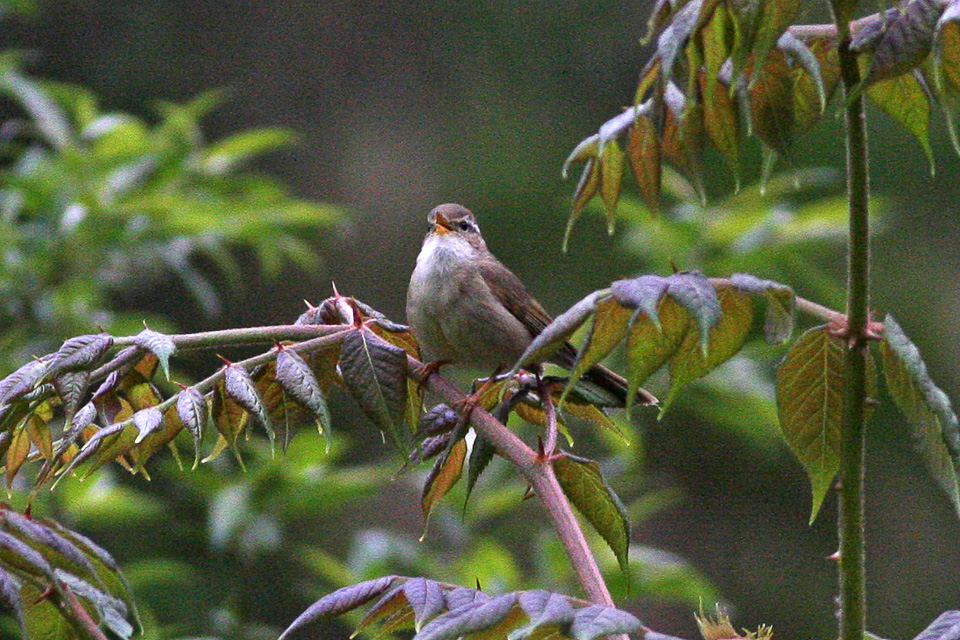
Large-billed Leaf Warbler
Phylloscopus magnirostris
Order: Passeriformes / Family: Phylloscopidae

Wikimedia Commons
About the Large-billed Leaf Warbler
The Large-billed Leaf Warbler, Phylloscopus magnirostris, is a small passerine bird notable for its distinctive large bill relative to its body size. This species belongs to the Phylloscopidae family, a group widely recognized for their agile movements and insectivorous diet. Found predominantly in the temperate and subtropical forests of Asia, the Large-billed Leaf Warbler plays a significant role in controlling insect populations, thus maintaining ecological balance. In terms of distribution, it inhabits regions stretching from the Himalayan foothills across to central China and northern parts of Southeast Asia. The preferred habitats are rich in foliage, offering ample cover and feeding opportunities.
During the breeding season, these warblers are especially active in the mountainous regions of Nepal, Bhutan, and northern India. Here, they occupy forests at elevations ranging from 900 to 3,000 meters. Their presence in these high-altitude regions underscores their adaptability to varied climatic conditions. The breeding season spans from May to July, during which the warbler engages in vocal displays to attract mates and establish territories. As autumn approaches, the Large-billed Leaf Warbler undertakes a southward migration to wintering grounds in southern China, northern Thailand, and Vietnam. This seasonal movement highlights its migratory nature, a common trait among warblers that helps them exploit different ecological niches throughout the year.
Ecologically, the Large-billed Leaf Warbler is vital for its role as a predator of insects, helping to regulate pest populations. By consuming various invertebrates, it aids in controlling outbreaks that could otherwise damage vegetation. This bird's presence indicates a healthy forest ecosystem, as it thrives in areas with abundant insect life and dense leaf cover. Its migratory patterns also contribute to gene flow between bird populations across vast geographic regions, ensuring genetic diversity and resilience. Conservation efforts are crucial for this species, given the rapid deforestation in parts of its range, which threatens its natural habitats.
The Large-billed Leaf Warbler belongs to the family Phylloscopidae, within the order Passeriformes. These birds typically live average 3-5 years with max recorded up to 7 years.
How to Identify a Large-billed Leaf Warbler
Identifying the Large-billed Leaf Warbler involves noting several key features. The adult warbler exhibits olive-green upperparts and yellowish underparts, with a striking supercilium that is pale and distinct against the darker eye stripe. Its namesake large bill is evident upon close inspection, far bulkier than those of similar species. Juveniles display a paler, more washed-out coloration, lacking the vibrant contrast seen in adults. Males and females appear similar, making sex differentiation challenging without behavioral observation.
A common source of confusion arises with species like the Blyth's Leaf Warbler. However, the Large-billed Leaf Warbler's more robust bill and distinctive vocalizations usually provide reliable differentiation. In flight, this warbler exhibits a streamlined silhouette with rapid wingbeats, typical of the Phylloscopus genus. While perching, it often flicks its wings and tail, behaviors that, along with its vocal cues, aid birders in accurate identification.
Having trouble telling birds apart? Upload a photo to our bird identification tool for an instant species match.
Large-billed Leaf Warbler Habitat and Range
Preferred Habitat
The Large-billed Leaf Warbler predominantly occupies dense, deciduous, and mixed forests, often in mountainous regions. These habitats provide abundant foliage, crucial for nesting and feeding. Commonly found at elevations between 900 and 3,000 meters, it favors forested areas with dense undergrowth. During the breeding season, it is prevalent in the Himalayan regions, whereas in winter, it descends to lower altitudes, frequenting subtropical forests in southern China and parts of Southeast Asia. Unlike many urban-adapted species, this warbler tends to avoid cities, preferring the tranquility and resources of rural forested landscapes.
Geographic Range
The breeding range of the Large-billed Leaf Warbler extends through the Himalayan foothills, encompassing Nepal, Bhutan, and northern India. During winter, it migrates to southern China, northern Thailand, and Vietnam, following established migratory corridors. Population density is highest in the mid-elevation forests of Nepal and Bhutan during the breeding season. In winter, sightings are more scattered across lowland regions, where the warbler seeks warmer climates and abundant food. These migration patterns highlight the species' adaptability to diverse ecological zones.
Want to know which birds visit your area? Browse our backyard birds by location guides for region-specific species lists.
What Does the Large-billed Leaf Warbler Eat?
The diet of the Large-billed Leaf Warbler primarily consists of insects and other small invertebrates. During the breeding season, it targets caterpillars, beetles, and flies, which are abundant in forested habitats. This warbler employs a foraging technique known as 'gleaning,' where it picks insects off leaves and branches with precision. In the winter months, its diet diversifies to include seeds and berries, allowing it to sustain itself when insect availability diminishes. The warbler's large bill facilitates the consumption of a variety of prey sizes, enhancing its adaptability across seasons.
Large-billed Leaf Warbler Behavior and Social Structure
The Large-billed Leaf Warbler showcases intriguing behavioral patterns, notable for its solitary nature during the breeding season. It establishes and defends territories through vocalizations, a trait common among warblers. Courtship involves the male performing aerial displays, accompanied by song to attract a mate. In response to predators, this warbler employs a 'freeze' technique, relying on its camouflaged plumage to avoid detection. Typically solitary or in pairs during breeding, it may join mixed-species flocks while migrating or wintering, capitalizing on the safety and foraging efficiency of group dynamics. These birds exhibit diurnal activity patterns, with peak vocal activity at dawn.
Large-billed Leaf Warbler Nesting and Reproduction
The nesting habits of the Large-billed Leaf Warbler involve constructing cup-shaped nests using grass, leaves, and moss, often concealed within dense foliage or low shrubs. Nest sites are typically located between 1 and 3 meters above ground, ensuring protection from ground predators. Clutch size varies from three to five eggs, with incubation lasting approximately 12 to 14 days. Both parents partake in feeding the chicks post-hatching, with fledging occurring around 12 to 16 days after hatching. Generally, the species raises one brood per year, although in optimal conditions, a second brood might be attempted.
Large-billed Leaf Warbler Sounds and Vocalizations
The primary song of the Large-billed Leaf Warbler is a rapid sequence of high-pitched notes, often described as a 'tsee-tsee-tsee' trill. This song is delivered from prominent perches during the breeding season, serving territorial and mate attraction purposes. Call notes consist of sharp, metallic 'chip' sounds, used for communication between individuals. Alarm calls are more urgent and harsh, signaling potential threats. The dawn chorus is a notable time for vocal activity, with the warbler contributing significantly to the early morning symphony of forest sounds.
Interesting Facts About the Large-billed Leaf Warbler
- 1The Large-billed Leaf Warbler has a longer migration route than many other Phylloscopus species, traveling thousands of kilometers annually.
- 2Despite its small size, this warbler can consume an impressive number of insects daily, effectively controlling pest populations.
- 3The Large-billed Leaf Warbler's large bill is an adaptation that allows it to exploit a broader range of prey sizes compared to other warblers.
- 4During migration, this warbler may join mixed-species flocks, enhancing its survival chances through increased vigilance against predators.
- 5In Bhutan, the Large-billed Leaf Warbler is often found in the company of the similar-looking Blyth's Leaf Warbler, despite their differing vocalizations.
- 6The Large-billed Leaf Warbler's vocalizations play a crucial role in territory establishment and mate attraction, often heard echoing through its forest habitat.
- 7Research has shown that the Large-billed Leaf Warbler's breeding success correlates strongly with the abundance of caterpillars in its habitat.
Large-billed Leaf Warbler Conservation Status
The Large-billed Leaf Warbler currently holds a status of Least Concern on the IUCN Red List. However, populations are impacted by habitat loss due to deforestation in parts of its range. While overall population trends appear stable, continued habitat degradation poses a potential threat. Conservation efforts focus on preserving forested areas and mitigating deforestation impacts, particularly in breeding regions. Historically, population numbers have remained resilient, though localized declines emphasize the importance of habitat conservation initiatives.