
Lesser Bird-of-Paradise
Paradisaea minor
Order: Passeriformes / Family: Paradisaeidae
Wikimedia Commons
About the Lesser Bird-of-Paradise
The Lesser Bird-of-Paradise (Paradisaea minor) is a captivating species native to the lowland rainforests of New Guinea and the surrounding islands. This bird is a member of the Paradisaeidae family, which is famed for its striking appearance and complex mating rituals. The males are particularly noteworthy for their splendid display plumage, featuring long, filamentous flank plumes that they use to attract females during elaborate courtship displays. These displays are a critical component of the species' reproductive success, as the females select mates based on the quality of the male's performance and plumage.
The Lesser Bird-of-Paradise plays a significant role in its ecosystem, both as a pollinator and as a consumer of fruit, which helps in seed dispersal. The bird's diet primarily consists of fruits and arthropods, allowing it to act as an important agent in maintaining forest biodiversity. This species is a notable example of the intricate interdependencies within tropical forest ecosystems.
Seasonally, the Lesser Bird-of-Paradise may exhibit certain shifts in behavior and location, primarily related to breeding and feeding activities. While these birds are generally sedentary, they do display some local movements in response to food availability and breeding opportunities. The breeding season usually coincides with the availability of ripe fruits, ensuring an ample food supply for the developing chicks.
Due to their distinctive appearance and behaviors, Lesser Birds-of-Paradise have garnered significant attention from both ornithologists and avian enthusiasts. They have become emblematic of the biodiversity and beauty of New Guinea's forests. However, their dependence on intact forest habitats makes them vulnerable to habitat destruction, emphasizing the need for conservation efforts to preserve these irreplaceable environments.
The Lesser Bird-of-Paradise belongs to the family Paradisaeidae, within the order Passeriformes. These birds typically live average 5-10 years, with some individuals living longer in captivity..
How to Identify a Lesser Bird-of-Paradise
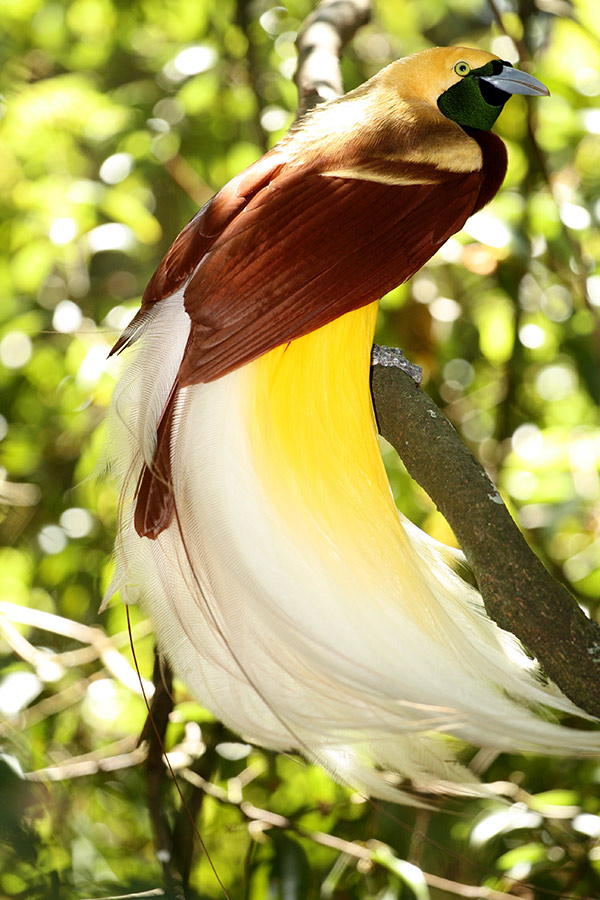
In the field, the Lesser Bird-of-Paradise is unmistakable due to its size and vibrant coloration. Adult males boast an impressive plumage, with yellow to orange flank plumes and a deep maroon upper body. Their heads are adorned with a yellow crown and a striking emerald-green throat. In contrast, females are less conspicuous, with a more muted brownish coloration and lack the elongated plumes that characterize the males.
Juveniles resemble females until they reach maturity, at which point young males begin to develop their distinctive plumage. This process can take several years, during which the young males hone their courtship displays. When perched, males display an erect posture to showcase their ornamental feathers, especially during mating season.
While the Lesser Bird-of-Paradise might be confused with the Greater Bird-of-Paradise (Paradisaea apoda), the latter is larger and has more extensive flank plumes. In flight, the Lesser Bird-of-Paradise presents a silhouette characterized by broad wings and a somewhat rounded tail, lacking the streamers seen in some other bird-of-paradise species.
Having trouble telling birds apart? Upload a photo to our bird identification tool for an instant species match.
Lesser Bird-of-Paradise Habitat and Range
Preferred Habitat
The Lesser Bird-of-Paradise primarily inhabits the lowland and hill forests of New Guinea, often preferring areas with dense canopy cover. These birds thrive in tropical rainforests, where they can find ample food and safe nesting sites. While they are typically found at elevations ranging up to 1,500 meters, they are most commonly seen in forests below 1,000 meters.
They demonstrate some adaptability in their habitat preferences, occasionally venturing into secondary forests and forest edges. However, they generally avoid urban areas, as their reliance on forested environments makes them vulnerable to habitat loss. During certain times of the year, slight movements might occur in response to seasonal changes in food availability or breeding cycles, but these are often limited to local shifts within their established range.
Geographic Range
The Lesser Bird-of-Paradise is endemic to northern New Guinea and nearby islands such as Yapen and Misool. It occupies a relatively restricted range, primarily within lowland and foothill forests. Breeding occurs throughout their range, with no significant migratory movements. Local populations may exhibit minor movements in response to food resources, but these are not extensive.
In terms of population density, these birds are more abundant in areas where the forest remains intact, particularly in protected regions and national parks. The western part of its range, including areas such as the Vogelkop Peninsula, provides key habitats. Despite their limited range, the population of Lesser Birds-of-Paradise remains relatively stable in well-preserved areas, though local declines can occur where forest destruction is prevalent.
Want to know which birds visit your area? Browse our backyard birds by location guides for region-specific species lists.
What Does the Lesser Bird-of-Paradise Eat?
The diet of the Lesser Bird-of-Paradise consists primarily of fruits and arthropods. They are known to forage both in the canopy and at lower levels, demonstrating a versatile approach to feeding. Fruit consumption plays a significant role in their diet, with figs and other soft fruits being common staples.
Arthropods provide an essential protein source, and the birds are adept at capturing insects and other small invertebrates. During breeding season, the demand for food increases, prompting more intensive foraging to support both adults and chicks. Foraging typically occurs during the early morning and late afternoon when the birds are most active.
Interestingly, these birds often employ a sit-and-wait strategy, perching quietly before suddenly darting out to snatch prey or pluck fruit. Their role as seed dispersers is vital in maintaining forest health and diversity, as they contribute to the regeneration of vegetation.
Lesser Bird-of-Paradise Behavior and Social Structure
The Lesser Bird-of-Paradise exhibits fascinating social and territorial behaviors. Males are particularly territorial, often establishing and defending specific display sites known as leks. These sites serve as arenas for their elaborate courtship displays, where males gather to compete for the attention of visiting females. Each male performs a series of intricate dances and calls, showcasing his plumage and stamina.
Outside of the breeding season, Lesser Birds-of-Paradise are generally solitary or found in loose associations. They exhibit a crepuscular activity pattern, with peaks of activity occurring during dawn and dusk. When not displaying, males and females maintain separate territories, focusing on foraging and resting.
Their response to predators involves a combination of alarm calls and evasive flight, with smaller birds often mobbing potential threats. The species' reliance on intact forest makes them sensitive to changes in their environment, reinforcing the importance of preserving their natural habitat.
Lesser Bird-of-Paradise Nesting and Reproduction
Nesting for the Lesser Bird-of-Paradise involves careful selection of site and materials. Nests are typically built high in the forest canopy, often over 10 meters above the ground, to minimize predation risk. The female constructs the nest alone, using twigs, leaves, and other plant materials to create a sturdy cup structure.
Clutches usually consist of one to two eggs, with the female undertaking the incubation duties for approximately 18 days. During this period, the male's role is limited to providing protection and sometimes food resources. Once hatched, chicks remain in the nest for about 20 to 30 days before fledging.
Parental care continues even after fledging, with the female feeding the young until they gain independence. Typically, the species breeds once a year, although in optimal conditions, a second brood may be raised. The success of nesting efforts is closely linked to food availability and environmental conditions.
Lesser Bird-of-Paradise Sounds and Vocalizations
The vocalizations of the Lesser Bird-of-Paradise are distinctive and varied. The primary song, often heard during the breeding season, consists of a series of loud, resonant whistles and chattering notes. The pitch and rhythm can vary, creating a complex and melodious soundscape within their forest habitat.
Call notes are generally higher-pitched and more abrupt, serving as communication between individuals or as alarm signals in the presence of threats. During displays, males may emit a series of repetitive calls, which are both a territorial advertisement and an attraction for females.
The dawn chorus, featuring a cacophony of overlapping calls, marks a vibrant start to the day in their habitat. These sounds, unique among the diverse avian community of New Guinea, contribute to the auditory tapestry of the rainforest.
Interesting Facts About the Lesser Bird-of-Paradise
- 1The Lesser Bird-of-Paradise's courtship display can last for several hours, showcasing both endurance and skill.
- 2Males may spend up to half of their day maintaining and displaying in their chosen lek site during the breeding season.
- 3The species plays a critical role in seed dispersal, aiding in the regeneration of tropical forests in New Guinea.
- 4Despite their vibrant appearance, females are the primary choosers in mating, selecting males based on display quality.
- 5The Lesser Bird-of-Paradise has inspired numerous cultural expressions, including art and dance, among indigenous peoples.
- 6The bird's display plumes were once highly sought after for fashion, but conservation laws now protect them.
- 7Their vocalizations can be heard up to a kilometer away, making them prominent in their forest habitats.
Lesser Bird-of-Paradise Conservation Status
The Lesser Bird-of-Paradise is currently listed as Least Concern by the IUCN, with populations considered stable overall. However, habitat loss due to logging and agriculture poses a significant threat to their long-term survival. Conservation efforts focus on habitat preservation and the establishment of protected areas. Historically, the species faced pressure from hunting for their feathers, used in traditional adornments. While this has decreased due to legal protections and awareness, the threat of deforestation remains. Maintaining the ecological integrity of New Guinea's forests is crucial for the survival of this iconic species. Conservation strategies emphasize sustainable land-use practices and the protection of key habitats, ensuring that both Lesser Birds-of-Paradise and the myriad other species sharing their environment can thrive.


