
Long-tailed Paradigalla
Paradigalla carunculata
Order: Passeriformes / Family: Paradisaeidae
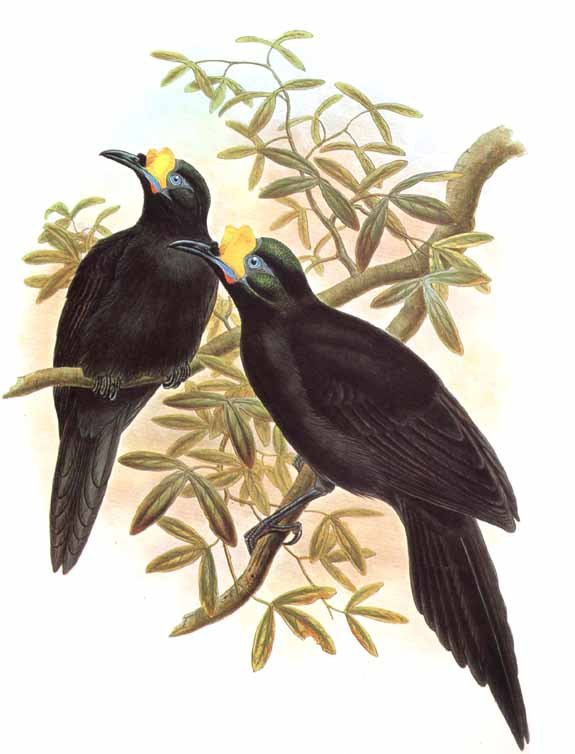
Wikimedia Commons
About the Long-tailed Paradigalla
The Long-tailed Paradigalla (Paradigalla carunculata) is a fascinating bird of paradise belonging to the family Paradisaeidae. This medium-sized bird is endemic to the montane forests of Papua New Guinea, specifically thriving at elevations between 1,500 and 2,800 meters in the central ranges. Its habitats are rich in biodiversity, offering a plethora of resources crucial for its survival.
The significance of the Long-tailed Paradigalla extends beyond its captivating appearance. As a frugivore, it plays a vital role in seed dispersal within its ecosystem. This contribution is essential for maintaining the diverse flora of the New Guinean forests, which in turn supports a multitude of other species.
Seasonally, the Long-tailed Paradigalla exhibits some altitudinal movement, especially during the breeding season when it may descend to slightly lower elevations to exploit different food resources. However, it generally remains a resident bird, showcasing a degree of territoriality in its high-altitude domain. This behavior contrasts with many other bird species, which often migrate long distances.
The Long-tailed Paradigalla also holds cultural significance among indigenous peoples of New Guinea, often featuring in local folklore and traditional ceremonies. Its presence in these narratives highlights its importance within the cultural and ecological tapestry of the region. Despite the challenges posed by habitat destruction and climate change, this enigmatic bird continues to thrive, underscoring its adaptability and resilience.
The Long-tailed Paradigalla belongs to the family Paradisaeidae, within the order Passeriformes. These birds typically live average 5-8 years, with the potential to live over 10 years..
How to Identify a Long-tailed Paradigalla
The Long-tailed Paradigalla is easily recognized by its sleek black plumage, offset by a bright yellow bill and colorful facial wattles. These wattles, which are a vivid red and blue, are a distinctive feature unique to this species. The bird's namesake long tail adds to its elegant silhouette, especially when perched atop the canopy.
In terms of sexual dimorphism, males and females appear quite similar, making field identification based on plumage alone challenging. However, males are typically slightly larger and more robust than females. Juveniles, on the other hand, exhibit duller coloration, lacking the full vibrancy of the adult’s wattles, which develop fully as they mature.
Although there are few species with which the Long-tailed Paradigalla might be confused, its closest relatives within the Paradisaeidae family, such as the Short-tailed Paradigalla, can appear similar. However, the Short-tailed Paradigalla has a notably shorter tail and lacks the striking combination of facial wattles seen in the Long-tailed Paradigalla. Observers should also note the bird's posture: it often perches with its body held horizontally, a characteristic stance that aids in identification.
Having trouble telling birds apart? Upload a photo to our bird identification tool for an instant species match.
Long-tailed Paradigalla Habitat and Range
Preferred Habitat
The Long-tailed Paradigalla inhabits montane forests, primarily those of Papua New Guinea's central ranges. These forests, characterized by dense undergrowth and a rich canopy, provide an ideal environment for foraging and nesting. The bird prefers altitudes between 1,500 and 2,800 meters, where it can find ample food resources and suitable nesting sites.
Despite its affinity for untouched wilderness, the Long-tailed Paradigalla can adapt to varying degrees of habitat disturbance, provided the overall forest structure remains intact. Unlike many birds that frequent urban areas, the Long-tailed Paradigalla remains firmly rooted in rural, forested regions, rarely venturing into human-dominated landscapes.
During certain seasons, the bird may exhibit slight altitudinal shifts, moving to lower elevations in search of food or suitable breeding sites. This movement, however, is limited and does not constitute long-distance migration. The conservation of montane forests is thus critical for the species' continued survival, as these forests offer the primary habitat necessary for its lifecycle.
Geographic Range
The Long-tailed Paradigalla is endemic to Papua New Guinea, with its range confined to the central mountainous regions of the island. This includes the main cordillera that runs through the heart of New Guinea, a hotspot for biodiversity and endemism.
During the breeding season, the Long-tailed Paradigalla remains within its established range, indicating a strong preference for its montane environment. Unlike many other bird species, it does not undertake long migratory journeys, instead exhibiting limited altitudinal movements within its habitat.
Population density tends to be higher in areas where the forest canopy is dense and fruit resources are abundant. These pockets of higher density are crucial for the bird's breeding and feeding activities. While the overall range of the Long-tailed Paradigalla is limited, within its preferred habitat, it is relatively widespread.
Conservation efforts focus on preserving these key areas, ensuring that the bird's habitat remains intact amid increasing threats from deforestation and environmental change. The species’ absence from lowland areas further emphasizes its specialization and reliance on montane ecosystems.
Want to know which birds visit your area? Browse our backyard birds by location guides for region-specific species lists.
What Does the Long-tailed Paradigalla Eat?
The diet of the Long-tailed Paradigalla primarily consists of fruit, making it an important frugivore within its ecosystem. It feeds on a variety of fruits found in the montane forests of New Guinea, including those from native fig and laurel species. This dietary preference makes it a vital agent for seed dispersal, aiding in the propagation of many plant species.
In addition to fruits, the Long-tailed Paradigalla supplements its diet with insects and small invertebrates, which provide necessary protein. This opportunistic feeding behavior allows it to adapt to seasonal changes in fruit availability. During times when fruit is scarce, the bird may spend more time foraging for insects under the forest canopy.
The Long-tailed Paradigalla typically forages alone or in pairs, using its strong bill to pluck fruits from trees or to probe into crevices for insects. It is most active during the early morning and late afternoon when temperatures are cooler and food resources more accessible. This feeding schedule ensures it utilizes the most productive times of day while avoiding the midday heat.
Long-tailed Paradigalla Behavior and Social Structure
The Long-tailed Paradigalla exhibits a range of intriguing behaviors that reflect its adaptation to the montane forest environment. It primarily leads a solitary life or stays in monogamous pairs, a common trait among many birds of paradise.
Territorial behavior is significant, with pairs or individuals often defending a specific area that contains valuable resources such as food and nesting sites. This territoriality is most pronounced during the breeding season when competition for resources intensifies.
Courtship displays of the Long-tailed Paradigalla are less elaborate compared to some of its relatives, yet they involve fascinating vocalizations and postures. Males may perform subtle movements to attract females, utilizing their colorful wattles and plumage to their advantage.
In terms of daily activity, the bird is diurnal, starting its day with feeding and becoming more vocal during the morning hours. While generally silent, it becomes more active vocally during courtship and territorial disputes. When faced with predators, the Long-tailed Paradigalla employs a combination of camouflage and alert calls to avoid detection, relying on its dark plumage to blend into the forest shadows.
Long-tailed Paradigalla Nesting and Reproduction
The Long-tailed Paradigalla constructs nests in the branches of trees, often choosing locations that provide both concealment and easy access to food resources. The nest itself consists of a shallow cup made from twigs, leaves, and other plant materials, providing a secure environment for eggs and chicks.
Clutch size for the Long-tailed Paradigalla typically consists of one to two eggs. The incubation period lasts approximately 18 to 21 days, with both parents participating in the incubation process. This biparental care continues after hatching, as both the male and female share responsibilities in feeding and protecting the chicks.
Fledging occurs about four weeks after hatching. During this time, the young depend heavily on their parents for food and protection. The parents often continue to care for their offspring even after they leave the nest, ensuring they are well-prepared to survive independently.
The Long-tailed Paradigalla usually has one brood per year, though in environments with abundant resources, a second brood may be possible. This reproductive strategy highlights the bird's adaptability to its montane forest habitat, where conditions can vary significantly.
Long-tailed Paradigalla Sounds and Vocalizations
The Long-tailed Paradigalla produces a series of distinctive calls that serve various functions. Its primary song is a melodious series of whistles and chatters, characterized by a rhythmic pattern that can carry through the dense forest.
In addition to its song, the bird has a repertoire of call notes used for communication between mates and signaling alarm. These calls are sharper and more abrupt, often resembling a quick 'chit-chit' sound when alerting others to potential danger.
Alarm calls are particularly important in the bird's defense strategy. When a predator is detected, these calls become more frequent and intense, helping to warn other birds in the vicinity.
During the dawn chorus, the Long-tailed Paradigalla becomes more vocal, contributing to the symphony of sounds that marks the beginning of the day in the forest. Its song, though not as complex as some other birds of paradise, is an integral part of its communication and courtship behavior.
Interesting Facts About the Long-tailed Paradigalla
- 1Long-tailed Paradigalla males and females look alike, which is uncommon among birds of paradise where males often have more elaborate plumage.
- 2The colorful facial wattles of the Long-tailed Paradigalla are not only for display but may also play a role in thermoregulation.
- 3Despite its brilliant colors, the Long-tailed Paradigalla's dark plumage helps it blend into the shadows of the forest canopy.
- 4The bird's diet primarily consists of fruits, but it also consumes insects, showcasing its adaptability to seasonal food availability.
- 5Long-tailed Paradigallas exhibit territorial behavior, with pairs often defending a specific area rich in resources.
- 6This bird is endemic to Papua New Guinea, highlighting the region's rich biodiversity and the need for targeted conservation efforts.
- 7The Long-tailed Paradigalla contributes to seed dispersal, playing a vital role in maintaining the health and diversity of its forest ecosystem.
Long-tailed Paradigalla Conservation Status
The Long-tailed Paradigalla is currently classified as Near Threatened on the IUCN Red List. Its population trend is stable, but it faces ongoing threats from habitat destruction, primarily due to logging and agricultural expansion in New Guinea. Conservation efforts focus on protecting the montane forests that constitute its habitat. These efforts include establishing protected areas and promoting sustainable land-use practices that balance human needs with environmental preservation. Historically, the bird has maintained a relatively stable population, but increasing human activity poses a significant risk. Climate change also threatens its montane environment, potentially altering the availability of resources and suitable habitats. Despite these challenges, the Long-tailed Paradigalla's adaptability provides hope for its continued survival. Conservationists emphasize the importance of local community involvement in conservation strategies, recognizing the role of indigenous knowledge in preserving these critical ecosystems.


