
Magdalena Antbird
Sipia palliata
Order: Passeriformes / Family: Thamnophilidae

Wikimedia Commons
About the Magdalena Antbird
The Magdalena Antbird, Sipia palliata, is a fascinating species belonging to the family Thamnophilidae. It inhabits the dense tropical forests of northwestern South America, primarily within Colombia and Panama. These birds are notable for their dependence on army ant swarms, a behavior that has intrigued ornithologists for decades. The Magdalena Antbird plays a critical ecological role by following these swarms, preying on insects and other small creatures that attempt to escape the advancing ants. This species thrives in the humid, lowland forests, often at elevations ranging from sea level to about 1,200 meters. The bird's adaptation to these environments makes it an important indicator of forest health, as its presence often signifies a well-preserved ecosystem. Seasonal variations in behavior include specific breeding rituals and vocalizations that coincide with the wet season, when food is more abundant. The Magdalena Antbird has a significant role in its habitat, not only as a predator but also as prey for larger birds of prey, maintaining the delicate balance of its ecosystem. Conservationists have noted its importance as a species that can indicate the effects of habitat disturbance, such as deforestation and climate change. Understanding the dynamics of the Magdalena Antbird's life cycle and interactions with its environment offers insights into the broader ecological processes at play in tropical forests.
The Magdalena Antbird belongs to the family Thamnophilidae, within the order Passeriformes. These birds typically live average 4 years with a maximum recorded of 7 years..
How to Identify a Magdalena Antbird
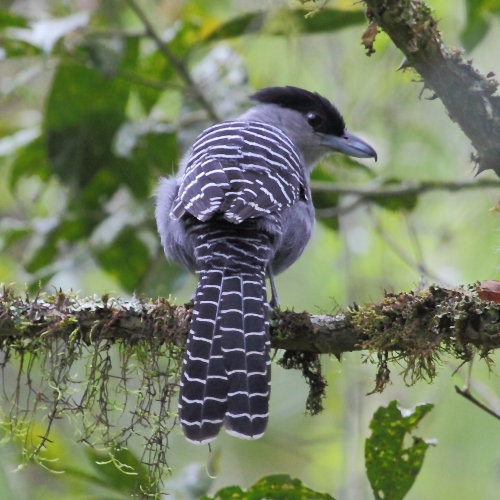
The Magdalena Antbird can be identified by its striking plumage, predominantly black with large white wing patches that are especially visible during flight. Adult males and females are similar in appearance, although males tend to display a slightly more glossy black plumage. Juveniles, on the other hand, exhibit a duller brownish hue until their first molt. One might confuse this species with other antbirds, but the distinctive white wing patches provide a key identifying feature. In the field, the Magdalena Antbird's posture is upright when perching, often holding its tail slightly cocked. Its flight is typically short and direct, as it moves from one perch to another within the forest understory. This bird's behavior when perched is to remain relatively still, making it a challenge to spot despite its bold coloration.
Having trouble telling birds apart? Upload a photo to our bird identification tool for an instant species match.
Magdalena Antbird Habitat and Range
Preferred Habitat
The primary habitat of the Magdalena Antbird consists of humid, dense lowland tropical forests. It prefers areas with thick understory vegetation, where it can follow ant swarms undisturbed by larger predators. It is most commonly found at elevations from sea level to 1,200 meters, where it takes advantage of the rich biodiversity. Seasonal shifts may occur, with some individuals moving slightly in response to food availability, although the species is largely sedentary. The bird is rarely found in urban areas, as it requires the complex structure of natural forests to thrive.
Geographic Range
The Magdalena Antbird is primarily located in northwestern South America, with a range extending across Colombia and into portions of Panama. This bird's breeding range is within these countries, where the climate and habitat conditions meet its specific needs. Unlike long-distance migratory species, the Magdalena Antbird remains within this region year-round, with little evidence of large-scale migration. Population density is highest in undisturbed primary forests in Colombia's Magdalena Valley, a biodiversity hotspot. The presence of this bird in these regions highlights the importance of conserving these areas.
Want to know which birds visit your area? Browse our backyard birds by location guides for region-specific species lists.
What Does the Magdalena Antbird Eat?
The diet of the Magdalena Antbird mainly consists of insects and other arthropods, which it captures while following army ant swarms. This ant-following behavior allows it to exploit a food resource that is otherwise difficult to access. During the wet season, when the abundance of insects increases, the bird's diet becomes more varied, including beetles, spiders, and small lizards. Foraging typically occurs in the early morning and late afternoon, aligning with the peak activity times of the ant swarms. The Magdalena Antbird utilizes a sit-and-wait strategy, perching quietly and darting out to capture prey flushed by the ants.
Magdalena Antbird Behavior and Social Structure
The Magdalena Antbird exhibits fascinating behaviors, particularly its association with army ant swarms. This relationship is primarily solitary, with individuals or pairs following the ants rather than forming flocks. Territoriality is pronounced, with males often engaging in vocal displays to defend their patch of forest. During the breeding season, courtship involves both visual displays and vocalizations, with males showcasing their plumage to attract mates. In response to predators, the Magdalena Antbird relies on its cryptic coloration and stealth, often remaining motionless to avoid detection. Daily activities revolve around foraging, with peak activity in the cooler hours of morning and late afternoon.
Magdalena Antbird Nesting and Reproduction
The nesting practices of the Magdalena Antbird are typical of antbirds, involving the construction of a cup-shaped nest using leaves, twigs, and fibers. These nests are usually situated low to the ground, hidden within dense vegetation. A typical clutch consists of two eggs, which both parents incubate over approximately 14 days. After hatching, the chicks remain in the nest for around 12-14 days before fledging. Parental care is shared, with both parents involved in feeding and protecting the young. The species generally produces one brood per year, timed to coincide with the rainy season when food is most plentiful.
Magdalena Antbird Sounds and Vocalizations
The primary song of the Magdalena Antbird is a series of sharp, high-pitched whistles that rise and fall in pitch. These vocalizations serve as both territorial signals and mate attraction calls. Call notes are shorter and softer, used for communication between mates or family groups. Alarm calls are more abrupt and harsh, intended to alert others to the presence of predators. During the dawn chorus, the Magdalena Antbird's song can be heard echoing through the forest, contributing to the rich tapestry of sounds that characterize tropical mornings.
Interesting Facts About the Magdalena Antbird
- 1The Magdalena Antbird relies heavily on army ants to flush out its prey, a behavior known as ant-following.
- 2Despite its striking appearance, the Magdalena Antbird can be incredibly elusive due to its preference for dense forest understory.
- 3This antbird's vocalizations can be heard over considerable distances, making it easier to detect by sound than sight.
- 4The white wing patches of the Magdalena Antbird are not just for show; they play a role in signaling during territorial disputes.
- 5Unlike many bird species, both male and female Magdalena Antbirds share nesting duties equally.
- 6The species' dependence on pristine forest environments makes it an important indicator for conservation status.
- 7The Magdalena Antbird's diet shifts seasonally, expanding during the wet season to include a wider variety of prey.
Magdalena Antbird Conservation Status
The Magdalena Antbird is currently listed as Near Threatened on the IUCN Red List. The primary threat to this species is habitat loss due to deforestation, driven by agricultural expansion and logging. While the population is decreasing, conservation efforts focus on preserving and restoring its natural habitat. Historical population data suggest a gradual decline correlating with increased human activity in its range. Protecting the remaining forested areas in Colombia and Panama is crucial for the survival of this species.
Other Thamnophilidae Species



Birds Similar to the Magdalena Antbird
These species are often confused with the Magdalena Antbird due to similar appearance or overlapping range.

