
Magdalena Antbird
Myrmeciza palliata
Order: Passeriformes / Family: Thamnophilidae

Wikimedia Commons
About the Magdalena Antbird
The Magdalena Antbird, or Myrmeciza palliata, is a distinctive member of the Thamnophilidae family, known for its striking appearance and unique behaviors within the tropical forests of South America. This bird primarily inhabits the dense understory of rainforests, particularly in Colombia's Magdalena Valley, from which it derives its name. The region's humid, tropical climate provides an ideal environment for this species, promoting its active foraging amidst the leaf litter and low vegetation. The significance of the Magdalena Antbird extends beyond its striking appearance; it plays a critical ecological role as an insectivore, helping to control insect populations and thereby maintain the balance of its ecosystem. The bird's presence is an indicator of healthy forest environments, as it thrives in areas rich with invertebrate life. This bird is non-migratory, largely staying within its established range throughout the year, though its activities may vary slightly with changes in rainfall and insect abundance. During the wet season, the Magdalena Antbird increases its foraging activity to take advantage of the higher insect populations, while the dry season may see a slight shift in its movement patterns to areas with higher humidity. Despite its seemingly elusive nature, the Magdalena Antbird's vocalizations make it more detectable within its dense forest habitat. Its sharp, repetitive calls serve not only as a means of communication with conspecifics but also as a territorial signal to potential intruders. These calls are particularly important during the breeding season when maintaining territory becomes a priority. In summary, the Magdalena Antbird is a vital component of its ecosystem, with its presence reflecting the health of the tropical forests in which it resides.
The Magdalena Antbird belongs to the family Thamnophilidae, within the order Passeriformes. These birds typically live average 5 years, with a max recorded of 8 years..
How to Identify a Magdalena Antbird
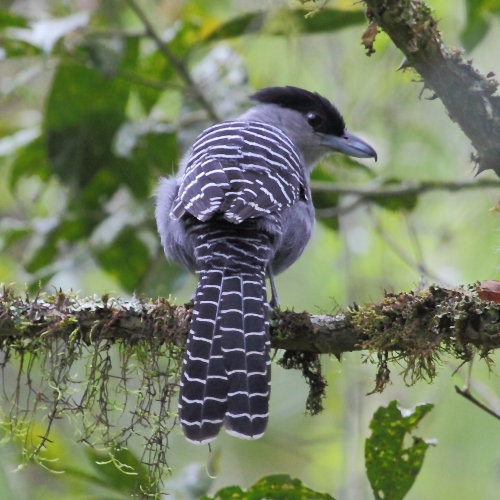
The Magdalena Antbird is a medium-sized bird, measuring approximately 19 centimeters in length, with a wingspan that accentuates its streamlined silhouette when in flight. The adult male is easily identifiable by its bold black and white coloration. The head, throat, and chest are predominantly black, contrasted by a white belly and flanks. Females, while sharing a similar overall structure, exhibit a more subdued color palette with brown tones interspersed with black and white, helping them blend into their surroundings when nesting. Juveniles resemble females but often sport more muted tones, lacking the stark contrasts seen in adults. The Magdalena Antbird's distinct plumage helps differentiate it from similar species within its range, such as the Bicolored Antbird, which has a more uniform coloration. In flight, the Magdalena Antbird's wings appear relatively short and rounded, aiding in its maneuverability through dense underbrush. When perched, it often adopts an upright posture, with its tail held slightly below the body line. This species' strong legs and feet are well-adapted for hopping and clambering amongst the forest's low vegetation, a behavior that is frequently observed while foraging. Its distinct color pattern and specific behaviors make the Magdalena Antbird a rewarding sight for birdwatchers familiar with the dense tropical environments it calls home.
Having trouble telling birds apart? Upload a photo to our bird identification tool for an instant species match.
Magdalena Antbird Habitat and Range
Preferred Habitat
The Magdalena Antbird thrives in the humid, lowland tropical forests of Colombia, particularly within the Magdalena Valley. This region's rich biodiversity and dense forest understory provide ideal conditions for the bird's insectivorous diet and breeding habits. Typically found at elevations between 100 and 1,000 meters, the species shows a marked preference for primary and secondary growth forests with abundant leaf litter and low vegetation. While it predominantly occupies rural and remote forested areas, the bird can occasionally be observed in less disturbed secondary forests, indicating some level of adaptability to habitat changes. However, the species tends to avoid heavily urbanized or agricultural landscapes, where habitat degradation can significantly impact its foraging and nesting opportunities. Throughout the year, the Magdalena Antbird remains within its preferred forest habitats, showing little seasonal movement. The availability of insects and other small invertebrates, driven by seasonal rainfall, plays a crucial role in determining its precise location within these forests. As a non-migratory species, its presence is a reliable indicator of the health and integrity of the tropical forest ecosystems where it resides.
Geographic Range
The Magdalena Antbird's range is primarily confined to Colombia, where it occupies the tropical forests of the Magdalena Valley. This region, spanning parts of central Colombia, provides the bird with its primary habitat and has shaped its ecological niche. The bird's range does not extend significantly beyond this area, making it an endemic species with a relatively limited distribution. Within its confined range, the Magdalena Antbird does not exhibit migratory behavior, choosing instead to remain in its tropical forest environment year-round. This limited range highlights the bird's dependence on the specific climatic and ecological conditions found within the Magdalena Valley. While the population density of the Magdalena Antbird is highest in undisturbed forest areas, it can also be found in secondary growth forests, provided that these habitats offer sufficient cover and food resources. The bird's lack of significant migratory movement means that it does not traverse international borders, remaining a species of concern primarily within Colombia. Conservation efforts within these regions are crucial for maintaining the populations of this endemic bird, as habitat destruction poses a significant threat to its continued survival.
Want to know which birds visit your area? Browse our backyard birds by location guides for region-specific species lists.
What Does the Magdalena Antbird Eat?
The Magdalena Antbird's diet primarily consists of insects and other small invertebrates, making it a crucial insectivore within its ecosystem. This bird forages primarily on the forest floor, utilizing its strong legs and keen eyesight to detect and capture prey. Common food items include ants, beetles, spiders, and caterpillars, which the bird picks from leaf litter and low vegetation. The diet of the Magdalena Antbird shows some seasonal variation, with a higher abundance of insects during the wet season leading to increased foraging activity. This period of abundance allows the bird to meet its nutritional needs more easily, supporting its breeding activities and general health. The bird employs a methodical foraging technique, often seen hopping along the forest floor or climbing through dense underbrush to reach hidden prey. Occasionally, it may join mixed-species foraging flocks, benefiting from the increased safety and efficiency provided by group foraging. Despite its insectivorous diet, the Magdalena Antbird may occasionally consume small fruits or seeds when insect prey is less abundant, although this forms a minor part of its diet. The bird's feeding schedule dictates peak foraging activity during the early morning and late afternoon, when temperatures are cooler and insect activity is higher.
Magdalena Antbird Behavior and Social Structure
The Magdalena Antbird exhibits fascinating behaviors that reflect its adaptation to dense tropical forests. It is a territorial bird, with pairs defending their chosen area against intruders through vocalizations and occasional physical displays. These territories are typically small, covering areas rich in food resources and suitable nesting sites. In terms of social structure, the Magdalena Antbird forms monogamous pairs that often remain together throughout the year. During the breeding season, which coincides with the wet season, courtship displays become more pronounced, featuring a combination of vocalizations and visual displays such as wing flicking. The bird is generally solitary or found in pairs outside of the breeding season, although it may join mixed-species flocks for foraging purposes. The Magdalena Antbird is diurnal, with peak activity occurring in the early morning and late afternoon. Its response to predators involves a combination of stealth and vocal alarms. When threatened, the bird may freeze or retreat into dense cover to avoid detection, while emitting sharp alarm calls to warn conspecifics. This behavior, along with its cryptic plumage, provides effective protection against potential threats. Overall, the Magdalena Antbird's behaviors are well-adapted to its tropical forest environment, allowing it to thrive despite the challenges of its ecosystem.
Magdalena Antbird Nesting and Reproduction
The Magdalena Antbird constructs its nest in the dense undergrowth of tropical forests, typically placing it close to the ground where it is well-concealed among leaves and branches. The nest itself is a cup-shaped structure, crafted from a combination of twigs, leaves, and other plant materials, bound together with spider silk to provide cohesion. This nesting strategy minimizes exposure to predators, leveraging the natural cover of the forest underbrush. During the breeding season, the female typically lays a clutch of two to three eggs, which she and her partner incubate for about 14-16 days. Both parents participate actively in feeding and caring for the chicks once they hatch, demonstrating a high level of parental investment. Fledging occurs approximately 12-14 days post-hatching, at which point the young birds begin to venture from the nest while still receiving food and protection from their parents. The Magdalena Antbird may produce one to two broods per year, depending on environmental conditions and resource availability. This reproductive strategy ensures that at least some offspring survive the challenges of the tropical forest environment, contributing to the ongoing survival of the species.
Magdalena Antbird Sounds and Vocalizations
The Magdalena Antbird is known for its sharp, distinctive vocalizations, which play a crucial role in its communication and territorial behavior. The primary song consists of a series of rapid, high-pitched notes delivered in a rhythmic sequence, often described as a 'chirr-chirr-chirr' sound. These calls are clear and penetrating, allowing them to travel through the dense forest environment. In addition to its primary song, the Magdalena Antbird emits various call notes, including softer contact calls used between mates and more urgent alarm calls when potential threats are detected. These alarm calls are shorter and more abrupt, serving to alert conspecifics of danger. During the dawn chorus, the Magdalena Antbird is particularly vocal, establishing its presence and territory through frequent singing. This behavior is common among many bird species but is especially important for this antbird, given its dense forest habitat where visual signals may be obstructed. The Magdalena Antbird's vocalizations are a vital aspect of its ecological niche, facilitating communication in the lush, sound-dampening environment of its tropical home.
Interesting Facts About the Magdalena Antbird
- 1The Magdalena Antbird's scientific name, Myrmeciza palliata, reflects its association with ants, as 'Myrmeciza' refers to its ant-following habits.
- 2Despite their preference for dense forest, Magdalena Antbirds occasionally follow army ant swarms to catch fleeing insects.
- 3The Magdalena Antbird's distinctive song is a key diagnostic feature, helping birders identify it amidst the dense forest foliage.
- 4Females Magdalena Antbirds have a unique brown coloration, providing camouflage while nesting and caring for young.
- 5The species is endemic to Colombia, making it a priority for conservation efforts focused on preserving the country's unique biodiversity.
- 6Magdalena Antbirds are known to participate in mixed-species flocks, which helps reduce predation risk and improve foraging efficiency.
- 7During breeding season, both male and female Magdalena Antbirds engage in nest-building, showcasing cooperative breeding behavior.
Magdalena Antbird Conservation Status
According to the International Union for Conservation of Nature (IUCN), the Magdalena Antbird is currently classified as Near Threatened, with its populations facing pressures from habitat loss and fragmentation. Deforestation for agriculture and other human activities poses the most significant threat to its habitats in the Magdalena Valley. The bird's limited range exacerbates the impact of these threats, as it restricts the availability of suitable environments for the species to thrive. Conservation efforts focus on preserving and restoring forest habitats within its range, with initiatives aimed at sustainable land use and reforestation. Local and international organizations work to raise awareness of the importance of preserving the Magdalena Valley's unique ecosystems, not only for the antbird but also for the myriad of other species that share its habitat. Historical population trends indicate that while the species has faced challenges in recent decades, targeted conservation efforts may help stabilize and potentially increase its numbers in the future. Protecting the Magdalena Antbird is crucial for maintaining the ecological balance of its tropical forest ecosystem, underscoring the need for continued conservation measures.
Other Thamnophilidae Species



Birds Similar to the Magdalena Antbird
These species are often confused with the Magdalena Antbird due to similar appearance or overlapping range.

