
Scalloped Antbird
Myrmeciza ruficauda
Order: Passeriformes / Family: Thamnophilidae

Wikimedia Commons
About the Scalloped Antbird
The Scalloped Antbird, known scientifically as Myrmeciza ruficauda, is a striking bird found primarily in the lush understories of tropical forests. This species plays a critical role in the ecosystems it inhabits, primarily through its interactions with army ants. As a member of the Thamnophilidae family, the Scalloped Antbird is an obligate ant-follower, which means it relies on swarms of army ants to flush out insects and other invertebrates from the leaf litter. This behavior not only provides the bird with food but also influences the dynamics of the forest floor, aiding in pest control and maintaining ecological balance.
Geographically, the Scalloped Antbird is found in parts of Venezuela, Colombia, and Brazil, inhabiting areas that offer dense canopy cover and ample ground-level vegetation. Its presence is a sign of healthy, undisturbed primary forests, although it may occasionally venture into secondary growth when necessary. The bird's preference for such habitats underscores the importance of conservation efforts aimed at preserving these vital ecosystems.
Behaviorally, the Scalloped Antbird is known for its secretive nature. It spends much of its time near the ground, navigating through the dense underbrush. During the breeding season, which typically coincides with the rainy season, the Scalloped Antbird becomes more vocal, engaging in complex duets that serve both as mate attraction and as territorial displays. This period is crucial for the bird's reproductive success, as it needs to secure a territory that provides sufficient food resources for raising its young.
Ecologically, the Scalloped Antbird contributes to the biodiversity of its habitat by participating in mixed-species flocks, where it interacts with other bird species. These flocks enhance foraging efficiency and provide added protection against predators. Thus, the Scalloped Antbird is both a vital component of its ecosystem and an indicator of forest health.
The Scalloped Antbird belongs to the family Thamnophilidae, within the order Passeriformes. These birds typically live average 5 years, with a max recorded of 8 years..
How to Identify a Scalloped Antbird
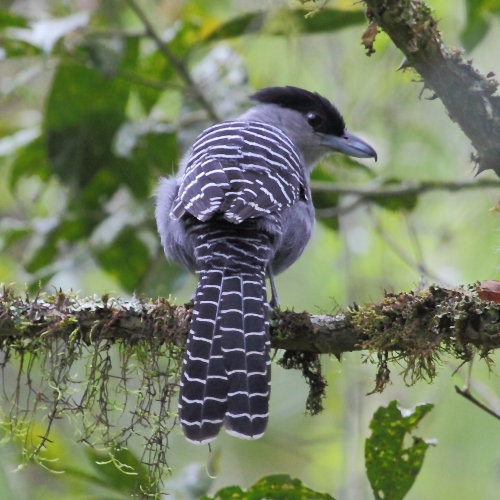
The Scalloped Antbird is a medium-sized bird, easily recognized by its distinctive scalloped pattern on the plumage. Adult males exhibit a striking combination of black and gray plumage with scalloped markings running across their wings and back, while females have more subdued brown tones interspersed with similar scalloping. Juveniles resemble females but with slightly duller colors, making them harder to distinguish until they mature.
The key features for identifying the Scalloped Antbird include its dark face mask and a prominent white throat that contrasts sharply with the rest of its body. In flight, the bird's wings display a rounded silhouette, typical of many antbirds, which allows for agile maneuvers through dense vegetation. Its perching posture is characterized by a horizontal stance, often with its tail slightly cocked upwards.
Confusion with other species can occur, particularly with closely related antbirds within its range, such as the White-shouldered Antbird. However, the scalloped pattern unique to Myrmeciza ruficauda and its characteristic vocalizations aid in correct identification.
Having trouble telling birds apart? Upload a photo to our bird identification tool for an instant species match.
Scalloped Antbird Habitat and Range
Preferred Habitat
The Scalloped Antbird thrives in the dense, humid understory of tropical lowland forests. It prefers areas with thick ground cover and tangled vegetation, which provide both protection from predators and a plentiful supply of food. Typical habitats include the Amazon Basin and the forested regions of the Guiana Shield, where it inhabits elevations ranging from sea level to about 1,000 meters.
This species predominantly resides in primary forests but can occasionally be found in mature secondary forests, provided they offer similar structural complexity. Seasonal shifts in habitat use are minimal, as the Scalloped Antbird remains year-round within its tropical environment. While it avoids urban areas, it can sometimes be observed on the edges of rural landscapes, especially those adjacent to forested regions.
Geographic Range
The Scalloped Antbird's range spans several South American countries, predominantly within tropical rainforests. Its breeding and year-round range encompasses parts of northern Brazil, southern Venezuela, and eastern Colombia. Within these areas, the bird exhibits a preference for the Amazonian lowlands, which offer the dense forest cover it requires.
While the Scalloped Antbird is not a migratory species, its range overlaps with that of several other ant-following birds, leading to potential competition for resources. Population density hotspots often occur in regions with stable army ant populations, as these ants are crucial to the bird's foraging success. Despite its relatively localized distribution, the Scalloped Antbird remains a common sight within its preferred habitats.
Want to know which birds visit your area? Browse our backyard birds by location guides for region-specific species lists.
What Does the Scalloped Antbird Eat?
The Scalloped Antbird's diet primarily consists of insects and other small invertebrates. It employs a unique foraging technique, following swarms of army ants to capture prey items flushed out by the ants' activity. This opportunistic feeding strategy allows the bird to exploit a reliable food source, especially during periods of high ant activity.
Seasonal changes in diet are minimal, as the bird relies heavily on the availability of army ants year-round. However, it may supplement its diet with spiders and small vertebrates when the opportunity arises. The Scalloped Antbird typically forages during daylight hours, often in the company of mixed-species flocks, which can enhance its foraging efficiency and reduce the risk of predation.
Scalloped Antbird Behavior and Social Structure
The Scalloped Antbird is generally a solitary bird, although it participates in mixed-species flocks, especially during foraging. Its social structure is largely based on territorial pairs, which establish and defend territories through vocalizations and physical displays. The bird's territorial calls serve both to attract mates and to warn potential intruders.
Courtship displays often involve vocal duets between males and females, with the male taking the lead in producing a series of melodious whistles. These displays are crucial during the breeding season, as they reinforce pair bonds and ensure reproductive success. The Scalloped Antbird remains alert to predators, relying on its cryptic plumage and the cover of dense foliage for protection.
Daily activity patterns include foraging in the early morning and late afternoon, with periods of rest during the hottest parts of the day. This crepuscular activity helps the bird avoid peak predator activity and increases its chances of encountering active ant swarms.
Scalloped Antbird Nesting and Reproduction
The Scalloped Antbird constructs its nest close to the ground, often in dense thickets or among the roots of large trees. The nest itself is a simple cup structure, made from twigs, leaves, and other plant materials, providing camouflage from predators.
Clutch size typically ranges from two to three eggs, with both parents sharing incubation duties over a period of about 14 to 16 days. Once hatched, the chicks remain in the nest for approximately two weeks before fledging. Parental roles are shared, with both male and female contributing to feeding and caring for the young.
The Scalloped Antbird generally raises one brood per year, timed to coincide with the peak availability of food resources, such as during the wet season when insect prey is abundant.
Scalloped Antbird Sounds and Vocalizations
The primary song of the Scalloped Antbird is a series of clear, melodious whistles that descend in pitch. This song is often delivered in a sequence, with pauses between phrases, creating a rhythmic and recognizable pattern. The bird also produces a variety of call notes, including sharp, staccato chips used in communication between mates or to signal alarm.
Alarm calls are more rapid and higher-pitched, serving to alert other birds of potential threats. During the early morning hours, the Scalloped Antbird participates in a dawn chorus, joining other forest birds in a symphony of sound that serves to establish territory and strengthen pair bonds.
Interesting Facts About the Scalloped Antbird
- 1The Scalloped Antbird's obligate ant-following behavior is a specialized adaptation that allows it to thrive in tropical forests.
- 2Males and females often engage in synchronized vocal duets, which play a crucial role in maintaining pair bonds.
- 3The Scalloped Antbird's scalloped plumage pattern serves as excellent camouflage in the dappled light of the forest understory.
- 4Despite its reliance on army ants, the Scalloped Antbird does not harm the ants and benefits from the prey they flush out.
- 5The species' preference for undisturbed primary forests makes it a valuable indicator of forest health and biodiversity.
- 6The Scalloped Antbird participates in mixed-species flocks, where cooperation among different bird species enhances foraging success.
- 7Its melodic whistles can be heard echoing through the forest, especially during the early morning hours when it is most active.
Scalloped Antbird Conservation Status
The Scalloped Antbird is currently listed as Least Concern by the IUCN, with stable population trends observed across its range. However, primary threats include habitat loss and degradation due to deforestation and agricultural expansion. Conservation efforts focus on preserving large tracts of primary forest, which are essential for the species' survival. Historically, the Scalloped Antbird has faced relatively few population declines, thanks to its adaptation to a specialized niche within the forest ecosystem. Nevertheless, ongoing habitat destruction poses a significant risk, underscoring the need for continued conservation initiatives aimed at protecting its tropical forest habitats.
Other Thamnophilidae Species



Birds Similar to the Scalloped Antbird
These species are often confused with the Scalloped Antbird due to similar appearance or overlapping range.

