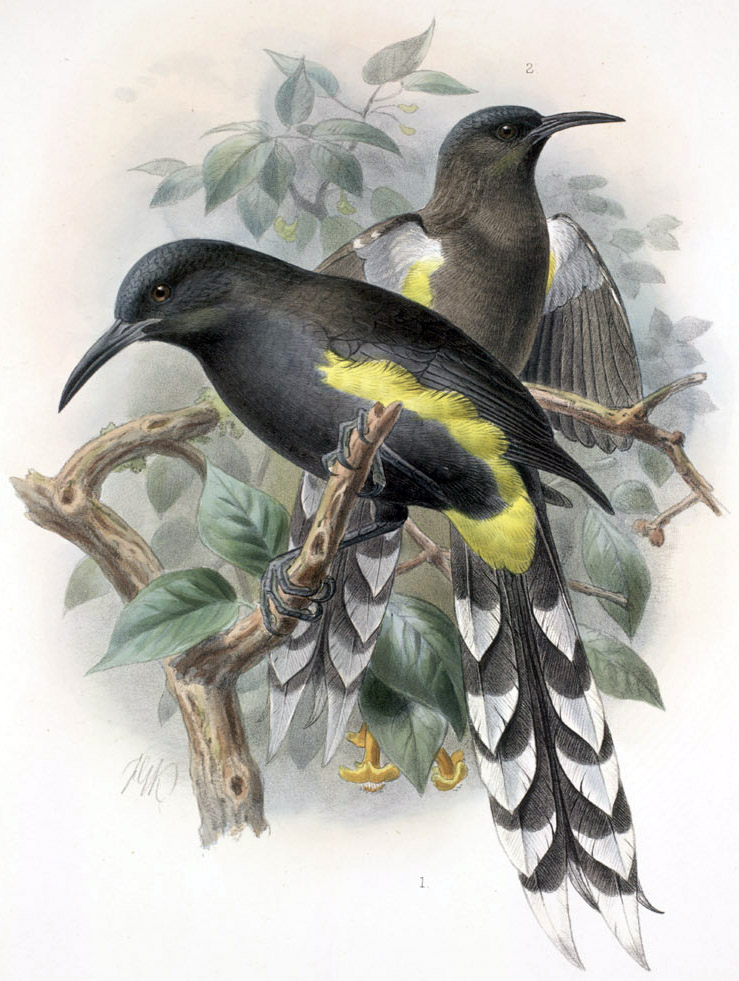
Moho pteroacariphagus
Moho pteroacariphagus
Order: Passeriformes / Family: Mohoidae
About the Moho pteroacariphagus
The Moho pteroacariphagus, commonly known as the iridescent moho, belongs to the family Mohoidae and is a remarkable species with a unique ecological niche. This striking songbird, once believed extinct, has reemerged in the dense, montane forests of Hawaii, its primary habitat. Its presence is significant due to its role as both a pollinator and a participant in seed dispersion, directly influencing forest dynamics. The bird thrives in the subtropical and tropical moist broadleaf forests found predominantly on the islands of Hawaii and Maui, where it contributes to maintaining the delicate ecological balance by feeding on a variety of insects and nectar, thus aiding in plant reproduction. Seasonal behaviors of the iridescent moho include altitudinal migration, where it descends to lower elevations during the colder months, tracking the flowering and fruiting patterns of native flora. This bird's adaptability to the shifting availability of resources showcases its resilience and highlights its importance in the ecosystem. The Moho pteroacariphagus plays a critical role in its habitat, functioning as both a pollinator and a seed disperser. Its interactions with endemic plant species facilitate genetic exchange and contribute to the biodiversity of its environment. In particular, the bird's feeding habits help maintain the health of native plant populations, ensuring continued growth and reproduction. The bird is often observed in the understory of forests, where it flits between branches, searching for insects and sipping nectar from vibrant flowers. Its specialized bill is adapted for probing blossoms, allowing it to access nectar from deep within the flowers, a trait that underpins its role as an effective pollinator. During the nesting season, the bird's activities intensify, as it requires additional nourishment to support its offspring. The Moho pteroacariphagus is not just a fascinating subject of ornithological study but also a crucial component of the Hawaiian forest ecosystem. Its presence aids in the propagation of native plant species, serving as a keystone species in its habitat. The bird's ecological role underscores the interconnectedness of the forest ecosystem, where each species contributes to the overall health and stability of the environment. By understanding the iridescent moho's behaviors and ecological significance, conservationists can better devise strategies to protect and preserve its habitat, ensuring the continued vitality of Hawaii's unique biodiversity.
The Moho pteroacariphagus belongs to the family Mohoidae, within the order Passeriformes. These birds typically live unknown; similar species estimated to live 5-10 years..
How to Identify a Moho pteroacariphagus
The Moho pteroacariphagus is a visually striking bird, easily identifiable by its iridescent plumage, which ranges from deep blues and purples to shimmering greens, creating a dazzling effect in sunlight. Adult birds exhibit a glossy, sleek appearance with long tail feathers that enhance their elegant silhouette. Juveniles, in contrast, possess more muted colors, with a predominance of brown tones that gradually transition into the radiant hues of adulthood. Males and females are similar in appearance, though males often display slightly more vibrant coloration, especially during the breeding season. A key distinguishing feature of the iridescent moho is its elongated, decurved bill, perfectly adapted for probing flowers for nectar. This adaptation sets it apart from similar species that may frequent the same habitat. In flight, the Moho pteroacariphagus demonstrates agility and grace, with a distinctive, undulating flight pattern that aids in maneuvering through dense foliage. When perched, the bird adopts an upright posture, often tilting its head to survey its surroundings. This alert stance, coupled with its striking colors, makes it a captivating sight for birdwatchers. Despite its unique appearance, the iridescent moho can sometimes be confused with the ʻIʻiwi, another Hawaiian honeycreeper. However, the moho's larger size and iridescent plumage provide reliable identification markers. Observers should also note the bird's behavior and preferred habitats, which can further assist in distinguishing it from other species.
Having trouble telling birds apart? Upload a photo to our bird identification tool for an instant species match.
Moho pteroacariphagus Habitat and Range
Preferred Habitat
The Moho pteroacariphagus thrives in the lush, montane forests of Hawaii, particularly favoring the islands of Hawaii and Maui. These forests, characterized by their subtropical and tropical moist broadleaf vegetation, offer the ideal conditions for the bird's ecological needs. Here, the moho finds ample food resources, including insects and nectar-producing flowers. The bird predominantly inhabits elevations between 1,500 and 3,000 meters, where it enjoys a cooler climate and abundant plant life. During colder months, the iridescent moho may migrate to lower elevations, taking advantage of the seasonal availability of blooming flowers and fruiting plants. This altitudinal migration allows the bird to maintain a consistent food supply throughout the year, showcasing its adaptability to environmental changes. While the moho is primarily found in forested areas, it occasionally ventures into adjacent open lands, although it tends to avoid urbanized regions. The species prefers undisturbed habitats, where it can forage and breed without significant human interference. Preservation of these forested areas is crucial for the continued survival of the iridescent moho, as habitat loss poses a significant threat to its population.
Geographic Range
Historically, the Moho pteroacariphagus inhabited a broader range across the Hawaiian Islands, but its current distribution is largely restricted to the islands of Hawaii and Maui. Within these regions, the bird occupies specific montane forest areas renowned for their biodiversity. The iridescent moho's breeding range is concentrated in the high-elevation forests where it constructs its nests and raises its young. During non-breeding seasons, the moho may migrate altitudinally, moving to lower forested areas where food resources remain abundant. This altitudinal movement is distinct from long-distance migration, as the bird predominantly remains within its insular environment. Population density hotspots include the Mauna Kea and Haleakalā regions, where conservation efforts focus on protecting the remaining suitable habitats. Though once widespread, the moho's range has significantly contracted due to habitat loss and environmental pressures, making conservation initiatives vital for its survival.
Want to know which birds visit your area? Browse our backyard birds by location guides for region-specific species lists.
What Does the Moho pteroacariphagus Eat?
The diet of the Moho pteroacariphagus primarily consists of nectar, which it extracts from a variety of native Hawaiian flowers. This dietary preference underscores its role as a vital pollinator within its ecosystem. The bird's elongated, decurved bill is perfectly adapted for reaching nectar deep within tubular flowers, such as those of the ʻŌhiʻa lehua and Lobelia species. In addition to nectar, the iridescent moho supplements its diet with a diverse array of insects and arachnids, providing essential protein, especially during the breeding season. The bird employs a combination of gleaning and hawking techniques to capture its insect prey, often observed flitting through the understory in pursuit of small arthropods. Seasonal changes in food availability influence the moho's foraging behavior, prompting it to adjust its feeding patterns to coincide with the flowering and fruiting cycles of its preferred plant species. The bird's flexible diet enables it to thrive in its habitat, maintaining its energy needs for nesting and rearing young.
Moho pteroacariphagus Behavior and Social Structure
The Moho pteroacariphagus exhibits a fascinating array of behaviors that reflect its ecological adaptations. Socially, the iridescent moho is relatively solitary, often foraging alone or in pairs rather than forming large flocks. This behavior may be linked to its specialized feeding strategy, which requires access to specific floral resources. Territoriality is a prominent aspect of the moho's behavior, especially during the breeding season when males vigorously defend their chosen territories from rivals. This defense involves a combination of vocal displays and physical posturing to deter intruders. Courtship displays are a captivating aspect of the moho's behavioral repertoire, with males performing elaborate flight displays and vocalizations to attract mates. These displays often occur in the early morning, coinciding with peak feeding times when the birds are most active. The iridescent moho's response to predators involves a series of alarm calls and evasive maneuvers, utilizing its agility and speed to escape threats. Daily activity patterns show that the moho is most active during the cooler hours of dawn and dusk, capitalizing on the availability of nectar and insects during these times.
Moho pteroacariphagus Nesting and Reproduction
The nesting habits of the Moho pteroacariphagus reflect its adaptation to its montane forest habitat. The iridescent moho constructs cup-shaped nests woven from fine plant fibers and lined with softer materials such as moss and feathers. These nests are typically situated in the fork of a tree branch, often at heights ranging from 3 to 10 meters above the ground, providing protection from ground-based predators. The bird's clutch size generally consists of 2 to 3 eggs, with both male and female sharing incubation duties. The incubation period lasts approximately 14 to 16 days, after which the chicks hatch, requiring intensive parental care. Both parents participate in feeding the young, bringing a diet rich in insects to support growth and development. Fledging occurs around 18 to 22 days post-hatching, with the juveniles remaining reliant on parental care for several weeks as they learn to forage independently. The Moho pteroacariphagus typically produces one brood per year, though favorable conditions may occasionally allow for a second brood.
Moho pteroacariphagus Sounds and Vocalizations
The vocalizations of the Moho pteroacariphagus are as distinctive as its appearance. The primary song consists of a series of melodious, flute-like notes, often delivered in a rhythmic sequence that resonates through the forest. The song is characterized by its clear, sweet tones, with variations in pitch that add a musical quality to the bird's calls. In addition to its song, the iridescent moho produces a range of call notes used for communication between mates and signaling alarm. These calls include sharp, staccato sounds that convey urgency, particularly when predators are detected. During the dawn chorus, the moho's vocalizations are most prominent, contributing to the vibrant soundscape of its habitat. The bird's calls are reminiscent of the Hawaiian ʻapapane, though the moho's song is typically more complex and varied.
Interesting Facts About the Moho pteroacariphagus
- 1The Moho pteroacariphagus was once thought extinct until its rediscovery in the late 20th century, highlighting the importance of conservation.
- 2This bird's iridescent plumage results from microscopic structures in its feathers that reflect light, creating a dazzling effect.
- 3The Moho pteroacariphagus contributes to the pollination of over 20 native Hawaiian plant species, showcasing its ecological significance.
- 4In Hawaiian culture, the moho is considered a symbol of beauty and grace, often featured in local folklore and song.
- 5The iridescent moho's call can be heard over long distances, earning it the nickname 'the voice of the forest' among local communities.
- 6Research shows that the moho's diet shift between nectar and insects supports its high-energy needs during breeding season.
- 7The Moho pteroacariphagus is one of the few birds uniquely adapted to thrive in Hawaii's montane cloud forests.
Moho pteroacariphagus Conservation Status
The Moho pteroacariphagus is currently classified as endangered, with its population showing a declining trend due to habitat loss and environmental pressures. Historically, the bird faced significant threats from deforestation and the introduction of invasive species, leading to a drastic reduction in its numbers. Conservation efforts are now focused on habitat restoration and the protection of remaining forest areas to ensure the survival of the iridescent moho. Initiatives include controlling invasive species and promoting the growth of native plants that provide essential food resources. Captive breeding programs and research into the bird's ecological needs are also underway, aiming to bolster wild populations. Despite these efforts, the moho's future remains uncertain, necessitating continued conservation commitment to preserve this iconic species.