
Nahan's Francolin
Ptilopachus nahani
Order: Galliformes / Family: Odontophoridae

Wikimedia Commons
About the Nahan's Francolin
The Nahan's Francolin (Ptilopachus nahani) is a fascinating bird species endemic to certain regions in Africa. Found primarily in the dense, lowland rainforests of the Democratic Republic of the Congo and Uganda, this bird is part of the Odontophoridae family, which includes New World quails. Despite its quail-like appearance, it exhibits unique behaviors and adaptations suited to its specific habitat. The Nahan's Francolin plays a crucial ecological role as both a seed disperser and an insect predator, contributing to the health and diversity of its forest environment. This bird is particularly important in the ecology of the Ituri Forest and other significant forested areas within its range. Its presence is indicative of healthy forest ecosystems, as it relies on dense understory and well-preserved habitats for survival. The bird's significance extends beyond its ecological role. It holds cultural importance among local communities, often featuring in local folklore and traditional narratives. During the breeding season, typically between March and May, the Nahan's Francolin engages in distinctive courtship behaviors, which include vocalizations and displays designed to attract mates. These seasonal behaviors are critical for understanding the dynamics of its population and habitat requirements. Unfortunately, the Nahan's Francolin faces several conservation challenges. Habitat loss due to deforestation and human encroachment poses a significant threat to its survival. Conservation efforts are underway to protect the remaining forest habitat and ensure the continued existence of this remarkable bird.
The Nahan's Francolin belongs to the family Odontophoridae, within the order Galliformes. These birds typically live typically lives 5-7 years in the wild..
How to Identify a Nahan's Francolin
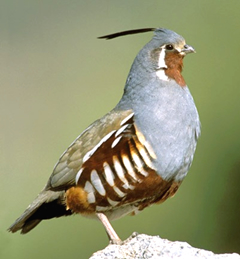
The Nahan's Francolin is a medium-sized bird, approximately 25-28 cm in length, with a robust body and short, rounded wings. Its plumage is predominantly reddish-brown, with intricate patterns that provide excellent camouflage among the forest leaf litter. Adults have a distinctive black and white facial pattern, with a striking bright red eye-ring that is a key identifying feature. The underparts are lighter, with a mottled appearance that varies between individuals. Juveniles resemble adults but are generally duller in coloration, lacking the pronounced facial markings and red eye-ring. Males and females of the species are similar in appearance, though males can be slightly larger. In terms of similar species, the Nahan's Francolin can be confused with the Coqui Francolin due to overlapping ranges, but the latter has a more pronounced black and white barring on the wings. When in flight, the Nahan's Francolin displays a rapid, whirring wingbeat and tends to keep low to the ground, rarely flying long distances. Its perching posture is upright and alert, often seen in small clearings or along forest edges.
Having trouble telling birds apart? Upload a photo to our bird identification tool for an instant species match.
Nahan's Francolin Habitat and Range
Preferred Habitat
The Nahan's Francolin inhabits dense lowland tropical forests, favoring areas with thick understory and abundant leaf litter. It is typically found at elevations ranging from 500 to 1,200 meters, primarily within the Ituri Forest of the Democratic Republic of the Congo and parts of western Uganda. This bird avoids open areas and is rarely seen in heavily disturbed or fragmented habitats. During the wet season, it may venture closer to forest edges or secondary growth, but it remains largely within mature forest interiors. The Nahan's Francolin is not adapted to urban environments and is seldom found in proximity to human settlements.
Geographic Range
The Nahan's Francolin's range is restricted to the central African region, particularly within the Democratic Republic of the Congo and Uganda. It is a non-migratory species, maintaining territories year-round within these areas. The most significant population density is noted in the Ituri Forest and surrounding forested regions. While it does not undertake long migrations, there may be minor altitudinal movements in response to seasonal changes in food availability and habitat conditions.
Want to know which birds visit your area? Browse our backyard birds by location guides for region-specific species lists.
What Does the Nahan's Francolin Eat?
The Nahan's Francolin has an omnivorous diet, primarily feeding on seeds, fruits, and insects. During the wet season, it increases its intake of insects, which are abundant and provide a rich protein source. Foraging occurs primarily on the forest floor, where the bird uses its sturdy bill to sift through leaf litter and soil. It may also consume small reptiles and amphibians when available. This bird forages mostly during the early morning and late afternoon, avoiding the midday heat. Its diet changes seasonally, with a greater emphasis on plant material during the dry season when insect availability is reduced.
Nahan's Francolin Behavior and Social Structure
The Nahan's Francolin exhibits intriguing behaviors, often seen in small family groups rather than large flocks. It is a ground-dweller, spending most of its time foraging on the forest floor. Territorial behavior is pronounced, particularly during the breeding season, with males engaging in vocal displays and physical posturing to defend their space. The bird's courtship display includes a series of rapid wing flaps and vocalizations, aimed at attracting a mate. In response to predators, the Nahan's Francolin relies on its cryptic plumage for camouflage, often freezing in place or quietly slipping into dense cover. It is most active during the cooler parts of the day, foraging and engaging in social interactions.
Nahan's Francolin Nesting and Reproduction
The Nahan's Francolin nests on the ground, often in a shallow depression lined with leaves and grass. Nest sites are typically well-concealed under dense vegetation or fallen logs. The typical clutch size ranges from 3 to 5 eggs, which are pale brown with subtle speckling. Incubation lasts for about 18-20 days, mainly performed by the female. Once hatched, the young are precocial, leaving the nest shortly after hatching and are cared for by both parents. Fledging occurs at approximately 2 weeks of age, although the young remain with the family group for some time thereafter. The species generally produces one brood per year.
Nahan's Francolin Sounds and Vocalizations
The primary vocalization of the Nahan's Francolin is a series of sharp, clear whistles, often described as 'cheer-cheer-cheer.' These calls serve both as a territorial signal and a contact call between mates. During the breeding season, its vocalizations are more frequent and can be heard throughout the day, particularly at dawn and dusk. Alarm calls are harsher and more abrupt, designed to alert other birds to potential danger. The bird's vocal repertoire is essential for maintaining social bonds and coordinating group activities.
Interesting Facts About the Nahan's Francolin
- 1The Nahan's Francolin is one of the few francolin species adapted to life in dense rainforest environments.
- 2Despite its quail-like appearance, the Nahan's Francolin belongs to the Odontophoridae family rather than the Phasianidae.
- 3The species is named after Nahan, an explorer who first documented it in the early 20th century.
- 4Its call is often compared to the sound of a referee's whistle, a distinctive feature for birdwatchers.
- 5The Nahan's Francolin's cryptic plumage allows it to blend seamlessly with the forest floor, aiding in its survival.
- 6Unlike many ground-dwelling birds, the Nahan's Francolin rarely flies, preferring to run when threatened.
- 7Its diet includes a variety of forest floor detritus, playing a role in nutrient cycling within its ecosystem.
Nahan's Francolin Conservation Status
The Nahan's Francolin is currently listed as Vulnerable on the IUCN Red List due to habitat loss and fragmentation. The primary threat to its population is deforestation driven by logging and agricultural expansion. Conservation efforts focus on habitat protection and restoration, with several forest reserves established in its range. Despite these efforts, the population trend remains uncertain, necessitating ongoing monitoring and research to ensure effective conservation measures. Historical records suggest that the species was once more widespread, but its range has contracted significantly over recent decades.
Other Odontophoridae Species


Birds Similar to the Nahan's Francolin
These species are often confused with the Nahan's Francolin due to similar appearance or overlapping range.

