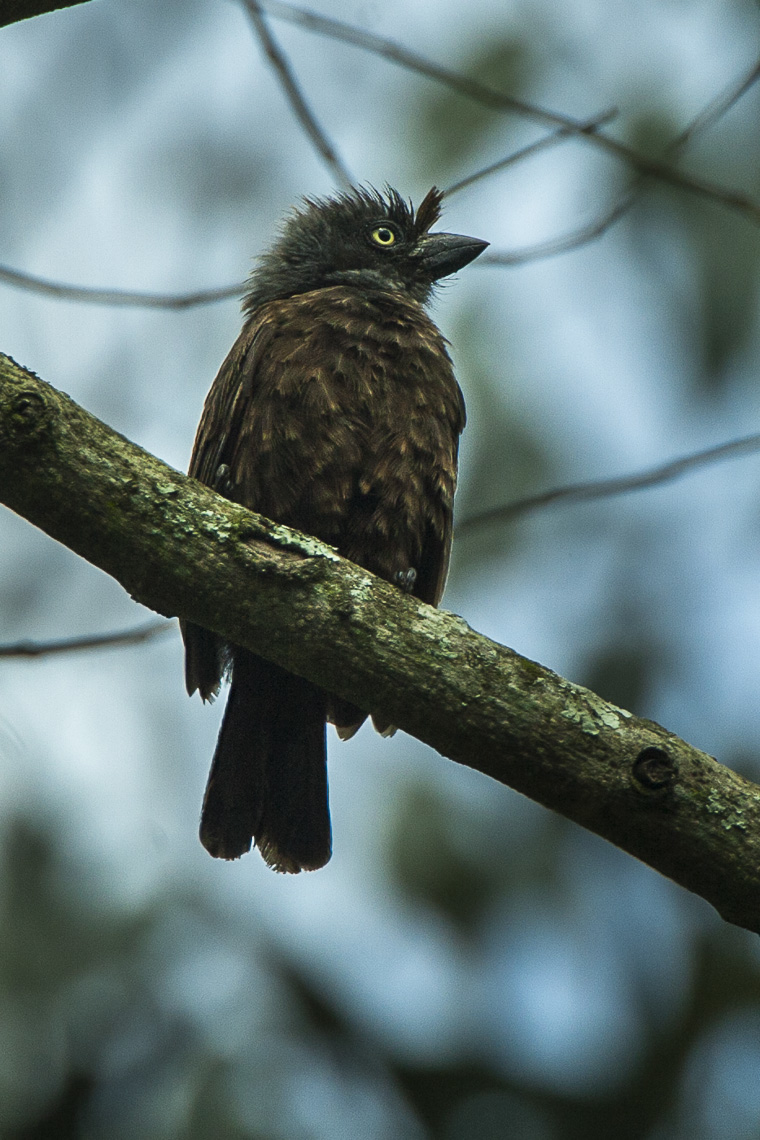
Naked-faced Barbet
Gymnobucco calvus
Order: Piciformes / Family: Lybiidae

Wikimedia Commons
About the Naked-faced Barbet
The Naked-faced Barbet, Gymnobucco calvus, is a distinctive bird found primarily in the dense rainforests of Central and West Africa. This species belongs to the Lybiidae family, which includes a variety of small to medium-sized barbets known for their stout bills and vibrant plumage. However, the Naked-faced Barbet is unique due to its lack of facial feathers, revealing a bare, fleshy area around its eyes and beak, giving it a somewhat peculiar appearance. This adaptation may play a role in thermoregulation, helping the bird manage heat in its humid environment.
Ecologically, the Naked-faced Barbet occupies an essential niche as both a seed disperser and an insect predator. Its diet consists mainly of fruits, seeds, and small invertebrates, which it forages for within the forest canopy. By consuming a variety of fruits, this barbet aids in the dispersal of seeds across the forest floor, promoting plant diversity and forest regeneration. Its insectivorous habits also help control insect populations, maintaining a balanced ecosystem.
The species is primarily found in the humid tropical forests of countries like Cameroon, the Democratic Republic of the Congo, and Uganda. It thrives in these dense habitats, where it can access a rich supply of food and suitable nesting sites. The Naked-faced Barbet is a non-migratory bird, meaning it spends its entire life within these tropical regions. During the breeding season, which typically coincides with the rainy season, the species becomes more vocal and active as it searches for mates and establishes territories.
The Naked-faced Barbet's role in its ecosystem extends to its interactions with other species. As a frugivore, it competes with other fruit-eating birds and mammals for resources. Additionally, its nesting habits in tree cavities make it a target for nest predators like snakes and larger birds. Despite these challenges, the Naked-faced Barbet remains a common sight in its native range, demonstrating its adaptability and resilience in a complex environment.
The Naked-faced Barbet belongs to the family Lybiidae, within the order Piciformes. These birds typically live average 8 years with a maximum recorded of 12 years..
How to Identify a Naked-faced Barbet
The Naked-faced Barbet is easily identified by its bare facial skin, which is a pale pinkish color, contrasting with the dark brown plumage that covers most of its body. Adults typically measure about 20 centimeters in length, making them medium-sized for barbets. The species exhibits no sexual dimorphism, with males and females appearing similar in plumage and size. Juveniles, however, may have slightly duller plumage and less prominent bare skin.
In terms of flight, the Naked-faced Barbet exhibits a strong, direct flight pattern, with rapid wingbeats and a tendency to fly low through the forest canopy. When perched, the bird often adopts an upright posture, displaying its robust bill and bare face prominently. This perching behavior, combined with its unique facial appearance, makes the Naked-faced Barbet relatively easy to distinguish from other barbet species.
While other barbets in the region may share similar sizes and body shapes, the lack of facial feathers is a key differentiator. For example, the Bristle-nosed Barbet, another species found in similar habitats, has a more feathered face and a distinct bristle-like nasal tuft, which sets it apart from the Naked-faced Barbet.
Having trouble telling birds apart? Upload a photo to our bird identification tool for an instant species match.
Naked-faced Barbet Habitat and Range
Preferred Habitat
The primary habitat of the Naked-faced Barbet is the dense, humid lowland rainforests of Central and West Africa. These forests provide the rich fruit and insect resources that the species depends on. The barbet typically resides at elevations ranging from sea level up to about 2,000 meters, although it prefers the lush, low-lying regions where fruiting trees are abundant.
In addition to primary forests, the Naked-faced Barbet can also inhabit secondary forests and forest edges, demonstrating some adaptability to habitat modifications. However, it is less frequently found in heavily urbanized or agricultural areas, as these environments lack the dense canopy cover and diverse food sources the species requires.
During the breeding season, the Naked-faced Barbet may venture into slightly different areas of the forest to locate optimal nesting sites, but it generally remains within its preferred habitat year-round. Its dependence on forested environments underscores the importance of preserving these habitats to ensure the bird's continued survival.
Geographic Range
The range of the Naked-faced Barbet is largely confined to the humid tropical belt of Central and West Africa. Countries where it is commonly found include Cameroon, Gabon, the Democratic Republic of the Congo, and Uganda. Within these regions, its distribution is closely tied to the availability of suitable forest habitats.
Unlike many bird species, the Naked-faced Barbet does not undertake long-distance migrations. Instead, it remains resident within its range throughout the year, benefiting from the consistent availability of food in its tropical environment. This stability allows the bird to maintain local populations without the pressures faced by migratory species.
Population density tends to be highest in areas where food resources are plentiful and human disturbance is minimal. In well-preserved forest reserves and national parks, the Naked-faced Barbet can be observed with relative ease, often in small family groups or pairs.
Want to know which birds visit your area? Browse our backyard birds by location guides for region-specific species lists.
What Does the Naked-faced Barbet Eat?
The diet of the Naked-faced Barbet is primarily frugivorous, consisting largely of a variety of fruits and berries that it finds within the forest canopy. It favors figs and other soft fruits, which provide essential nutrients and energy. This bird also supplements its diet with seeds and small invertebrates, such as insects and spiders, especially during the breeding season when protein demand increases.
Foraging typically occurs in the early morning and late afternoon, when the barbet becomes most active. It employs a methodical approach, hopping through branches and using its strong bill to pluck fruits and capture insects. The barbet's feeding technique is often deliberate, as it selects ripe fruits and carefully maneuvers them with its bill before swallowing.
Seasonal changes can affect the availability of certain fruits, prompting the Naked-faced Barbet to adjust its diet accordingly. During times of fruit scarcity, it may rely more heavily on insects and seeds to meet its dietary needs.
Naked-faced Barbet Behavior and Social Structure
The Naked-faced Barbet exhibits a variety of interesting behaviors that reflect its social and ecological strategies. Typically, these birds are seen in pairs or small family groups, which suggests a degree of social structuring centered around breeding pairs and their offspring.
Territorial behavior is evident during the breeding season, with pairs vocally defending their chosen nesting sites from intruders. This vocalization serves both to deter rivals and to strengthen pair bonds. Courtship displays are subtle compared to other species, often involving mutual preening and synchronized movements as a demonstration of partnership.
The barbet's response to predators includes a combination of vocal alarm calls and evasive flight. When threatened, it will often retreat to dense foliage, using its drab plumage as camouflage. Despite this, the Naked-faced Barbet remains an active and vocal participant in the forest's daily rhythm, with periods of intense foraging activity interspersed with quieter moments of rest and social interaction.
Naked-faced Barbet Nesting and Reproduction
Nesting for the Naked-faced Barbet takes place primarily in tree cavities, which the birds either find naturally or enlarge themselves using their robust bills. These cavities are typically located at varying heights within trees, offering protection from ground-based predators.
The nesting season often aligns with the onset of the rainy season, when food resources become more abundant. Clutches usually consist of 2-4 eggs, with both parents sharing responsibilities for incubation and feeding. Incubation lasts approximately 13-15 days, followed by a fledging period of about 30 days, during which the young are entirely dependent on parental care.
Both male and female barbets participate equally in raising the chicks, ensuring that they are well-fed and protected. The commitment to parental care ensures a relatively high survival rate for the young, allowing the species to maintain stable population levels. Typically, the Naked-faced Barbet can produce one or two broods per year, depending on environmental conditions and food availability.
Naked-faced Barbet Sounds and Vocalizations
The Naked-faced Barbet's vocalizations are a key aspect of its behavior, characterized by repetitive, rhythmic calls that can be heard echoing through the forest. The primary song consists of a series of low-pitched, monotonous notes, often described as 'poo-poo-poo' that rise and fall in a steady cadence.
In addition to its song, the barbet emits a variety of call notes, ranging from short, sharp 'tuk' sounds to more complex chatter during social interactions. Alarm calls are harsher and more abrupt, serving to alert nearby birds to potential threats.
During the dawn chorus, the Naked-faced Barbet's calls contribute to the rich tapestry of sounds that define its tropical forest habitat. This vocal activity peaks in the early morning and late afternoon, coinciding with periods of increased feeding and social activity.
Interesting Facts About the Naked-faced Barbet
- 1Despite its bare face, the Naked-faced Barbet's skin helps it regulate body temperature in the humid forest climate.
- 2The strong bill of the Naked-faced Barbet is not only for eating but also for excavating nesting cavities in trees.
- 3Naked-faced Barbets are known to form small social groups outside the breeding season, often seen foraging together.
- 4These birds are non-migratory, spending their entire lives in the tropical forests of Central and West Africa.
- 5The Naked-faced Barbet's diet is highly adaptable, shifting from primarily fruits to more insects when necessary.
- 6Their vocalizations, while monotonous, play a crucial role in territory defense and mating rituals.
- 7The facial skin of the Naked-faced Barbet, devoid of feathers, gives it a distinctive appearance not common among other barbets.
Naked-faced Barbet Conservation Status
The Naked-faced Barbet is currently listed as a species of Least Concern by the International Union for Conservation of Nature (IUCN). Its populations are considered stable across much of its range, thanks to its adaptability to a variety of forested habitats. Primary threats to the species include habitat loss due to deforestation and land conversion for agriculture. However, the barbet's ability to thrive in both primary and secondary forests has mitigated some of these pressures. Conservation efforts focused on preserving large tracts of forest habitat and establishing protected areas have been beneficial to the species. Historically, the Naked-faced Barbet has maintained stable population levels, attributed to its successful breeding strategies and adaptability. Continued conservation measures are essential to ensure that this unique bird continues to thrive in its native environments.