
Yellow-spotted Barbet
Buccanodon duchaillui
Order: Piciformes / Family: Lybiidae

Wikimedia Commons
About the Yellow-spotted Barbet
The Yellow-spotted Barbet (Buccanodon duchaillui) is a captivating bird species within the family Lybiidae, under the order Piciformes. This small barbet is predominantly found in the lush, humid forests of Central and West Africa, where it plays a vital role in the ecosystem as both a seed disperser and insect predator. Its presence is particularly noted in countries such as Gabon, Cameroon, and the Democratic Republic of the Congo, thriving in regions rich with dense canopy cover and abundant fruiting trees. The barbet's vibrant appearance, characterized by yellow spots on its greenish body, makes it a notable member of the avian community in these biodiverse habitats. Throughout the year, the Yellow-spotted Barbet engages in various behaviors that contribute to the forest's ecological balance. During the wet season, when fruits are plentiful, it becomes an avid frugivore, consuming a wide array of berries and seeds. By doing so, it assists in the propagation of numerous plant species, ensuring forest regeneration. Its insectivorous tendencies further aid in controlling pest populations. As a cavity-nesting bird, the Yellow-spotted Barbet often utilizes old woodpecker holes or naturally occurring tree cavities, supporting the broader cycle of forest dynamics by maintaining the health and diversity of tree populations. This barbet's role extends beyond mere ecological interaction. It acts as an indicator species, reflecting the health of its forest environment. Changes in its population can signal shifts in habitat quality, making it an essential subject for conservation studies. The seasonal behaviors of the Yellow-spotted Barbet are deeply intertwined with the phenology of the forests it inhabits. Birders and researchers alike can observe subtle shifts in its diet and territorial behavior, adapting to the cyclical abundance of food resources. These adaptations highlight the bird's resilience and its evolutionary success in navigating the challenges of its forest home.
The Yellow-spotted Barbet belongs to the family Lybiidae, within the order Piciformes. These birds typically live typically 5-8 years, with some individuals living over 10 years..
How to Identify a Yellow-spotted Barbet
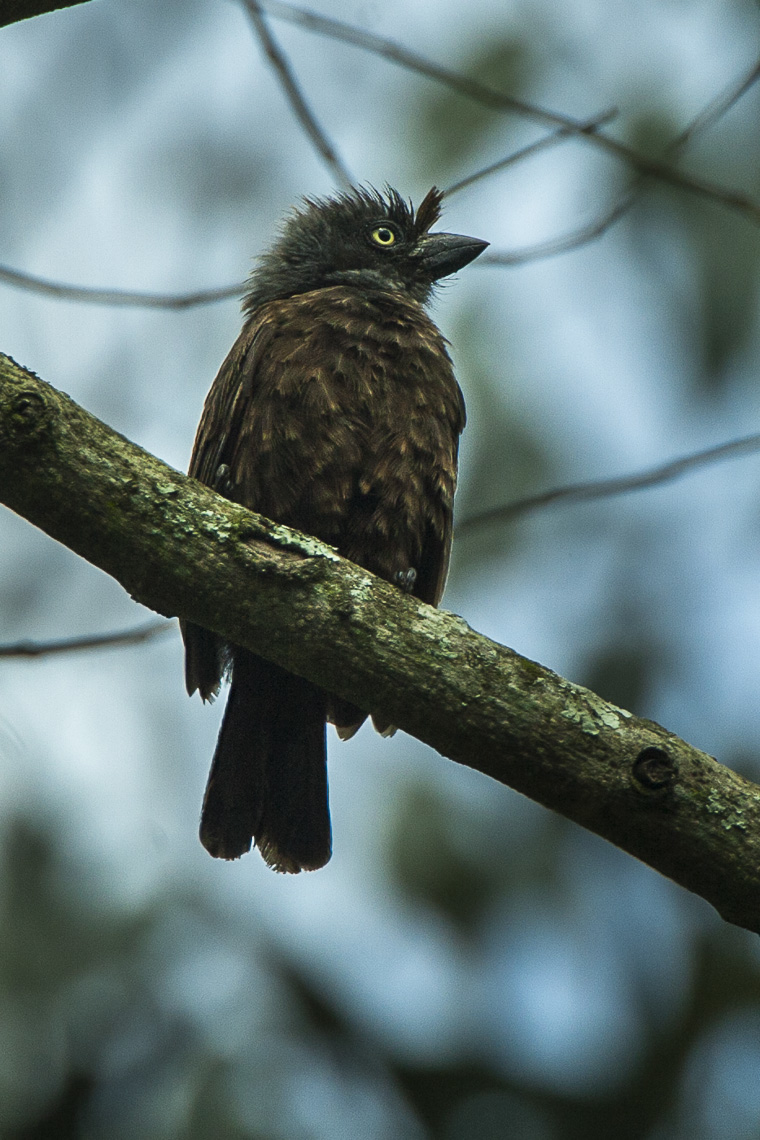
The Yellow-spotted Barbet is a small bird, measuring around 15 centimeters in length, with a robust body typical of barbets. Its plumage is predominantly green, adorned with bright yellow spots that give the bird its name. These conspicuous spots are most prominently displayed across the wings and back, while the underparts are a lighter green, providing an effective camouflage amongst the leafy canopy. The adult has a short, thick bill, which is dark in color, suited for its varied diet of fruits and insects. Juveniles resemble adults but have less distinct spotting and a duller overall appearance, allowing them to blend into their surroundings as they develop. Males and females share similar plumage, making sex differentiation in the field challenging without behavioral context. Confusion may arise with other barbet species, such as the Hairy-breasted Barbet, but the Yellow-spotted Barbet's distinct yellow marking pattern and smaller size help distinguish it. In flight, the Yellow-spotted Barbet has a relatively direct yet undulating flight pattern, often moving in short bursts between trees. When perching, it adopts an upright posture, frequently observed in pairs or small family groups. This perching behavior, combined with its vivid plumage, makes the Yellow-spotted Barbet an exciting find for bird enthusiasts exploring the dense forests of its range.
Having trouble telling birds apart? Upload a photo to our bird identification tool for an instant species match.
Yellow-spotted Barbet Habitat and Range
Preferred Habitat
The Yellow-spotted Barbet thrives in the humid tropical forests of Central and West Africa, favoring lowland regions with rich biodiversity. It occupies primary and secondary forests, particularly areas with a dense canopy and abundant fruiting trees. Elevation-wise, the barbet is generally found from sea level up to about 1,500 meters, where the forest structure provides ample nesting and feeding opportunities. Seasonal habitat shifts occur as the bird follows fruiting patterns, occasionally venturing into forest edges or nearby woodland areas during periods of scarcity. While primarily a forest inhabitant, it can occasionally be spotted in more open areas adjacent to dense woodland, illustrating some level of habitat adaptability. However, urban presence is minimal, as the barbet typically avoids heavily populated or developed areas.
Geographic Range
The Yellow-spotted Barbet's range is centered in Central and West Africa. It is widely distributed across countries such as Gabon, Cameroon, the Democratic Republic of the Congo, and the Central African Republic. Its presence extends into parts of Nigeria, Equatorial Guinea, and Angola. The species does not undertake long-distance migrations but may exhibit local movements in response to seasonal food availability, particularly following fruiting cycles in its forest habitats. Population density hotspots are often found in regions where there is minimal human disturbance and abundant fruit-bearing trees, reflecting the bird's reliance on healthy forest ecosystems. The Yellow-spotted Barbet's range does not extend into regions outside the African continent, and it remains absent from the drier savannas and desert areas of the continent.
Want to know which birds visit your area? Browse our backyard birds by location guides for region-specific species lists.
What Does the Yellow-spotted Barbet Eat?
The Yellow-spotted Barbet primarily consumes a diet rich in fruits, favoring figs, berries, and small drupes found within its forested environment. This frugivorous diet is supplemented by a variety of insects, including beetles, caterpillars, and ants, which it gleans from foliage or captures in flight. Seasonal diet shifts are evident as the barbet adjusts its feeding habits to the availability of different fruit species, often seen actively feeding during the early morning and late afternoon. Its robust bill is well-adapted for crushing fruit and extracting seeds, playing a significant role in seed dispersal. Foraging behavior is typically solitary or in pairs, but small family groups may come together when food is particularly plentiful. The Yellow-spotted Barbet's feeding schedule aligns with the forest's natural rhythms, providing a reliable source of sustenance for itself and its offspring.
Yellow-spotted Barbet Behavior and Social Structure
Socially, the Yellow-spotted Barbet is often observed in pairs or small family groups, reinforcing its territorial nature. It establishes and defends territory through vocalizations, using its distinctive calls to communicate with mates and deter intruders. Courtship displays involve mutual preening and gentle feeding, which strengthen pair bonds. During the breeding season, the barbet becomes more vocal, often participating in duets with its mate. Flocking behavior is less common, with barbets generally maintaining loose associations with other forest species. In response to predators, the Yellow-spotted Barbet employs evasive flight and seeks cover within dense foliage. Its daily activity pattern is diurnal, with increased activity during the cooler morning and late afternoon hours. This timing aligns with the availability of food resources and the reduced risk of predation.
Yellow-spotted Barbet Nesting and Reproduction
The Yellow-spotted Barbet nests in tree cavities, often utilizing abandoned woodpecker holes or natural cavities in decaying wood. The selection of nesting sites is crucial, as these locations offer protection from predators and environmental elements. The barbet lines the cavity with minimal material, relying on the natural insulation provided by the wood. Egg clutches typically consist of two to four eggs, which both parents incubate over a period of approximately 13 to 15 days. After hatching, the chicks remain in the nest for about 30 days, during which both parents partake in feeding and protecting their young. The barbet generally raises one to two broods per year, depending on food availability and environmental conditions. Parental roles are shared, with both male and female engaging in incubation and chick-rearing duties.
Yellow-spotted Barbet Sounds and Vocalizations
The Yellow-spotted Barbet's primary song is a series of melodious whistles, with a rhythm that is both deliberate and slightly erratic. These whistles, often described as 'tyoo-tyoo' or 'pyo-pyo', serve as both territorial markers and mate communications. Call notes are sharp and clear, easily carrying through the forest canopy. Alarm calls are typically harsher, alerting other birds to potential threats. During the dawn chorus, the barbet's song contributes to the symphony of forest sounds, providing a natural soundtrack to the waking forest. Its vocalizations are distinctive enough to be a reliable tool for field identification, even when the bird itself remains hidden among the foliage.
Interesting Facts About the Yellow-spotted Barbet
- 1Yellow-spotted Barbets are often associated with figs, a cornerstone of their diet, which makes them key seed dispersers.
- 2Despite their small size, these barbets have powerful calls that can be heard over considerable distances in dense forests.
- 3The barbet's nesting strategy relies heavily on existing cavities, making them dependent on the presence of woodpeckers and naturally occurring tree holes.
- 4Yellow-spotted Barbets are one of the few species in their range that can be identified by sound alone, thanks to their distinctive vocal patterns.
- 5Barbet pairs often engage in duets, a behavior that strengthens pair bonds and reinforces territorial claims.
- 6Unlike many forest birds, the Yellow-spotted Barbet shows some resilience to habitat changes, adapting to secondary forests when necessary.
- 7The Yellow-spotted Barbet's bright yellow spots help camouflage it among the sun-dappled leaves of the forest canopy.
Yellow-spotted Barbet Conservation Status
The International Union for Conservation of Nature (IUCN) currently lists the Yellow-spotted Barbet as a species of Least Concern, indicating a relatively stable population. However, deforestation and habitat fragmentation pose ongoing threats to its natural habitat. Conservation efforts focus on preserving large swathes of forest and promoting sustainable land-use practices. Historically, the Yellow-spotted Barbet has maintained stable populations due to its adaptability to secondary forests, but continuous monitoring is essential to ensure its ongoing survival. Conservationists emphasize the importance of maintaining biodiverse environments to support this and other forest-dependent species.
Other Lybiidae Species


Birds Similar to the Yellow-spotted Barbet
These species are often confused with the Yellow-spotted Barbet due to similar appearance or overlapping range.
