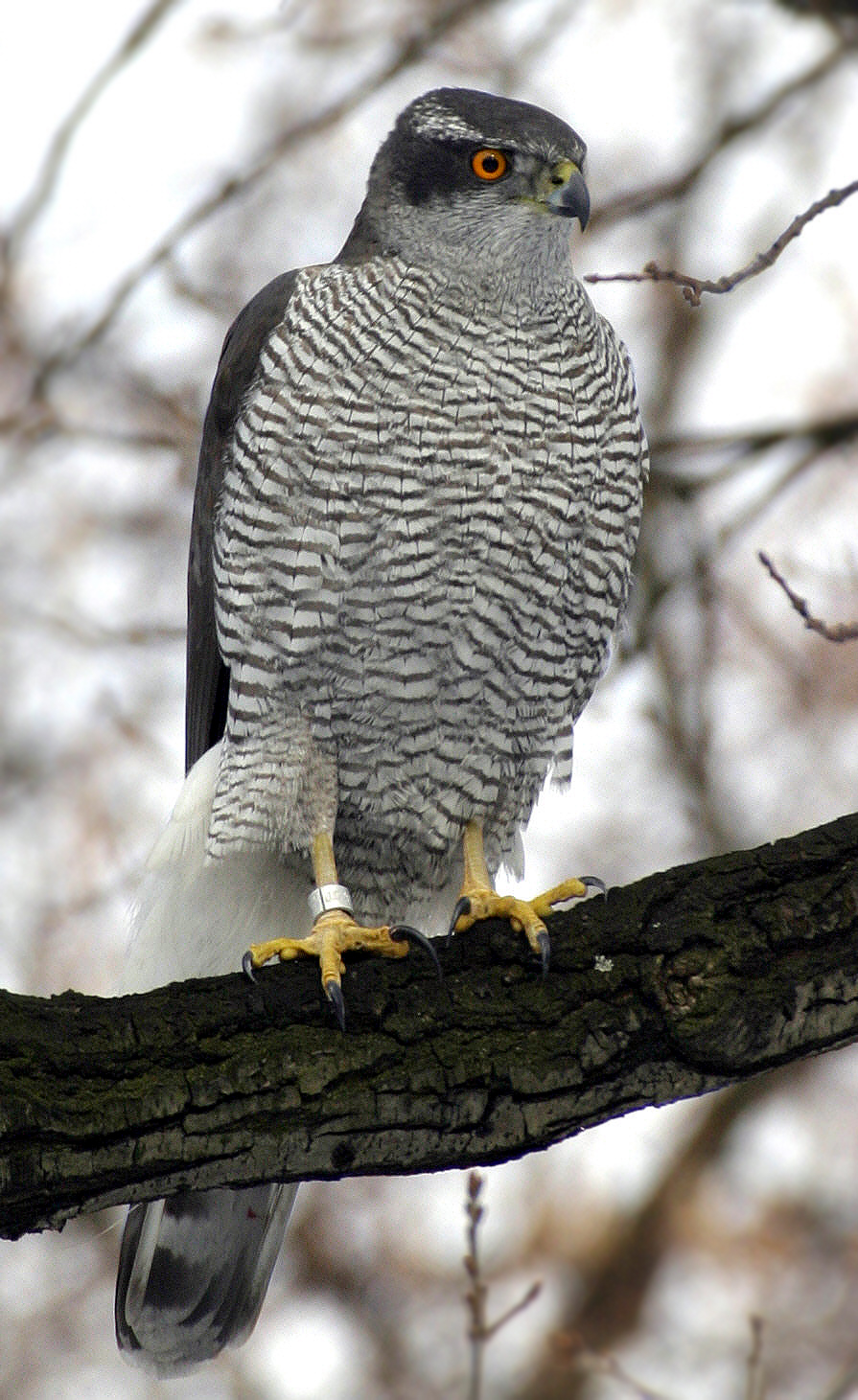
Cooper's Hawk
Accipiter cooperii
Order: Accipitriformes / Family: Accipitridae

Wikimedia Commons
About the Cooper's Hawk
The Cooper's Hawk (Accipiter cooperii) is a medium-sized raptor belonging to the family Accipitridae and order Accipitriformes. Renowned for its adaptability and hunting skills, this species is a prevalent bird of prey across North America. Its presence is a testament to the health of various ecosystems, as it plays a crucial role in controlling bird and small mammal populations. Cooper's Hawks are particularly significant in urban and suburban areas, where they have adapted impressively well to human-altered landscapes, often seen gliding through wooded neighborhoods or perched silently in city parks.
These hawks are most commonly found in deciduous, mixed, and coniferous forests, but they also thrive in woodlots, riparian zones, and semi-urban areas. During the breeding season, which typically runs from March through June, they establish territories and build nests high in trees, often reusing old nests from previous years. In terms of geographical distribution, they are widespread across the United States, southern Canada, and northern Mexico during the breeding season, with some populations in the northern regions migrating to Central and South America during the winter months.
Seasonal behaviors of the Cooper's Hawk include notable migration patterns in the fall, with many individuals traveling south from their northern breeding grounds. During migration, they often join mixed-species flocks, taking advantage of favorable winds and thermal currents. In the winter, they can be found in a variety of habitats, including open woodlands and urban areas, where they continue their role as top predators. The ecological role of the Cooper's Hawk extends beyond their predatory habits; they are also indicators of environmental health, as they require relatively large territories with abundant prey to thrive.
The Cooper's Hawk belongs to the family Accipitridae, within the order Accipitriformes. These birds typically live on average, cooper's hawks live up to 12 years, with the oldest recorded at 20 years..
How to Identify a Cooper's Hawk
The adult Cooper's Hawk features a steely blue-gray upper body with a contrasting rufous barring on its breast and belly, which provides a striking appearance. One of the most distinguishing field marks is its rounded tail with broad, dark bands and a white tip, differentiating it from the sharp-shinned hawk, which has a more square-shaped tail. Juvenile Cooper's Hawks have brown upperparts and heavily streaked underparts, making them more challenging to identify. However, the longer tail and larger size help distinguish them from similar species.
Sexual dimorphism is evident in this species, with females being notably larger than males, a common trait among raptors. The size difference is significant, as females can be up to one-third larger than males. This size disparity can aid in identification when observing pairs during the breeding season. In flight, the Cooper's Hawk exhibits rapid wingbeats followed by short glides, a characteristic flight pattern that helps differentiate it from other raptors.
When perched, the Cooper's Hawk maintains an upright posture, often remaining motionless for extended periods while scanning for prey. Its piercing yellow to red eyes, depending on age, give it a fierce expression. As with many accipiters, confusion with other similar-sized raptors can occur, but the combination of its rounded tail, size, and behavior provides reliable identification cues.
Having trouble telling birds apart? Upload a photo to our bird identification tool for an instant species match.
Cooper's Hawk Habitat and Range
Preferred Habitat
Cooper's Hawks inhabit a wide range of habitats, predominantly favoring deciduous and mixed forests as their primary environment. They are also commonly found in suburban and urban areas, where mature trees provide suitable nesting and hunting grounds. Elevation-wise, they can be found from sea level up to 3,000 meters in the mountainous regions of the western United States.
Seasonally, these hawks may shift their habitats slightly, moving from dense forests to more open areas during migration and winter. In rural settings, they inhabit woodlots, riparian corridors, and even agricultural fields, provided there is adequate tree cover for nesting and hunting. Urban environments present ample opportunities for these adaptable birds, as they take advantage of bird feeders and parks for easy prey.
During the breeding season, Cooper's Hawks prefer habitats that offer a mix of dense cover for nesting and open areas for hunting. This habitat preference allows them to remain widespread and common across their range, despite environmental changes.
Geographic Range
The Cooper's Hawk's breeding range spans much of North America, from southern Canada through the United States and into northern Mexico. Populations in the northernmost parts of this range, such as those in southern Canada and the northern United States, migrate southwards during the winter months. Wintering grounds extend into Central America and occasionally as far south as northern South America.
Migration corridors for Cooper's Hawks are well-documented, with large numbers passing through the central flyways of North America. Notably, migration hotspots include the Great Lakes region, the Appalachian Mountains, and along both the Atlantic and Pacific coasts. These pathways are crucial for the species as they travel between breeding and wintering areas.
Within their range, population density is highest in areas with abundant prey and suitable nesting sites. Urban areas have seen increasing populations of Cooper's Hawks thanks to their adaptability, while rural and forested regions continue to support stable numbers. Despite being widespread, sightings of Cooper's Hawks can be more frequent during migration when they are more visible and active.
Want to know which birds visit your area? Browse our backyard birds by location guides for region-specific species lists.
What Does the Cooper's Hawk Eat?
Cooper's Hawks have a varied diet that primarily consists of medium-sized birds, making up the bulk of their prey. Common avian targets include pigeons, doves, starlings, and robins. They also hunt small mammals, such as squirrels and chipmunks, providing some dietary flexibility. Seasonal changes affect their diet, with more small mammals being taken during the winter months when bird numbers are reduced.
These hawks employ ambush tactics to capture their prey, using their agility and stealth to surprise unsuspecting birds. They often hunt in forested areas, taking advantage of dense cover to launch swift, direct attacks. Their speed and maneuverability allow them to pursue prey through trees, a hunting technique that distinguishes them from other raptors.
Prey size varies, but Cooper's Hawks typically target animals weighing between 50 to 500 grams. They usually hunt during the day, with peak activity occurring in the early morning and late afternoon. The adaptability of their diet and hunting methods is a key factor in their success across a wide range of habitats.
Cooper's Hawk Behavior and Social Structure
Cooper's Hawks are solitary and territorial birds, particularly during the breeding season when they fiercely defend their chosen area. Courtship displays involve aerial acrobatics and calling, with males often presenting food to females as part of the bonding process. These displays help establish pair bonds, which are crucial for successful breeding.
Outside of the breeding season, Cooper's Hawks are less territorial and may be seen in loose associations, especially during migration. They do not form true flocks but will take advantage of favorable conditions alongside other migrating birds. Their behavior becomes more secretive in winter, as they rely on stealth to hunt in sparser landscapes.
In response to predators, Cooper's Hawks exhibit aggressive behaviors, often chasing away intruding raptors or other threats. Their daily activity patterns include periods of intense hunting interspersed with resting and preening. They are generally most active at dawn and dusk, taking advantage of the crepuscular hours when their prey is also active.
Cooper's Hawk Nesting and Reproduction
Cooper's Hawks build large, bulky nests high in trees, typically 6 to 20 meters above the ground. These nests are composed of sticks and lined with bark, leaves, and other soft materials. Preferred nesting locations are within dense forests or wooded areas that offer ample cover and protection from predators.
The typical clutch comprises 3 to 5 eggs, which are pale blue to bluish-white. Both parents share incubation duties, which last approximately 30 to 36 days. Once hatched, the young remain in the nest for about 4 to 5 weeks before fledging. During this time, both parents actively hunt and provide food for the chicks.
Cooper's Hawks typically raise one brood per year, although in some southern regions, a second brood may occur if conditions are favorable. Parental roles are well-defined, with the male responsible for hunting and the female primarily tending to the nest and young.
Cooper's Hawk Sounds and Vocalizations
The primary vocalization of the Cooper's Hawk is a loud, cackling call often described as 'kek-kek-kek.' This call serves multiple purposes, including territory defense and communication between mates. During the breeding season, males may emit a softer, more rapid version of this call to attract females or during courtship displays.
Alarm calls are sharper and more insistent, used to warn of potential threats. These calls can be heard during interactions with intruding predators or when humans approach nests too closely. The dawn chorus often includes these vocalizations, with Cooper's Hawks actively establishing their presence in the early morning hours.
Compared to familiar sounds, the Cooper's Hawk's calls are similar to those of other accipiters but are generally lower in pitch and more resonant. These vocalizations are essential for maintaining territories and facilitating pair bonds.
Interesting Facts About the Cooper's Hawk
- 1Cooper's Hawks can reach speeds of up to 50 mph while pursuing prey, showcasing their incredible agility.
- 2These hawks have been known to crash through dense thickets at high speeds, risking injury to capture prey.
- 3The species is named after the early American naturalist William Cooper, who first described it.
- 4Cooper's Hawks have been observed stealing prey from other raptors, exhibiting kleptoparasitic behavior.
- 5During the breeding season, courtship displays can include 'sky-dancing,' with males performing aerial loops.
- 6Their eyes change color with age, starting as yellow in juveniles and turning orange to red in adults.
- 7Cooper's Hawks have specially adapted tail feathers that allow for swift, nimble turns in dense forests.
Cooper's Hawk Conservation Status
The Cooper's Hawk is currently listed as Least Concern by the IUCN, with stable or increasing population trends across much of its range. Despite past declines due to habitat loss and pesticide use, conservation efforts have successfully stabilized populations. The banning of harmful pesticides, like DDT, has significantly contributed to their recovery. Primary threats today include habitat destruction and urban development, which can reduce available nesting sites. However, their adaptability to urban environments has mitigated some of these impacts. Ongoing conservation efforts focus on maintaining suitable habitats and monitoring populations to ensure continued stability. Historical population changes highlight the Cooper's Hawk's resilience and adaptability. From declines in the mid-20th century to their current widespread presence, these raptors demonstrate the success of conservation initiatives and the importance of continued vigilance.
Other Accipitridae Species


Birds Similar to the Cooper's Hawk
These species are often confused with the Cooper's Hawk due to similar appearance or overlapping range.