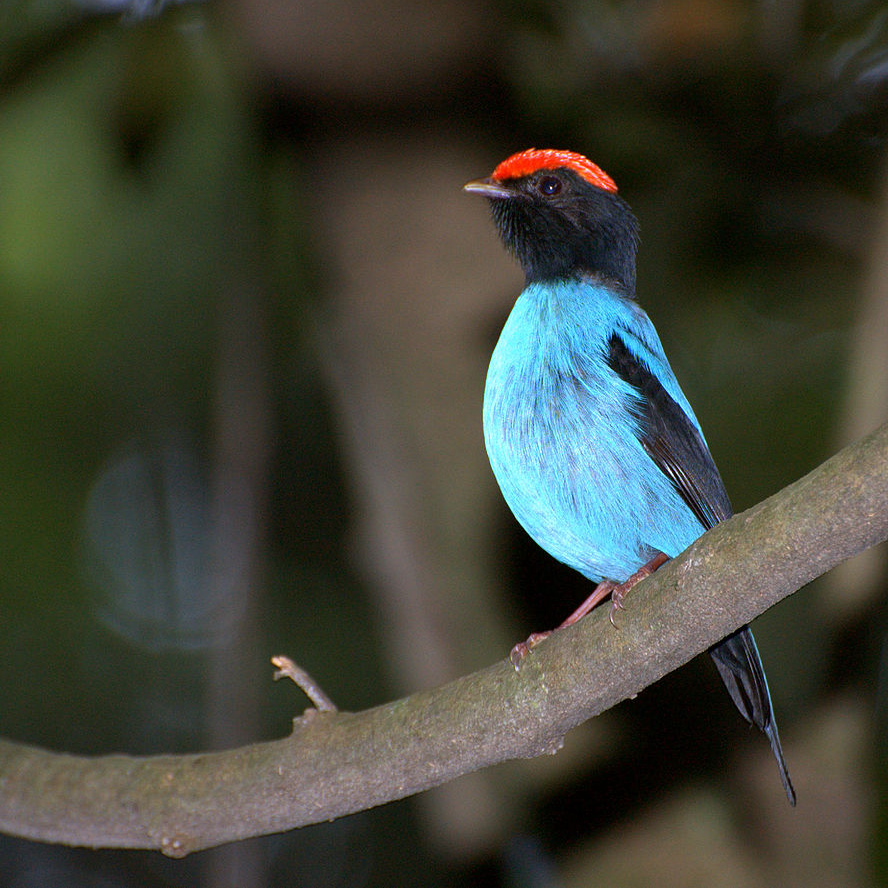
Olive Manakin
Xenopipo uniformis
Order: Passeriformes / Family: Pipridae

Wikimedia Commons
About the Olive Manakin
The Olive Manakin, scientifically recognized as Xenopipo uniformis, is a remarkable bird within the Pipridae family, known for its distinctive olive-green plumage. This species inhabits the tropical forests of South America, notably thriving in regions such as the Amazon Basin, the Guianas, and parts of Venezuela. Its presence in these humid forested environments underscores its reliance on dense, mature woodlands that provide ample cover and food resources. Olive Manakins play a significant role as seed dispersers and insect controllers, contributing to the ecological balance of their habitats. During the breeding season, males engage in elaborate courtship displays, which involve rapid flights and complex vocalizations to attract females. These displays not only highlight the bird's unique behavior but also serve as a crucial mechanism for species propagation. As the seasons change, the Olive Manakin exhibits slight shifts in behavior, with movements often dictated by food availability. While primarily resident, some populations may display localized movements in response to environmental changes, ensuring their survival in diverse tropical environments.
The Olive Manakin belongs to the family Pipridae, within the order Passeriformes. These birds typically live average lifespan is 5-6 years, with some individuals living up to 8 years..
How to Identify a Olive Manakin
The Olive Manakin is a small, robust bird characterized by its striking olive-green plumage, which provides excellent camouflage in its forest habitat. Adult males and females exhibit similar coloration, making them one of the few manakin species without marked sexual dimorphism. However, males may display slightly brighter plumage during the breeding season. Juveniles resemble adults but often have a duller appearance, lacking the sheen seen in mature birds. A distinguishing feature of the Olive Manakin is its relatively short tail and wings, giving it a compact silhouette when perched. Compared to similar species, the Olive Manakin's uniform body color and subtle wing markings help differentiate it from other manakins, which may have more pronounced coloration or patterns. In flight, this bird maintains a direct and swift trajectory, often darting between trees with remarkable agility.
Having trouble telling birds apart? Upload a photo to our bird identification tool for an instant species match.
Olive Manakin Habitat and Range
Preferred Habitat
The Olive Manakin predominantly inhabits lowland tropical forests, particularly favoring areas with dense undergrowth and closed canopies. These environments, found throughout the Amazon Basin and extending into the Guianas and northern Brazil, provide the necessary cover and resources for feeding and nesting. The species usually resides at elevations below 1,000 meters, rarely venturing into higher mountainous regions. Although primarily forest-dwelling, the Olive Manakin can occasionally be spotted in secondary forests or forest edges, particularly where habitat restoration projects have taken place. Unlike some avian species, the Olive Manakin shows little affinity for urbanized areas, maintaining its preference for the seclusion of forest interiors throughout the year.
Geographic Range
The Olive Manakin's range is concentrated in the tropical lowland forests of South America, primarily within the countries of Brazil, Venezuela, and the Guianas. These regions host dense populations, given the species' preference for the vast, unfragmented forest tracts found there. The bird's distribution also extends slightly into eastern Colombia and northern Peru, where suitable habitats exist. Unlike many migratory birds, the Olive Manakin is largely sedentary, with its movements restricted to local shifts driven by food availability. These shifts are often subtle, as the bird remains within the forested regions that provide its primary habitat needs. Population density tends to be highest in areas with a rich diversity of fruiting trees and insect populations, which support year-round sustenance.
Want to know which birds visit your area? Browse our backyard birds by location guides for region-specific species lists.
What Does the Olive Manakin Eat?
The Olive Manakin's diet primarily consists of fruit, which constitutes a significant portion of its nutritional intake. It shows a marked preference for small, fleshy fruits such as berries, which it adeptly plucks from trees and shrubs. In addition to fruit, the bird supplements its diet with insects, capturing them during short, agile flights or gleaning them from foliage. This insect consumption is particularly prominent during the breeding season, providing essential protein for egg production and chick rearing. The Olive Manakin typically forages in the lower to mid-canopy levels, where it can effectively navigate the foliage in search of food. Its feeding schedule is influenced by the availability of ripe fruit, with peak activity often occurring in the early morning and late afternoon when temperatures are cooler.
Olive Manakin Behavior and Social Structure
The Olive Manakin exhibits fascinating social and territorial behaviors, with males often engaging in competitive displays to establish dominance and attract mates. These displays, which take place within established territories, involve intricate aerial maneuvers and vocalizations that are both complex and captivating. Although generally solitary outside the breeding season, the Olive Manakin may occasionally join mixed-species flocks to exploit food resources or evade predators. Its territorial nature becomes most pronounced during the breeding season when males vigorously defend their display grounds against rivals. In response to predators, Olive Manakins rely on their cryptic coloration and swift, evasive flight to avoid detection. Their daily activity patterns are largely diurnal, with periods of high activity interspersed with bouts of rest and preening.
Olive Manakin Nesting and Reproduction
The Olive Manakin constructs a delicate cup nest, often situated in the fork of a small tree or shrub within dense undergrowth. These nests are crafted using fine plant fibers, leaves, and spider silk, providing a secure cradle for the eggs. The typical clutch size ranges from two to three eggs, with an incubation period lasting approximately two weeks. Female Olive Manakins take on the primary role in incubation, while males continue to display nearby. Once hatched, the nestlings remain under parental care for another two to three weeks before fledging. During this time, both parents, but especially the female, provide nourishment and protection. Typically, the Olive Manakin produces one to two broods per year, depending on environmental conditions and food availability.
Olive Manakin Sounds and Vocalizations
The Olive Manakin's vocal repertoire includes a series of high-pitched calls and whistles, often delivered in rapid succession. Its primary song, characterized by a rhythmic series of short, melodious notes, serves as a key component of the male's courtship display. These songs carry well through the forest, allowing males to advertise their presence to females and ward off rival males. In addition to its primary song, the Olive Manakin also produces a variety of call notes used for communication within its territory. Alarm calls are sharper and more abrupt, designed to alert nearby individuals to potential threats. During the dawn chorus, the Olive Manakin's voice blends with those of other forest birds, contributing to the vibrant soundscape of its habitat.
Interesting Facts About the Olive Manakin
- 1The Olive Manakin is one of the few manakin species where males and females share similar plumage colors.
- 2Despite its small size, the Olive Manakin plays a crucial role in forest ecology by dispersing seeds through its fruit-based diet.
- 3The Olive Manakin's courtship displays are among the most intricate in the avian world, featuring rapid flight patterns and complex songs.
- 4This species is largely sedentary, with most individuals spending their entire lives within a limited range of forest habitat.
- 5Olive Manakins are known to join mixed-species flocks, a behavior that enhances foraging efficiency and predator avoidance.
- 6During the breeding season, male Olive Manakins dedicate significant time to defending their display territories from rivals.
- 7The Olive Manakin's nests are often cleverly camouflaged in dense foliage, reducing the risk of predation.
Olive Manakin Conservation Status
According to the IUCN, the Olive Manakin currently holds a status of Least Concern, with its population considered stable across its range. However, ongoing deforestation and habitat fragmentation pose significant threats to its long-term survival. Conservation efforts focus on preserving large tracts of contiguous forest, particularly within the Amazon Basin, to ensure the species' habitat remains intact. Historical population trends suggest that while the species has maintained stable numbers, localized declines have occurred in areas experiencing intense logging or agricultural expansion. Continued protection of its natural habitat remains crucial for the conservation of the Olive Manakin and the rich biodiversity it supports.