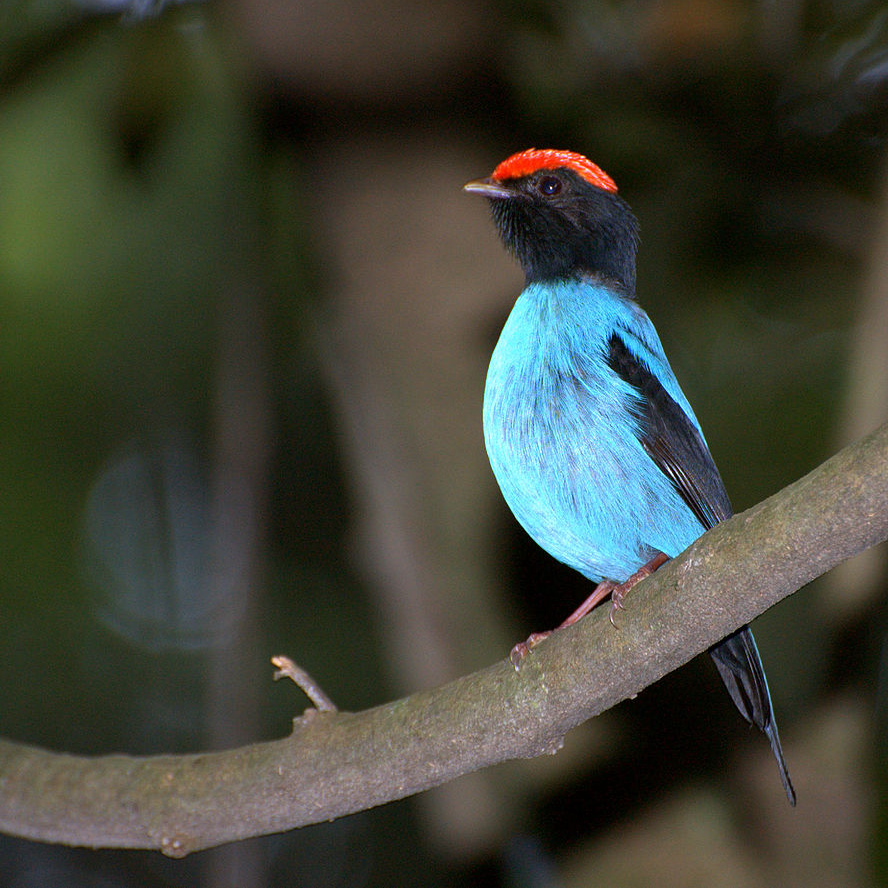
Orange-collared Manakin
Manacus aurantiacus
Order: Passeriformes / Family: Pipridae

Wikimedia Commons
About the Orange-collared Manakin
The Orange-collared Manakin (Manacus aurantiacus) is a captivating species found primarily in the humid lowland and foothill forests of Costa Rica and Panama. This small, colorful bird is a member of the Pipridae family and is well known for its striking plumage and fascinating breeding behaviors. Males, with their bright orange collars and olive-green backs, are particularly eye-catching as they perform elaborate courtship displays to attract females.
This species plays a critical role in its ecosystem, primarily through seed dispersal. As it consumes various fruits, the Orange-collared Manakin aids in the propagation of numerous tropical plant species, contributing to the health and diversity of its forest habitat. The bird's presence in the ecosystem also serves as an indicator of forest health, as it thrives in well-preserved environments.
The bird exhibits seasonal behaviors that vary with the breeding cycle. During the breeding season, males engage in highly energetic and acrobatic lekking displays, a behavior that has fascinated ornithologists and birdwatchers alike. These displays are not only crucial for mating but also serve to reinforce social hierarchies within the species. Outside the breeding season, the Orange-collared Manakin becomes less conspicuous, as it retreats deeper into the forest to feed and roost.
In terms of ecological significance, the Orange-collared Manakin contributes to the complex food web of its tropical forest habitat. Its diet of fruits and occasional small insects positions it as both a consumer and a seed disperser, linking different trophic levels and facilitating nutrient cycling within the ecosystem. Its presence underscores the importance of conserving the pristine habitats it occupies, as deforestation and habitat fragmentation pose ongoing threats to this vibrant species.
The Orange-collared Manakin belongs to the family Pipridae, within the order Passeriformes. These birds typically live average 5-8 years with a maximum recorded of 12 years.
How to Identify a Orange-collared Manakin
Adult Orange-collared Manakins are unmistakable with their vivid orange throat and collar contrasting against a black cap and wings. The back and tail are olive-green, providing camouflage when perching among foliage. Males are particularly vibrant, while females display a more subdued olive-green coloration throughout, lacking the bright orange collar that characterizes the males. Juvenile birds resemble females but may show hints of the adult male coloration as they mature.
The Orange-collared Manakin can be distinguished from similar species by its distinctive coloration and size. At approximately 10 cm in length, it is a small bird, but its striking color pattern sets it apart from other manakins. The closely related White-collared Manakin (Manacus candei) can create confusion, but the latter lacks the orange collar and instead displays a white collar and belly.
In flight, the Orange-collared Manakin exhibits a rapid, fluttering wingbeat typical of manakins, which aids in short, agile flights through dense forest understory. When perched, it often assumes an upright posture, allowing for easy observation of its vibrant collar against the darker forest backdrop. Observers should note its preference for perching on thin, horizontal branches within its lekking arenas.
Having trouble telling birds apart? Upload a photo to our bird identification tool for an instant species match.
Orange-collared Manakin Habitat and Range
Preferred Habitat
The Orange-collared Manakin inhabits the tropical lowland and foothill forests of Central America, with a preference for areas with dense understory vegetation. These forests provide the necessary cover and resources for feeding, breeding, and roosting. The species is most commonly found in well-preserved primary forests, but it can also be observed in secondary growth areas where sufficient vegetation cover remains.
Elevationally, the Orange-collared Manakin typically occupies areas from sea level up to about 1,200 meters. Its presence is most prominent in regions such as the Osa Peninsula in Costa Rica, where the humid rainforest meets the Pacific lowlands. Seasonal habitat shifts are minimal, as the species tends to remain in its preferred forested environments year-round, though it may move locally within its range to follow food availability.
While not typically found in urban environments, the Orange-collared Manakin may occasionally be seen in rural areas adjacent to suitable forest habitats. Its reliance on intact forest ecosystems makes it sensitive to urban encroachment and deforestation, underscoring the need for habitat protection and restoration.
Geographic Range
The Orange-collared Manakin's range is relatively restricted to the lowland and foothill forests of Costa Rica and western Panama. This ranges from the Pacific slopes of Costa Rica, particularly the Osa Peninsula and the Golfo Dulce region, to the adjacent areas of western Panama. This limited range highlights the bird's reliance on specific forest types and the importance of these regions for its continued survival.
As a non-migratory species, the Orange-collared Manakin does not undertake large-scale migrations. Instead, it remains within its established territories throughout the year, although it may exhibit local movements in response to food availability and habitat conditions.
Population densities are highest in areas of undisturbed forest, where suitable lekking sites and an abundance of fruiting trees provide optimal conditions for breeding and feeding. These hotspots are critical for the species, as the loss of habitat due to deforestation and agricultural expansion poses a significant threat to its long-term viability.
Want to know which birds visit your area? Browse our backyard birds by location guides for region-specific species lists.
What Does the Orange-collared Manakin Eat?
The Orange-collared Manakin primarily feeds on a diverse array of fruits, which constitute the bulk of its diet. It favors small, berry-like fruits produced by a variety of understory plants and shrubs, playing an essential role in seed dispersal. During the dry season, when fruit availability may decrease, the bird supplements its diet with small insects, providing necessary protein intake.
Foraging typically occurs in the middle to lower canopy levels, where the bird deftly plucks fruits while flitting among branches. The Orange-collared Manakin demonstrates a keen ability to locate fruiting trees, often following mixed-species flocks to capitalize on feeding opportunities.
Feeding mainly occurs during the early morning and late afternoon, aligning with periods of peak fruit availability and reduced competition from other frugivores. The bird's small size and agile flight allow it to navigate dense foliage efficiently as it searches for sustenance.
Orange-collared Manakin Behavior and Social Structure
The Orange-collared Manakin exhibits a fascinating array of behaviors, particularly during the breeding season. Males participate in lekking, where they perform elaborate courtship displays within designated arenas. These displays involve rapid wing snaps, jumps, and intricate maneuvers designed to attract females. The lekking behavior serves not only a reproductive function but also reinforces social hierarchies among males.
Socially, the Orange-collared Manakin is relatively solitary outside of the breeding season, though it may join mixed-species flocks when foraging. Territorial during the breeding season, males defend their display arenas from rivals, ensuring they maintain prime positions for attracting potential mates.
Daily activity patterns are influenced by the bird's need for food and rest. Most active during the cooler parts of the day, the Orange-collared Manakin spends midday hours resting in shaded areas. It demonstrates keen awareness of predators, utilizing its agile flight and cryptic coloration to avoid detection by avian and terrestrial threats.
Orange-collared Manakin Nesting and Reproduction
Nesting for the Orange-collared Manakin involves constructing a small, cup-shaped nest, typically placed in the fork of a low tree or shrub. The nest is composed of fine plant fibers, leaves, and sometimes spider silk, providing a secure platform for the eggs.
Females, who are solely responsible for nest building and incubation, lay clutches of 2-3 eggs. The incubation period lasts about 18-20 days, during which the female remains vigilant, occasionally leaving the nest to forage. Upon hatching, chicks receive care exclusively from the female, who feeds them regurgitated fruit pulp and insects.
Fledging occurs approximately 15-20 days after hatching, with young birds learning to forage independently soon after leaving the nest. The Orange-collared Manakin typically raises one brood per year, though favorable conditions may allow for a second. Parental care ceases once fledglings become self-sufficient.
Orange-collared Manakin Sounds and Vocalizations
The vocalizations of the Orange-collared Manakin are an essential aspect of its courtship displays. The primary song consists of a series of high-pitched, rapid-fire 'chee-chee-chee' notes, delivered at a steady rhythm. This song, while not melodious, is distinctive and serves to advertise the male's presence at the lek.
Call notes are sharp and metallic, often used to communicate with other individuals or signal alarm in the presence of predators. The Orange-collared Manakin participates in the dawn chorus, adding its unique voice to the cacophony of the forest as day breaks.
Alarm calls are harsher and quicker than typical calls, effectively alerting nearby birds to potential threats. These sounds play a crucial role in maintaining the bird's safety in the dense forest environment.
Interesting Facts About the Orange-collared Manakin
- 1Male Orange-collared Manakins perform up to 60 wing snaps per second during courtship displays.
- 2The species is known for its unique lekking behavior, where multiple males display in close proximity to each other.
- 3Orange-collared Manakins contribute to the forest ecosystem by dispersing seeds of over 20 different plant species.
- 4The vibrant orange collar of the male serves as a major attraction for females during the breeding season.
- 5Despite their striking appearance, these birds can be difficult to spot due to their small size and agile movements.
- 6The species is capable of producing a loud mechanical sound with its wings, which is unusual for a bird of its size.
- 7Orange-collared Manakins are rarely found outside of Costa Rica and western Panama, highlighting their specialized habitat needs.
Orange-collared Manakin Conservation Status
The Orange-collared Manakin is currently listed as Least Concern by the IUCN, indicating a stable population trend. However, this status belies the challenges it faces from habitat destruction. Primary threats include deforestation for agriculture and urban development, particularly in the sensitive regions of Costa Rica and Panama. Conservation efforts focus on preserving and restoring the tropical forests that sustain the Orange-collared Manakin. Protected areas and national parks play a critical role in safeguarding habitat, although ongoing efforts are needed to mitigate the impacts of human encroachment. Historically, population levels have remained relatively stable, but continued habitat loss could pose significant risks. Collaborative conservation initiatives aim to balance ecological preservation with sustainable development, ensuring the long-term survival of this vibrant species.