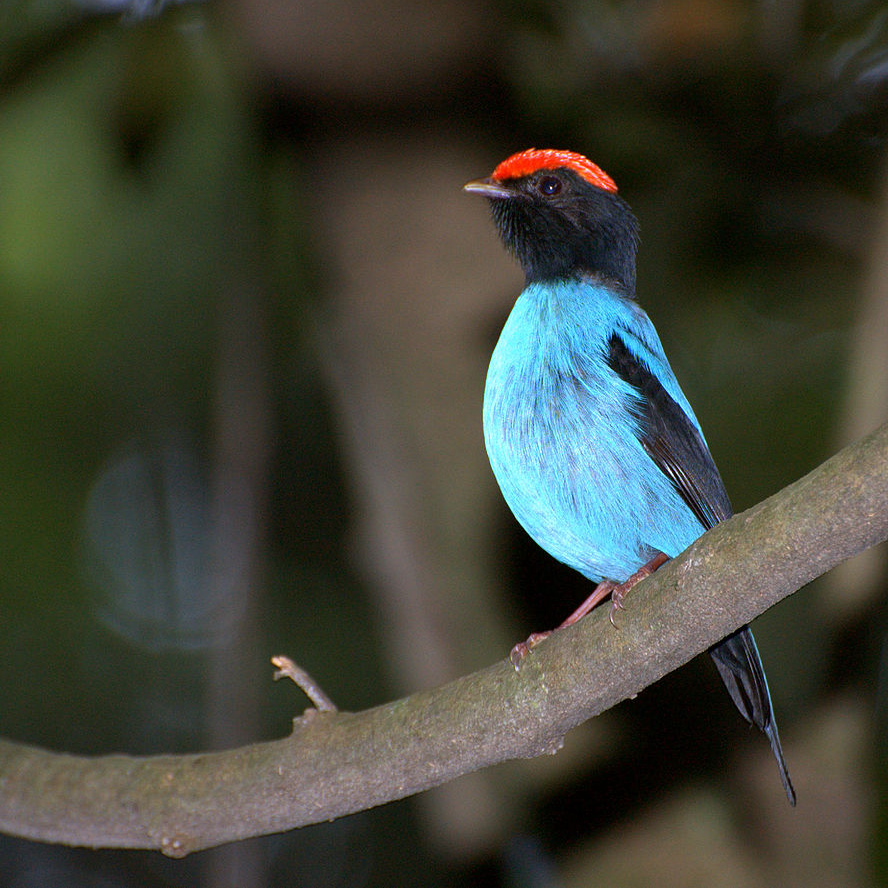
Pale-bellied Tyrant-Manakin
Neopelma pallescens
Order: Passeriformes / Family: Pipridae

Wikimedia Commons
About the Pale-bellied Tyrant-Manakin
The Pale-bellied Tyrant-Manakin, or Neopelma pallescens, is a small passerine bird residing primarily in the lowland forests of South America, notably across Brazil, Bolivia, and Paraguay. This species belongs to the Pipridae family, which is renowned for its vibrant manakins. However, the Pale-bellied Tyrant-Manakin contrasts with its more flamboyant relatives by exhibiting a more subdued coloration, which plays a significant role in its ecological interactions and survival strategies. The bird is typically found at elevations ranging from sea level to about 1,200 meters, favoring areas with dense understory where it can forage and nest efficiently. These environments include subtropical and tropical moist lowland forests, often along riverbanks or in forest clearings where sunlight penetrates the canopy, promoting a rich growth of underbrush. The ecological role of the Pale-bellied Tyrant-Manakin is multifaceted. It acts as both a consumer and a seed disperser, primarily feeding on insects and small fruits. By consuming these fruits, the bird aids in seed dispersal, contributing to forest regeneration and plant diversity. Additionally, it serves as prey for larger predators, thus integrating into the forest food web. Seasonally, the Pale-bellied Tyrant-Manakin exhibits subtle shifts in behavior and habitat use. During the wet season, when food is abundant, it may show increased activity levels, foraging more actively and expanding its range slightly to exploit the available resources. In contrast, the dry season might see a more localized and conservative approach, with birds utilizing known territories and familiar food sources to maintain their energy balance. The significance of the Pale-bellied Tyrant-Manakin extends beyond its ecological role; it also serves as an indicator species for the health of its forest habitat. The presence of these birds often signifies a well-structured understory and a balanced ecosystem, crucial for the survival of many forest-dependent species. As deforestation and habitat degradation continue to threaten the Amazon and other South American forests, the study and conservation of species like the Pale-bellied Tyrant-Manakin become integral to preserving biodiversity.
The Pale-bellied Tyrant-Manakin belongs to the family Pipridae, within the order Passeriformes. These birds typically live around 7 years, with a maximum recorded of 10 years..
How to Identify a Pale-bellied Tyrant-Manakin
Identifying the Pale-bellied Tyrant-Manakin requires attention to its subtle yet distinctive features. Adults exhibit a predominantly olive-green upper body with a noticeable pale belly, which gives the species its common name. The plumage appears more muted compared to the vibrant hues of other manakins, with the pale belly contrasting against the darker back and wings. Juveniles mirror the adults but often with slightly duller colors and less sharp demarcation between the belly and the rest of the body. There are slight differences between males and females, with males typically having a more pronounced pale coloration on the belly. In terms of size, the Pale-bellied Tyrant-Manakin is a small bird, measuring about 12 to 14 centimeters in length. Its body is compact, with a relatively short tail and wings adapted for quick, agile movements through dense foliage. When perched, it maintains an upright posture, often remaining still for extended periods, which can make it a challenge to spot against the complex background of its habitat. The flight silhouette of this manakin is characterized by rapid wingbeats and short, darting flights, reflecting its need to navigate through thick undergrowth efficiently. Similar species that might confuse an observer include other small, olive-green birds within its range. However, the unique combination of its pale underparts and specific habitat preferences can aid in distinguishing it from other species.
Having trouble telling birds apart? Upload a photo to our bird identification tool for an instant species match.
Pale-bellied Tyrant-Manakin Habitat and Range
Preferred Habitat
The Pale-bellied Tyrant-Manakin thrives in subtropical and tropical moist lowland forests. These forests offer dense understory vegetation, which is crucial for the bird's foraging and nesting behaviors. It is commonly found in regions such as the Amazon Basin, where it can exploit the rich diversity of plant and insect life. The bird's preferred habitats include areas along riverbanks, forest edges, and clearings where sunlight encourages undergrowth. While it predominantly inhabits lowland areas, it can also be found at elevations up to 1,200 meters. This elevation range allows it to exploit different forest strata, depending on resource availability. Unlike some urban-adaptable species, the Pale-bellied Tyrant-Manakin is rarely found in urban settings. Its reliance on dense, natural habitats makes it less adaptable to urban environments compared to more generalized species. However, in rural areas adjacent to forests, it might occasionally be observed if suitable cover is available. Seasonal habitat shifts are minimal, as the bird typically remains within its preferred forested areas year-round, exhibiting some local movement in response to food availability.
Geographic Range
The Pale-bellied Tyrant-Manakin has a relatively restricted range within South America. It is most commonly found in Brazil, extending into parts of Bolivia and Paraguay. Within Brazil, its presence is notable in the Amazon basin, where the largest tracts of its required habitat still exist. The bird's range is primarily determined by the availability of suitable lowland forest habitats, which provide the necessary resources for feeding and breeding. It does not undertake long-distance migrations, but may exhibit some local movement in response to seasonal changes in food availability. During the breeding season, which coincides with the wet season in its range, the Pale-bellied Tyrant-Manakin may expand its territory slightly to exploit the abundance of insects and fruit. Conversely, in the dry season, it remains more localized, taking advantage of familiar areas where resources are still sufficient. Population density hotspots are typically found in regions where forest cover is dense and relatively undisturbed, as these areas provide the optimal conditions for the species to thrive.
Want to know which birds visit your area? Browse our backyard birds by location guides for region-specific species lists.
What Does the Pale-bellied Tyrant-Manakin Eat?
The diet of the Pale-bellied Tyrant-Manakin is an intriguing mix of animal and plant matter, reflecting its adaptability to the forest environments it inhabits. Primarily, it feeds on small insects, which it catches through quick, agile flights or by gleaning them from foliage. This insectivorous diet is vital during the breeding season when protein demands increase. In addition to insects, the Pale-bellied Tyrant-Manakin also consumes a variety of small fruits and berries. This frugivorous aspect of its diet becomes more pronounced during the dry season, when insect availability may decline. By consuming fruits, the bird plays a crucial role in seed dispersal, aiding in the regeneration of forest vegetation. The bird's foraging technique is characterized by short, rapid flights through the understory, where it can deftly navigate to catch prey or pluck fruits. The prey size is typically small, matching the bird's own diminutive stature. Feeding occurs throughout the day, with peaks in activity during the cooler morning and late afternoon hours when insects are more active and fruits are more accessible.
Pale-bellied Tyrant-Manakin Behavior and Social Structure
The Pale-bellied Tyrant-Manakin exhibits intriguing behaviors that reflect both its ecological niche and social structures. It is generally a solitary bird, often found alone or in loosely associated pairs, particularly during the breeding season. Territorial behavior is pronounced, with individuals maintaining and defending specific areas within their forest habitat. Courtship displays, while less elaborate than those of other manakin species, involve a series of subtle movements and calls designed to attract mates. These displays typically occur on prominent perches within the male's territory. Flocking patterns are minimal, as the bird tends to avoid forming large groups, preferring the cover and solitude of dense foliage. Its response to predators involves remaining motionless to avoid detection or engaging in swift, evasive flights through the undergrowth. Daily activity patterns are dictated by the availability of light and food resources. The Pale-bellied Tyrant-Manakin is most active during the early morning and late afternoon, times when the forest is alive with insect activity and when temperature conditions are more favorable for foraging. During the heat of midday, the bird may reduce its activity, seeking shelter within the shaded understory.
Pale-bellied Tyrant-Manakin Nesting and Reproduction
The nesting behavior of the Pale-bellied Tyrant-Manakin is a fascinating aspect of its life cycle. It constructs open cup nests, typically placed on horizontal branches well concealed within dense undergrowth. The nests are built using a variety of materials such as grass, leaves, and spider silk, which help to secure the structure and provide camouflage. Clutch size is generally small, consisting of two to three eggs. These eggs are incubated primarily by the female, while the male plays a lesser role in direct incubation but may assist in territory defense and feeding of the female. The incubation period lasts approximately 14 to 16 days, after which the hatchlings emerge. The fledging timeline is relatively short, with young birds leaving the nest within two to three weeks post-hatching. During this time, both parents contribute to feeding the chicks, providing them with a diet rich in insects to ensure rapid growth and development. The species typically produces one brood per year, although favorable conditions may allow for a second. This reproductive strategy ensures that the young have the best possible start in life, emerging during periods of peak food availability.
Pale-bellied Tyrant-Manakin Sounds and Vocalizations
The vocalizations of the Pale-bellied Tyrant-Manakin are subtle yet distinctive, providing a key tool for identification in its dense forest habitat. The primary song is a series of soft, high-pitched notes delivered in a rhythmic pattern. These notes have a slightly whistling quality and are often repeated at regular intervals. Call notes are similarly soft and can resemble the gentle rustle of leaves in the wind. Alarm calls are sharper and more abrupt, serving as a warning to nearby birds of potential threats. During the dawn chorus, the Pale-bellied Tyrant-Manakin's song can be heard mingling with the calls of other forest residents, creating a rich tapestry of sound that signals the start of a new day. Compared to the more flamboyant songs of some larger birds, the manakin's vocalizations are understated but carry well across the understory, allowing communication without drawing undue attention from predators.
Interesting Facts About the Pale-bellied Tyrant-Manakin
- 1The Pale-bellied Tyrant-Manakin is one of the more inconspicuous members of the vibrant manakin family, often overlooked due to its subtle coloration.
- 2Despite its modest size, measuring only 12 to 14 centimeters, the Pale-bellied Tyrant-Manakin plays a vital role in seed dispersal within its ecosystem.
- 3This species exhibits a surprising level of territorial aggression, with males fiercely defending their chosen areas against intruders.
- 4Unlike many of its manakin relatives known for elaborate dances, the Pale-bellied Tyrant-Manakin has a more understated courtship display.
- 5The Pale-bellied Tyrant-Manakin's subtle song can often be heard at dawn, blending into the rich soundscape of the South American rainforest.
- 6Its reliance on dense understory makes the Pale-bellied Tyrant-Manakin particularly sensitive to deforestation and habitat fragmentation.
- 7The bird's diet shifts seasonally, showcasing its adaptability as it moves from primarily insectivorous in the wet season to more frugivorous in the dry season.
Pale-bellied Tyrant-Manakin Conservation Status
The Pale-bellied Tyrant-Manakin is currently listed as Least Concern by the IUCN, but its population is experiencing slight declines due to ongoing habitat loss. Deforestation, particularly in the Amazon basin, poses a significant threat as it reduces the availability of suitable habitats. Conservation efforts focus on preserving large tracts of continuous forest and promoting sustainable land use practices. The bird's historical stability has been challenged by recent environmental pressures, making ongoing monitoring essential. Protecting its habitat not only benefits the Pale-bellied Tyrant-Manakin but also supports the broader biodiversity of the region, underscoring the interconnected nature of tropical ecosystems.