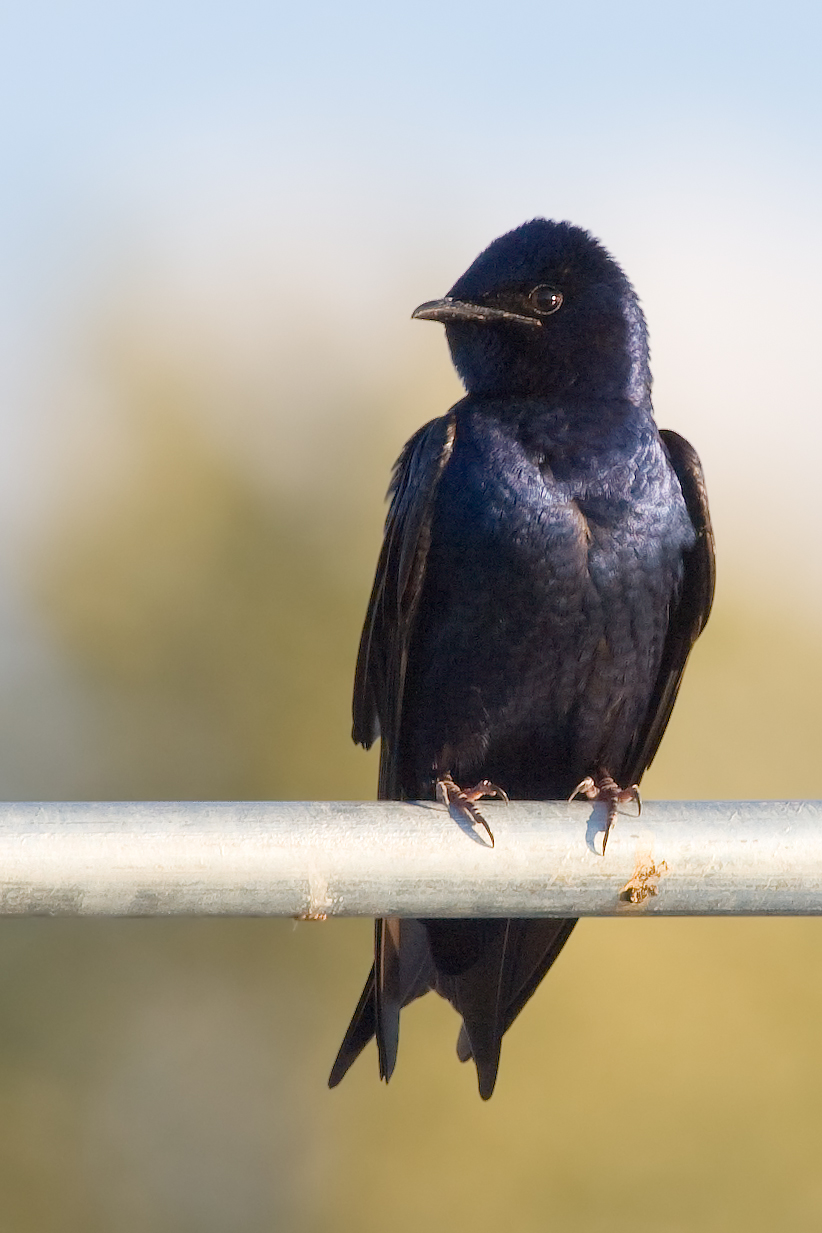
Peruvian Martin
Progne murphyi
Order: Passeriformes / Family: Hirundinidae

Wikimedia Commons
About the Peruvian Martin
The Peruvian Martin, scientifically known as Progne murphyi, is a remarkable member of the Hirundinidae family, boasting a unique adaptation to its environment. This medium-sized swallow, endemic to South America, primarily inhabits the western Andean slopes in Peru. Its distinctive glossy blue-black plumage, with a lighter underbelly, makes it easily recognizable when compared to other swallows in its range. Unlike many of its relatives, the Peruvian Martin exhibits a strong preference for high-altitude habitats, often found at elevations ranging from 2,000 to 3,500 meters. It plays a crucial ecological role as an insectivore, significantly controlling the populations of aerial insects, which are abundant in its high-altitude environment. During the breeding season, which typically extends from September to February, the Peruvian Martin becomes particularly conspicuous as it engages in complex aerial displays and vigorous courtship rituals. These birds are known for their agile flight, often seen darting in and out of clouds in pursuit of insects, their primary food source. This behavior not only reflects their adaptability to mountainous regions but also underscores their significance in maintaining the ecological balance by regulating insect populations. In recent years, ornithologists have noted changes in the distribution and behavior of the Peruvian Martin, likely linked to climate change and habitat alteration. Despite these challenges, the species remains a vital component of the Andean ecosystem, symbolizing the intricate interdependence between flora, fauna, and the unique highland environment they inhabit. Conservation efforts are critical to preserving this species, given the increasing threats from human encroachment and environmental changes.
The Peruvian Martin belongs to the family Hirundinidae, within the order Passeriformes. These birds typically live average 5-7 years, with a maximum recorded of 9 years..
How to Identify a Peruvian Martin
The Peruvian Martin is easily identified by its glossy blue-black plumage that covers the head, back, and wings, contrasting with its pale underparts. Males and females share similar plumage, although males often exhibit a slightly more iridescent sheen. Juveniles, on the other hand, can be differentiated by their duller coloration and the presence of brownish edges on the feathers, which gradually molt into the adults' striking coloration as they mature. In flight, the Peruvian Martin displays a characteristic silhouette, with long, pointed wings and a forked tail, which aids in its agile aerial maneuvers. When perched, these birds maintain an upright posture, often seen on exposed branches or wires. Confusion with other martin species is minimized due to its distinct altitude preferences and specific geographical range within the Andes. Compared to the Gray-breasted Martin and the Southern Martin, the Peruvian Martin's glossy back and altitude choices serve as reliable field marks for accurate identification.
Having trouble telling birds apart? Upload a photo to our bird identification tool for an instant species match.
Peruvian Martin Habitat and Range
Preferred Habitat
The Peruvian Martin primarily occupies high-altitude regions along the western slopes of the Andes in Peru. It thrives in semi-open landscapes, often near montane forests and agricultural lands where insect abundance is high. This species prefers elevations between 2,000 and 3,500 meters, taking advantage of the cooler, breezy conditions that help in its insect-hunting endeavors. During the breeding season, it may also frequent lower valleys and foothills, following insect swarms. Unlike many swallows that have adapted to urban environments, the Peruvian Martin remains closely tied to its natural montane habitat, rarely venturing into urban areas. This preference for remote, less-disturbed habitats highlights its reliance on specific ecological conditions found in the Andes.
Geographic Range
The Peruvian Martin is endemic to South America, with its range primarily centered in Peru. It inhabits the western Andes, from the northern regions near Cajamarca to the southern areas close to Arequipa. This species does not exhibit long-distance migration but may show altitudinal movements in response to seasonal changes in insect availability. During the breeding season, it is predominantly found at higher elevations, while non-breeding seasons may see it move to lower altitudes. Despite its limited range, the Peruvian Martin is often found in significant numbers where conditions are favorable, especially in areas with abundant insect prey and suitable nesting sites.
Want to know which birds visit your area? Browse our backyard birds by location guides for region-specific species lists.
What Does the Peruvian Martin Eat?
The diet of the Peruvian Martin consists mainly of flying insects, including beetles, flies, and moths. It exhibits a dynamic foraging technique, employing agile flight maneuvers to capture prey mid-air. This insectivorous diet is crucial during the breeding season, as high protein intake supports the energy demands of raising young. Seasonal variations in insect populations influence their diet, with a broader range of insect types consumed during peak abundance times. These birds typically forage in the early morning and late afternoon when insect activity is highest, although they remain opportunistic feeders throughout the day. Prey size varies, but they generally target small to medium-sized insects that can be easily captured in flight.
Peruvian Martin Behavior and Social Structure
The Peruvian Martin is a social species, often seen in small flocks outside the breeding season. During the breeding period, pairs establish territories and exhibit territorial behavior, with males performing aerial displays to deter rivals and attract mates. Courtship involves synchronized flight patterns, with both birds engaging in acrobatic maneuvers. These martins are diurnal, with peak activity in the morning and late afternoon. They exhibit mobbing behavior when threatened by predators, including hawks and larger birds of prey, often calling loudly and diving at intruders. Flocking behavior predominates outside the breeding season, with groups moving between feeding sites in response to insect availability.
Peruvian Martin Nesting and Reproduction
The Peruvian Martin nests in natural cavities found in cliffs, large trees, or occasionally in man-made structures that mimic these conditions. Nest construction involves gathering grasses, feathers, and mud to form a secure nesting cup within the cavity. The typical clutch size ranges from three to five eggs, which are incubated primarily by the female for about 15-18 days. Both parents participate in feeding the chicks, which fledge approximately 22-25 days after hatching. The species usually raises one brood per year, but in optimal conditions, a second brood may occur. Parental roles are shared, with both engaging in feeding and protection of the young.
Peruvian Martin Sounds and Vocalizations
The Peruvian Martin's primary song is a series of melodic chirps and whistles, often delivered in flight. These sounds are described as clear and musical, with a rhythm that varies between rapid sequences and slower, more deliberate notes. Alarm calls are sharper and more abrupt, serving as warnings to other martins about potential threats. During the dawn chorus, their song becomes more prominent, filling the air with a symphony of harmonious notes that contribute to the vibrant soundscape of their high-altitude habitats.
Interesting Facts About the Peruvian Martin
- 1The Peruvian Martin can fly at speeds up to 40 km/h, showcasing its impressive aerial agility.
- 2This species is known to travel over 10 km in search of food, demonstrating its extensive foraging range.
- 3During the breeding season, the Peruvian Martin engages in complex aerial displays to attract mates.
- 4It is one of the few swallow species adapted to high-altitude life, thriving above 2,000 meters.
- 5The Peruvian Martin's song, a series of melodious chirps, can be heard over a kilometer away on clear days.
- 6Unlike many swallows, the Peruvian Martin rarely frequents urban areas, preferring natural montane habitats.
- 7These birds contribute significantly to controlling insect populations, reducing pest pressures in their ecosystems.
Peruvian Martin Conservation Status
The Peruvian Martin is currently listed as Least Concern by the IUCN, with a stable population trend. However, habitat destruction due to deforestation and agricultural expansion poses significant threats. Conservation efforts focus on habitat protection and monitoring population trends. Historical population changes have shown resilience, yet ongoing environmental changes necessitate continued attention. Protection of breeding sites and maintaining insect populations are critical for the long-term survival of this species.
Other Hirundinidae Species


Birds Similar to the Peruvian Martin
These species are often confused with the Peruvian Martin due to similar appearance or overlapping range.