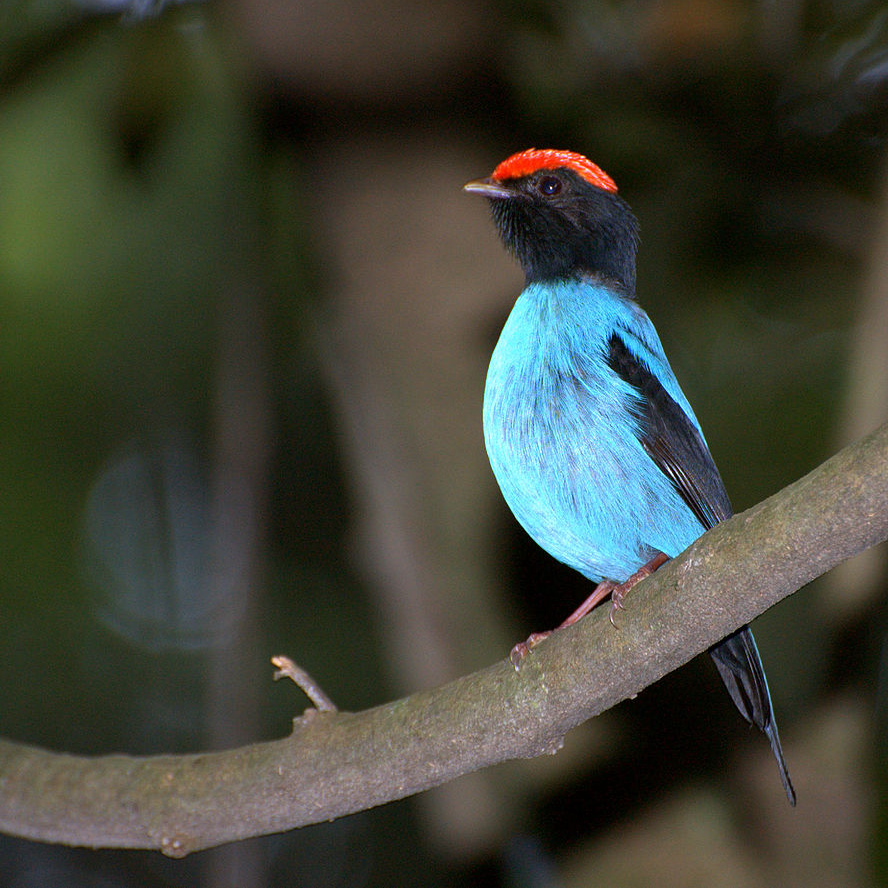
Pipra rupicola
Pipra rupicola
Order: Passeriformes / Family: Pipridae

Wikimedia Commons
About the Pipra rupicola
The Crimson-hooded Manakin, scientifically known as Pipra rupicola, is a striking avian species that captures the attention of birdwatchers across its range. Belonging to the family Pipridae, this bird is a quintessential member of the Neotropical manakins, renowned for their vibrant plumage and complex courtship behaviors. The Crimson-hooded Manakin is particularly notable for the male's brilliant red cap, contrasting sharply with its glossy black body, making it a visual highlight in the dense understories of tropical forests. This species occupies a significant ecological niche in South American rainforests, where it influences the dynamics of seed dispersal and insect population control through its feeding habits. Found predominantly in the Amazon Basin, the Crimson-hooded Manakin's range extends through countries like Brazil, Peru, and Colombia, thriving in lowland tropical forests and occasionally venturing into secondary growth areas. The species is non-migratory, adapting to the abundant resources of its habitat year-round. Despite its vivid appearance, the Crimson-hooded Manakin often remains elusive due to its preference for the dense forest understory, where it engages in its characteristic lekking behavior. This behavior is crucial for mating success, as males perform elaborate displays to attract females. In addition to their ecological contributions, these birds are a vital part of local biodiversity, reflecting the health of their unique habitats. The seasonal behaviors of the Crimson-hooded Manakin are largely centered around breeding activities, which peak in the rainy season when food resources are plentiful. During this time, males gather in leks, where their acrobatic displays and distinctive calls play a pivotal role in attracting mates. As seed dispersers, they contribute to forest regeneration, highlighting their importance in maintaining the ecological balance of their environments.
The Pipra rupicola belongs to the family Pipridae, within the order Passeriformes. These birds typically live typically around 6 years, with some reaching up to 10 years..
How to Identify a Pipra rupicola
Identifying the Crimson-hooded Manakin involves noting several distinct features that set it apart from other forest-dwelling birds. Adult males are unmistakable with their vibrant crimson-red hoods and jet-black bodies, creating a striking contrast that is visible even in the dim light of the forest understory. In contrast, females and juvenile birds exhibit a more subdued olive-brown plumage, which aids in camouflage among the foliage. This sexual dimorphism is typical among manakins, where males display vivid colors to attract mates, while females remain cryptic. The Crimson-hooded Manakin can be confused with other red-capped manakins, but its larger size and the uniformity of its black plumage help distinguish it. In flight, the bird displays a short, rounded silhouette with rapid wingbeats, typical of manakins, while perched, it maintains an upright posture, often found on thin branches or vines. These distinct field marks, combined with its unique vocalizations, make the Crimson-hooded Manakin a rewarding sight for avid birders.
Having trouble telling birds apart? Upload a photo to our bird identification tool for an instant species match.
Pipra rupicola Habitat and Range
Preferred Habitat
The habitat of the Crimson-hooded Manakin is primarily the lush, dense lowland tropical forests of the Amazon Basin. These environments provide the necessary cover and food resources for the species to thrive. The bird favors the understory and mid-canopy levels, where it can be found foraging and performing its courtship displays. While it primarily inhabits primary forests, the manakin can sometimes be found in secondary growth areas, particularly those with adequate understory development. It generally resides at elevations ranging from sea level to about 1,000 meters. The species demonstrates little seasonal habitat shift due to its non-migratory nature, maintaining a consistent presence in its preferred forest environments throughout the year. Unlike some bird species that adapt to urban environments, the Crimson-hooded Manakin remains strictly tied to forested areas, reflecting its reliance on the complex ecosystem services provided by these habitats.
Geographic Range
The Crimson-hooded Manakin is found across a broad range in the northern part of South America. Its distribution is primarily centered around the Amazon Basin, encompassing a multitude of countries such as Brazil, Peru, Ecuador, Colombia, and Venezuela. Within these regions, the bird inhabits vast expanses of tropical rainforest, where its specialized ecological niche is best supported. The species does not partake in long-distance migrations, instead, it remains within its tropical range year-round due to the consistent availability of food resources and suitable habitats. Population density tends to be highest in undisturbed forest tracts, where the presence of mature understory vegetation provides optimal conditions for feeding and breeding. Although it does not migrate, local movements might occur as the bird follows seasonal food availability or responds to habitat disturbances.
Want to know which birds visit your area? Browse our backyard birds by location guides for region-specific species lists.
What Does the Pipra rupicola Eat?
The diet of the Crimson-hooded Manakin is primarily composed of small fruits and berries, which make up the bulk of its food intake. These fruits not only provide the necessary nutrients but also play a role in the bird's role as a seed disperser within the forest ecosystem. In addition to frugivory, the manakin also consumes a variety of insects, which supplement its diet with proteins. This insectivorous behavior is particularly prevalent during the breeding season when the nutritional demands are higher. The bird employs a sallying technique to catch insects in mid-air, characterized by short, fast flights from a perch to capture prey. This foraging strategy is effective in the dense understory where the Crimson-hooded Manakin spends much of its time. Its feeding schedule is largely diurnal, with peak activity times in the early morning and late afternoon when the forest is cooler and insect activity is heightened.
Pipra rupicola Behavior and Social Structure
The behavior of the Crimson-hooded Manakin is fascinating, particularly its complex social and courtship dynamics. Males are well-known for their participation in lekking, a behavior where multiple males gather to perform elaborate displays to attract females. These displays include a series of acrobatic jumps and wing snaps, accompanied by distinctive vocalizations that resonate through the forest. The lek, typically situated in the dense understory, serves as a stage where males compete for the attention of females, who visit to select a mate based on these performances. Outside of breeding displays, the Crimson-hooded Manakin is relatively solitary, with individuals or small groups foraging silently through the forest understory. Their response to predators involves a rapid, darting flight into dense cover, where their small size and agile flight make them difficult targets. During the day, the Crimson-hooded Manakin is most active, engaging in feeding and social interactions, with a peak in activity during the early morning and late afternoon.
Pipra rupicola Nesting and Reproduction
Nesting for the Crimson-hooded Manakin involves the construction of a small, cup-shaped structure made primarily from plant fibers, leaves, and spider webs. These nests are intricately woven and typically placed on a horizontal branch or in a tangle of vines, usually 1 to 3 meters above the ground in the forest understory. The female assumes the primary role in nest building and incubation, laying a clutch of two eggs. The incubation period lasts about 16 to 18 days, during which the female remains vigilant over the nest, leaving only briefly to forage. Once the eggs hatch, the female continues to care for the nestlings, which fledge approximately 15 to 17 days after hatching. The male's role is limited to courtship and territorial displays, as he does not participate in rearing the young. Typically, the Crimson-hooded Manakin raises one brood per year, although conditions such as food availability can influence nesting success.
Pipra rupicola Sounds and Vocalizations
The vocal repertoire of the Crimson-hooded Manakin includes a variety of sounds used for communication and courtship. The primary song is a series of sharp, metallic notes that rise and fall in a rhythmic pattern, often described as a 'zip-zip-zip' sequence. This song is most commonly heard during the breeding season when males are actively displaying at leks. In addition to their song, the manakin produces a range of call notes, including short, buzzy sounds used to maintain contact with other individuals. Alarm calls, though less frequent, are sharp and piercing, designed to alert others to potential threats. During the dawn chorus, the Crimson-hooded Manakin contributes its distinctive voice to the cacophony of the forest, its calls blending with those of other species to create a rich auditory tapestry.
Interesting Facts About the Pipra rupicola
- 1The Crimson-hooded Manakin's lekking behavior is a spectacle, with up to 12 males performing simultaneously to attract females.
- 2This species is an important seed disperser, aiding in the regeneration of rainforest plants by consuming and passing seeds.
- 3Despite their bright plumage, Crimson-hooded Manakins are often difficult to spot due to their preference for dense understory.
- 4The Crimson-hooded Manakin's acrobatic displays can include backward somersaults and rapid wing snaps to impress potential mates.
- 5Females are the primary caretakers of the young, with males contributing solely to courtship and territory defense.
- 6The species' vocalizations are a key part of its courtship, with distinct songs used to signal male presence at leks.
- 7Crimson-hooded Manakins have a small, rounded wing structure that enables quick, agile maneuvers through dense forest.
Pipra rupicola Conservation Status
The Crimson-hooded Manakin is currently classified as Least Concern by the IUCN, indicating a stable global population. However, habitat destruction, particularly deforestation in the Amazon Basin, poses a significant threat to its long-term survival. The bird's reliance on primary forest habitats makes it vulnerable to logging and agricultural expansion, which can lead to localized population declines. Conservation efforts focus on preserving large tracts of continuous forest, which are essential for maintaining viable populations. Protected areas and reserves within its range play a crucial role in safeguarding the habitats necessary for the species' survival. Historically, the species has maintained stable numbers, but ongoing vigilance is required to ensure that habitat loss does not lead to more serious conservation challenges.