
Purple-throated Sunangel
Heliangelus viola
Order: Apodiformes / Family: Trochilidae
Wikimedia Commons
About the Purple-throated Sunangel
The Purple-throated Sunangel (Heliangelus viola) is a striking hummingbird species found in the high-altitude cloud forests of the Andes, predominantly in Colombia, Ecuador, and northern Peru. Belonging to the family Trochilidae, this bird is an exemplar of the biodiversity found in these rich ecosystems. Its vibrant plumage, particularly the iridescent purple throat, renders it a jewel of the montane forests. These birds play a vital ecological role as pollinators, contributing to the reproductive success of a myriad of flowering plants endemic to its range.
The cloud forests, with their persistent precipitation and lush vegetation, provide an ideal habitat for the Purple-throated Sunangel. These forests are characterized by a dense canopy and an understorey replete with epiphytes, which offer both nectar sources and nesting sites. This hummingbird's presence in the cloud forests underscores the ecological importance of these habitats, which serve as reservoirs of biodiversity and are crucial for sustaining numerous animal and plant species.
During the breeding season, which coincides with the rainy season from November to March, the Purple-throated Sunangel engages in territorial displays and courtship behaviors. The males, with their prominent throat patches, perform aerial displays to attract females. The seasonal abundance of flowers during this period provides ample nectar, enabling the birds to meet the high energy demands of reproduction. Beyond their ecological role, these birds are significant due to their sensitivity to habitat disturbance, serving as indicators of environmental health.
The Purple-throated Sunangel belongs to the family Trochilidae, within the order Apodiformes. These birds typically live average 4-5 years with a maximum recorded of 8 years..
How to Identify a Purple-throated Sunangel
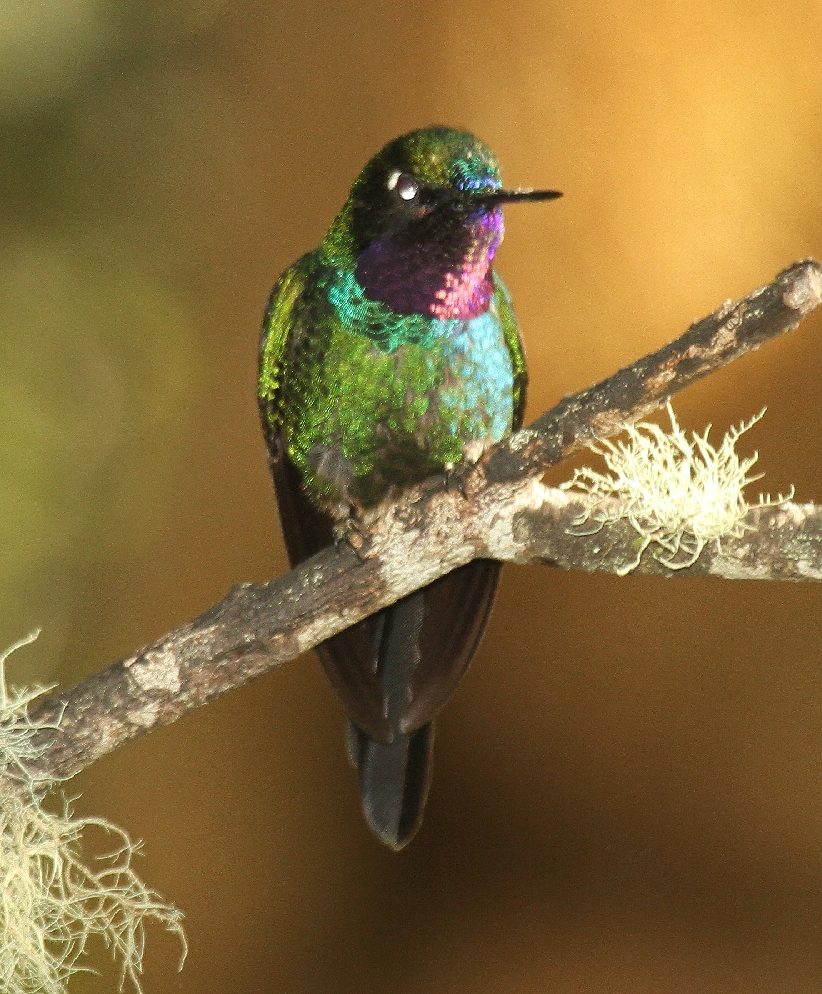
The adult Purple-throated Sunangel is immediately recognizable by its iridescent purple throat, which shimmers in the sunlight. This feature, coupled with its generally green body plumage, distinguishes it from other hummingbirds. The back and wings display a metallic green sheen, while the underparts are more subdued, often appearing grayish.
Juvenile Purple-throated Sunangels lack the vivid throat coloration, presenting instead with a mottled gray or brownish throat, which gradually develops the characteristic violet hue as they mature. Sexual dimorphism is subtle, with females exhibiting slightly less brilliant coloration than males. However, both sexes share the distinctive green back and brownish underparts.
In flight, the Purple-throated Sunangel shows a rapid, agile wingbeat typical of hummingbirds, with a silhouette that includes pointed wingtips and a slightly forked tail. When perched, they sit upright on thin branches, often preferring locations with a clear view, which aids in spotting potential threats or rivals.
Having trouble telling birds apart? Upload a photo to our bird identification tool for an instant species match.
Purple-throated Sunangel Habitat and Range
Preferred Habitat
The Purple-throated Sunangel inhabits the humid cloud forests of the Andes, typically between elevations of 1,800 to 3,600 meters. These forests, often shrouded in mist, provide a stable, humid environment rich in flowering plants. The bird favors areas with dense foliage and a high abundance of epiphytes, which offer both nectar and insect prey.
Seasonal habitat shifts are minimal due to the stable climate of the cloud forests, although some local movements may occur in response to flowering cycles. While primarily found in undisturbed forests, the Purple-throated Sunangel may occasionally venture into secondary growth areas, provided they offer sufficient floral resources.
Urban presence is rare, as these hummingbirds are closely tied to the specific ecological conditions of their montane habitats. Their reliance on high-elevation forests makes them vulnerable to habitat loss due to deforestation and climate change.
Geographic Range
The Purple-throated Sunangel's range is confined to the Andes of northern South America. It is predominantly found in the high-altitude regions of Colombia, Ecuador, and northern Peru. Within these countries, the species occupies a patchy distribution, closely aligned with the presence of montane cloud forests.
The bird does not undertake long-distance migrations, instead remaining within its montane range year-round. However, it may engage in altitudinal movements in search of food resources during seasonal variations in flower availability.
Population density hotspots include areas such as the eastern Andes in Colombia and the western slopes of Ecuador, where cloud forests remain relatively intact. These regions support higher densities due to the abundance of suitable habitat and nectar sources.
Want to know which birds visit your area? Browse our backyard birds by location guides for region-specific species lists.
What Does the Purple-throated Sunangel Eat?
The diet of the Purple-throated Sunangel primarily consists of nectar extracted from a variety of flowering plants. Its long, specialized bill allows it to access deep tubular flowers, which are abundant in its montane habitat. Key plant genera include Fuchsia, Passiflora, and various bromeliads, all of which rely on hummingbirds for pollination.
In addition to nectar, the Sunangel supplements its diet with small insects and arachnids, which provide essential proteins and nutrients. These are typically gleaned from foliage or caught in flight. The bird employs a hovering technique to access both nectar and insect prey, using its agility to maneuver through dense foliage.
Feeding activity peaks during the early morning and late afternoon, aligning with the opening and closing times of many flowers. Seasonal diet changes are minimal, given the consistent availability of floral resources in the cloud forests.
Purple-throated Sunangel Behavior and Social Structure
The Purple-throated Sunangel exhibits solitary and territorial behavior, particularly during the breeding season. Males establish and defend territories through aerial displays and vocalizations, deterring rivals and attracting females. These territories are often centered around abundant nectar sources, ensuring a reliable food supply.
Courtship displays involve rapid flights and hovering, showcasing the male's iridescent throat patch to potential mates. Once paired, the female assumes responsibility for nest building and rearing the young.
Daily activity patterns for the Purple-throated Sunangel include foraging during the cooler hours of the morning and late afternoon, while midday is often spent perching and preening. Despite their solitary nature, these hummingbirds may tolerate the presence of conspecifics in areas with abundant resources.
In response to predators such as hawks and larger birds, the Sunangel employs rapid evasive maneuvers, utilizing its speed and agility to avoid capture.
Purple-throated Sunangel Nesting and Reproduction
Purple-throated Sunangels construct small, cup-shaped nests using plant fibers, moss, and lichens, often bound together with spider silk for added strength. These nests are typically situated on horizontal branches within dense foliage, providing camouflage and protection from predators.
The female lays two white eggs per clutch, which she incubates for approximately 15 to 18 days. During this period, she remains vigilant, leaving the nest only briefly to forage. The male does not participate in incubation but may help defend the nesting territory.
Once hatched, the chicks remain in the nest for about 20 to 25 days, during which time the female feeds them regurgitated nectar and insects. The young fledge once they have developed enough strength and coordination to sustain flight. In a favorable year, the Purple-throated Sunangel may raise two broods, although this is contingent on resource availability.
Purple-throated Sunangel Sounds and Vocalizations
The vocalizations of the Purple-throated Sunangel consist primarily of sharp, high-pitched chips and trills. The primary song, often delivered by males, includes a series of rapid, melodious notes that rise and fall in pitch, serving both as a territorial marker and a courtship signal.
Call notes are shorter and more abrupt, used for communication between individuals or as alarm signals when potential threats are detected. In a chorus, these calls create a tapestry of sound typical of Andean cloud forests.
The dawn chorus, a common feature in their habitat, sees increased vocal activity as the sun rises, with Sunangels contributing their distinctive notes to the morning symphony. Their sound is often likened to the tinkling of small bells, a fitting accompaniment to the vibrant visual display of the birds themselves.
Interesting Facts About the Purple-throated Sunangel
- 1The Purple-throated Sunangel can flap its wings over 50 times per second, allowing for incredible maneuverability.
- 2Despite their small size, these birds consume up to twice their body weight in nectar and insects daily.
- 3Their nests are often camouflaged with lichens, making them nearly invisible to predators.
- 4These hummingbirds can enter torpor, a hibernation-like state, to conserve energy during cold nights.
- 5The iridescence of their plumage results from microscopic platelets that refract light, not pigment.
- 6During courtship, males perform 'pendulum flights,' swinging in wide arcs to display their vibrant throats.
- 7Purple-throated Sunangels are vital pollinators for over 20 plant species in the Andean cloud forests.
Purple-throated Sunangel Conservation Status
The Purple-throated Sunangel currently holds a status of Least Concern according to the IUCN Red List, with population trends considered stable. However, habitat destruction poses a significant threat, particularly from logging and agricultural expansion in the Andes. Conservation efforts focus on preserving montane cloud forests, which are crucial for the survival of this and many other species. Protected areas and national parks in Colombia, Ecuador, and Peru provide refuges for the Sunangel, although ongoing monitoring is necessary to ensure these populations remain secure. Historically, the Purple-throated Sunangel's range has not experienced drastic contractions, but localized declines highlight the need for habitat protection. Increasing awareness and sustainable land use practices are vital for maintaining the ecological balance in these biodiverse regions.
Other Trochilidae Species


Birds Similar to the Purple-throated Sunangel
These species are often confused with the Purple-throated Sunangel due to similar appearance or overlapping range.

