
Red-faced Crombec
Sylvietta whytii
Order: Passeriformes / Family: Macrosphenidae

Wikimedia Commons
About the Red-faced Crombec
The Red-faced Crombec (Sylvietta whytii) is a small passerine bird renowned for its distinctive red face and compact, tailless silhouette. This bird inhabits various regions across sub-Saharan Africa, from Tanzania to Malawi and Zambia. As a member of the Macrosphenidae family, it plays a vital role in the ecosystem by aiding in controlling insect populations, thus contributing to the health of its natural habitat. The Red-faced Crombec prefers open woodlands, savannas, and forest edges, where it forages for insects and spiders amidst dense foliage.
Its ecological significance extends beyond mere insect control. During the breeding season, which generally occurs after the rainy season, these birds engage in intricate courtship displays. These displays not only ensure successful mating but also maintain the genetic diversity within the population. The Red-faced Crombec’s adaptability to various woodland habitats makes it an important species for studying the effects of habitat fragmentation and climate change on small passerines.
Seasonally, the Red-faced Crombec exhibits slight changes in behavior. During the wet season, it becomes more vocal and conspicuous as it engages in breeding activities. In contrast, during the dry season, it may become more elusive, focusing on foraging efficiently to meet its nutritional needs. By understanding these seasonal behaviors, ornithologists can gain insights into the survival strategies of small woodland birds in fluctuating environments.
The Red-faced Crombec belongs to the family Macrosphenidae, within the order Passeriformes. These birds typically live typically around 5 years, with the potential to live up to 8 years..
How to Identify a Red-faced Crombec
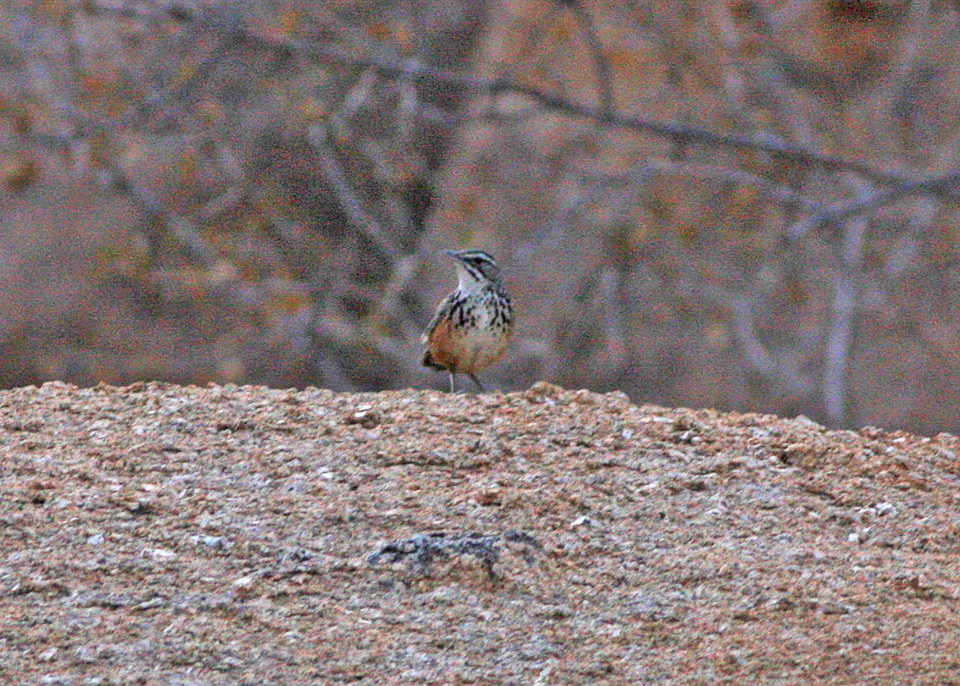
The Red-faced Crombec is easily identified by its vibrant red face, which contrasts with its grayish-brown back and wings. Its underparts are a paler gray-white, providing further distinction. Adults typically measure about 10-12 cm in length and weigh around 10-12 grams, with a strikingly short tail that gives them a stubby appearance. Males and females are similar in plumage, though males may exhibit slightly brighter facial coloring during the breeding season.
Juveniles resemble adults but may have a duller red face and a more muted overall coloration. This can make distinguishing young birds from adults a challenge for novice birders. However, their characteristic shape and behavior-often seen creeping along branches or flitting through understory vegetation-aid in identification.
Confusion with other crombec species is possible, though the Red-faced Crombec's unique facial coloration sets it apart. Its flight is typically short and direct, seldom venturing far from cover, and it perches with a distinctive upright posture, often cocking its head to survey its surroundings.
Having trouble telling birds apart? Upload a photo to our bird identification tool for an instant species match.
Red-faced Crombec Habitat and Range
Preferred Habitat
Red-faced Crombecs thrive in open woodlands, savannas, and forest edges across sub-Saharan Africa. They prefer habitats with dense underbrush, which provides ample foraging opportunities and protection from predators. These birds can be found at elevations ranging from sea level to about 2000 meters, depending on the local geography.
During the breeding season, they may favor slightly denser woodlands to ensure adequate nesting sites and protection for their young. In contrast, during non-breeding periods, they might venture into more open areas or even semi-urban settings, particularly if suitable vegetation provides necessary resources.
While primarily adapted to rural environments, the Red-faced Crombec’s presence in less disturbed urban green spaces highlights its adaptability. However, it remains more commonly associated with natural woodland environments where its niche as an insectivore can be most effectively fulfilled.
Geographic Range
The Red-faced Crombec inhabits a broad range across the eastern and southern parts of sub-Saharan Africa. Its primary range includes countries like Tanzania, Zambia, Malawi, and parts of Zimbabwe and Mozambique. While not migratory, the species exhibits local movements in response to food availability and seasonal changes in habitat conditions.
Breeding occurs predominantly in the southern and eastern sections of its range, where conditions are favorable post-rainy season. In regions with marked wet and dry seasons, the crombec may shift slightly in response to changes in insect abundance and habitat moisture levels.
Population density hotspots include the miombo woodlands of Zambia and the Acacia-dominated savannas of Tanzania. These areas provide the ideal mix of vegetation structure and food resources necessary for sustaining healthy populations of this small songbird.
Want to know which birds visit your area? Browse our backyard birds by location guides for region-specific species lists.
What Does the Red-faced Crombec Eat?
The Red-faced Crombec primarily feeds on a diet of insects and spiders, demonstrating a preference for small arthropods. Its foraging technique involves gleaning insects from leaves and branches, often seen meticulously inspecting foliage for hidden prey. This behavior not only helps maintain a balanced ecosystem but also ensures the bird’s nutritional needs are met.
Diet composition may vary slightly with seasons. During the wet season, when insect populations are at their peak, the Red-faced Crombec enjoys a more diverse menu, including caterpillars and beetles. In contrast, during the dry season, it may rely more heavily on ants and spiders, which are more readily available.
This bird engages in foraging throughout the day, though peak activity often occurs during the cooler morning and late afternoon hours when insect activity is also heightened. By understanding the dietary habits of the Red-faced Crombec, researchers can gain insights into the ecological dynamics of the habitats it occupies.
Red-faced Crombec Behavior and Social Structure
Red-faced Crombecs exhibit solitary or pair-based territorial behaviors, particularly during the breeding season. Males often engage in song displays to establish and defend their territories, a behavior that becomes more pronounced in the early morning and late afternoon.
Courtship involves male birds performing aerial displays and presenting food to females, a practice that strengthens pair bonds and increases reproductive success. Once paired, both parents participate in nest building and rearing of the young, demonstrating a cooperative breeding strategy.
In response to predators, the Red-faced Crombec employs a unique tactic of freezing or remaining motionless, relying on its cryptic coloration to blend into the surrounding foliage. Flocking behavior is rare outside of family groups, with individuals typically maintaining a defined territory throughout the year.
Daily activity patterns revolve around foraging and territory maintenance. During the heat of the day, these birds may seek shade, reducing activity to conserve energy and avoid predators.
Red-faced Crombec Nesting and Reproduction
Red-faced Crombecs construct cup-shaped nests in dense foliage, often preferring the forks of small trees or shrubs for added protection. The nest, meticulously woven from grass, leaves, and spider silk, provides a secure environment for the developing young.
Clutch size typically ranges from 2 to 4 eggs, with an incubation period of approximately 11 to 14 days. Both parents share the responsibility of incubation and feeding the hatchlings, showcasing their strong parental investment.
Fledging occurs about 14 to 18 days after hatching, with young birds remaining under parental care for several additional weeks to hone their foraging skills. The Red-faced Crombec generally produces one to two broods per year, depending on environmental conditions and resource availability.
Red-faced Crombec Sounds and Vocalizations
The song of the Red-faced Crombec is a series of high-pitched notes that rise and fall in a rhythmic pattern, often described as a tinkling or chattering sound. Males sing to assert territory and attract mates, with their song being most pronounced during the early morning hours.
Call notes are sharp and metallic, serving as communication between mates or to alert others of potential danger. Alarm calls are harsher and more urgent, designed to warn of predators. The Red-faced Crombec participates in the dawn chorus, contributing its unique vocalizations to the morning symphony.
These vocalizations, while distinct, might be mistaken for those of other woodland birds. However, the tonal quality and rhythmic pattern of the Red-faced Crombec's song remain distinctive to trained ears.
Interesting Facts About the Red-faced Crombec
- 1The Red-faced Crombec's tailless appearance is unique among songbirds, aiding its maneuverability through dense foliage.
- 2Despite its small size, the Red-faced Crombec possesses a surprisingly loud and far-reaching song.
- 3The bird's name 'crombec' is derived from the Afrikaans word for 'short beak,' reflecting its distinctive morphology.
- 4Red-faced Crombecs are among the few birds that construct their nests using spider silk, enhancing nest durability.
- 5During courtship, male Red-faced Crombecs perform elaborate aerial displays to attract and impress potential mates.
- 6This species avoids long-distance migrations, instead relying on local movements to adapt to seasonal changes.
- 7Red-faced Crombecs can adjust their breeding season to coincide with peak insect abundance, optimizing chick survival.
Red-faced Crombec Conservation Status
The Red-faced Crombec is currently listed as Least Concern by the IUCN, indicating a stable population across its range. However, habitat loss due to deforestation and agricultural expansion poses ongoing threats to its natural environment. Conservation efforts focus on preserving woodland habitats and promoting sustainable land-use practices. By maintaining healthy ecosystems, we can ensure the continued survival of this and other woodland species. Historically, the population has remained stable, with local fluctuations attributed to environmental changes and human activities. Continued monitoring is essential to detect potential declines and implement conservation strategies as needed.
Other Macrosphenidae Species


Birds Similar to the Red-faced Crombec
These species are often confused with the Red-faced Crombec due to similar appearance or overlapping range.

