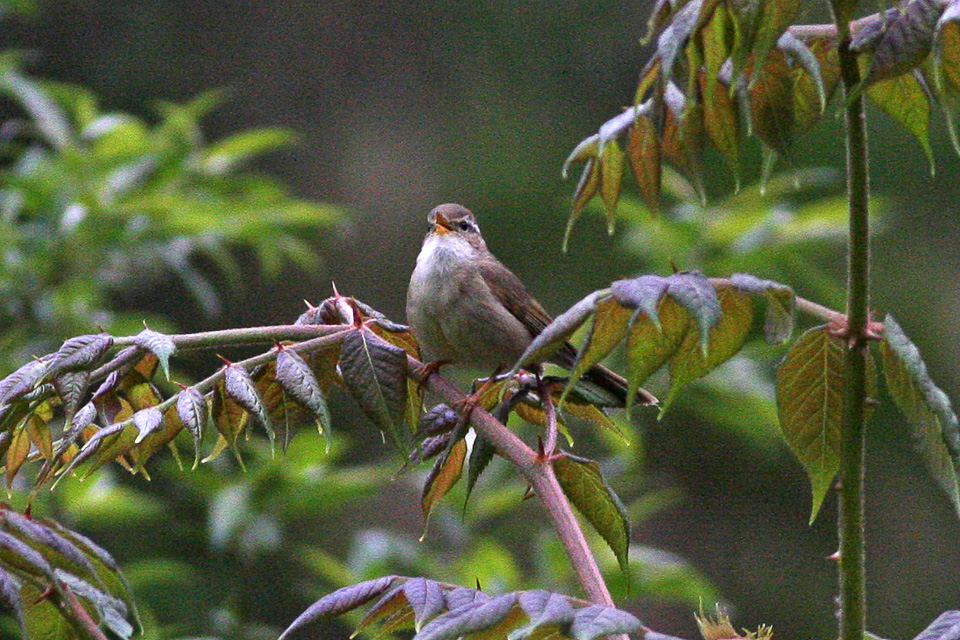
Red-faced Woodland-Warbler
Phylloscopus laetus
Order: Passeriformes / Family: Phylloscopidae

Wikimedia Commons
About the Red-faced Woodland-Warbler
The Red-faced Woodland-Warbler, scientifically known as Phylloscopus laetus, is a vibrant songbird that enchants birdwatchers with its striking appearance and melodious tunes. This species is primarily found in the montane forests of East Africa, specifically in Uganda, Rwanda, and the Democratic Republic of Congo. Within these regions, the warbler occupies high-altitude forests, typically ranging from 1,500 to 3,000 meters above sea level. These habitats provide both the dense foliage and abundant insect life necessary for their survival. The Red-faced Woodland-Warbler plays a critical role in its ecosystem, acting as both a predator of insects and a prey species for larger birds and mammals. This dual role helps maintain ecological balance by controlling insect populations and providing sustenance for its predators. During the breeding season, which spans from March to June, these warblers become more vocal and territorial, often engaging in spirited displays to attract mates. Their song serves as both a mating call and a method of delineating territory, ensuring that resources remain adequate for the rearing of offspring. Outside the breeding season, the Red-faced Woodland-Warbler tends to be less conspicuous, though its vibrant plumage still makes it a noticeable presence in the forest understory. As an insectivore, the Red-faced Woodland-Warbler contributes significantly to pest control, thus benefiting the local flora and aiding in the maintenance of forest health. Its preference for high-altitude forests makes it particularly sensitive to changes in climate and habitat degradation, underscoring the importance of conservation efforts focused on preserving these unique montane ecosystems.
The Red-faced Woodland-Warbler belongs to the family Phylloscopidae, within the order Passeriformes. These birds typically live typically 4-7 years, with some living up to 9 years..
How to Identify a Red-faced Woodland-Warbler
The Red-faced Woodland-Warbler is a small bird, typically measuring around 10 to 11 centimeters in length and weighing approximately 8 to 12 grams. Its most distinctive feature is its vivid red face, which contrasts sharply with its olive-green upperparts and whitish underparts. This red facial plumage is more intense in males, particularly during the breeding season, while females and juveniles exhibit a slightly duller coloration. Juveniles also tend to have more muted tones overall, with less pronounced red on the face compared to adults. In terms of flight silhouette, the Red-faced Woodland-Warbler displays a relatively rapid wingbeat, characteristic of many Phylloscopidae. Its perching posture is upright and alert, often seen flitting among the dense foliage of its montane forest habitat. Although similar in size and shape to other warblers in its range, the Red-faced Woodland-Warbler's distinctive red face and olive-green plumage make it less likely to be confused with other species. However, in poor lighting, it may be mistakenly identified as other greenish warblers, though the red facial markings are a reliable distinguishing feature.
Having trouble telling birds apart? Upload a photo to our bird identification tool for an instant species match.
Red-faced Woodland-Warbler Habitat and Range
Preferred Habitat
The Red-faced Woodland-Warbler thrives in montane forests, particularly those characterized by dense undergrowth and a rich canopy. These forests are typically found at elevations ranging from 1,500 to 3,000 meters, providing a cool, moist environment essential for the warbler's survival. In its primary range of Uganda, Rwanda, and the Democratic Republic of Congo, the warbler is associated with high-altitude areas such as the Rwenzori Mountains and Virunga Volcanoes. While it primarily inhabits forest interiors, it may occasionally venture to forest edges in search of food. Seasonal habitat shifts are minimal due to its preference for stable, high-altitude environments, and the warbler is rarely found in urban or heavily disturbed areas.
Geographic Range
The Red-faced Woodland-Warbler's range is relatively restricted, confined chiefly to the montane forests of East Africa. Its core distribution includes the Rwenzori Mountains in Uganda, parts of Rwanda, and the eastern Democratic Republic of Congo. This species is largely sedentary, with little evidence of long-distance migration, though local movements may occur in response to seasonal changes in insect abundance. Population density is highest in areas where suitable montane forest habitat remains intact and undisturbed by human activity. While the Red-faced Woodland-Warbler does not migrate extensively, its range is critically dependent on the preservation of high-altitude forests, which are increasingly threatened by deforestation and climate change.
Want to know which birds visit your area? Browse our backyard birds by location guides for region-specific species lists.
What Does the Red-faced Woodland-Warbler Eat?
The Red-faced Woodland-Warbler primarily feeds on insects, making it a vital player in controlling insect populations within its habitat. Its diet consists largely of small arthropods such as caterpillars, beetles, and spiders, which it gleans from leaves and branches in the forest understory. During the breeding season, the warbler's food intake increases to meet the demands of feeding its young, often targeting softer-bodied insects that are easier for chicks to digest. Foraging typically occurs during daylight hours, with peak activity in the early morning and late afternoon. The warbler employs a methodical approach to foraging, meticulously inspecting foliage and occasionally hovering to snatch prey from the underside of leaves. Seasonally, the diet may shift slightly to include more fruit or seeds, particularly when insect abundance is low.
Red-faced Woodland-Warbler Behavior and Social Structure
The Red-faced Woodland-Warbler exhibits a range of behaviors that reflect its adaptation to montane forest environments. Socially, it tends to be solitary or found in pairs, especially during the breeding season. Territorial behavior is pronounced as males vigorously defend their chosen nesting sites with a mix of vocal displays and physical posturing. Courtship involves males performing elaborate song displays to attract females, often accompanied by a fluttering flight and raised crest. Outside the breeding season, the warbler may join mixed-species foraging flocks, benefiting from the collective vigilance against predators. Daily activity patterns are diurnal, with the warbler most active during the cooler hours of morning and late afternoon. In response to predators, such as raptors or snakes, the warbler relies on its agility and the dense cover of foliage for protection, often freezing or darting into deeper cover when threatened.
Red-faced Woodland-Warbler Nesting and Reproduction
Nesting for the Red-faced Woodland-Warbler occurs primarily between March and June, aligning with the onset of the rainy season in East Africa. The species constructs its nest in dense shrubs or small trees, typically positioned 1 to 2 meters above the ground. The nest is an open cup structure woven from grass, leaves, and spider webs, camouflaged with local vegetation to deter predators. A typical clutch consists of 2 to 4 eggs, which are incubated by the female for about 12 to 14 days. Both parents participate in feeding the chicks, which fledge approximately 10 to 12 days post-hatching. The warbler generally raises one brood per year, though favorable conditions may lead to a second clutch.
Red-faced Woodland-Warbler Sounds and Vocalizations
The song of the Red-faced Woodland-Warbler is a melodic series of high-pitched notes that rise and fall in rapid succession, often interspersed with trills. This song, used primarily during the breeding season, serves both to attract mates and to establish territory. The warbler's call notes are softer, consisting of simple, repeated 'chip' sounds that facilitate communication between mates and signal alarm when predators are nearby. During the dawn chorus, their songs contribute to the rich tapestry of avian sounds in the montane forest. Compared to other warblers, its song is notably more complex and musical, often drawing comparisons to a flute-like melody.
Interesting Facts About the Red-faced Woodland-Warbler
- 1The Red-faced Woodland-Warbler can consume up to 30% of its body weight in insects daily.
- 2These warblers are known for their agility, capable of hovering like hummingbirds while foraging.
- 3Despite their vibrant plumage, Red-faced Woodland-Warblers are elusive, often heard before seen.
- 4Their nests are ingeniously camouflaged, often incorporating local mosses and lichens.
- 5The warbler's song can be heard over 100 meters away, a testament to its vocal prowess.
Red-faced Woodland-Warbler Conservation Status
The Red-faced Woodland-Warbler currently holds a conservation status of Least Concern according to the IUCN, though its population is thought to be in slow decline due to habitat loss. Primary threats include deforestation for agriculture and logging, which reduce the availability of suitable montane forest habitat. Climate change further exacerbates these issues by altering the delicate balance of high-altitude ecosystems. Conservation efforts focus on protecting existing forest reserves and promoting sustainable land use practices. Historically, the warbler maintained stable populations, but ongoing habitat degradation poses a significant threat to its future.